


Financial Feasibility Study Of Our Bank Feasibility Study Templates For Different Projects




Try Before you Buy Download Free Sample Product
 Impress Your
 Audience
 100%
100% Editable
 Save Hours
 of Time


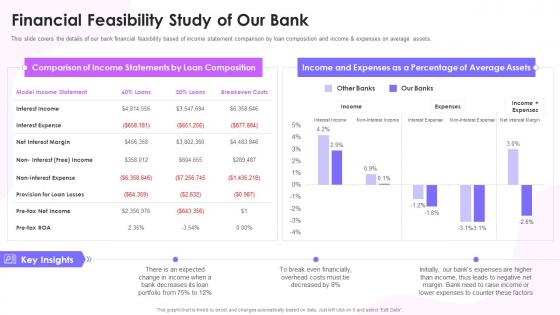
This slide covers the details of our bank financial feasibility based of income statement comparison by loan composition and income and expenses on average assets.
People who downloaded this PowerPoint presentation also viewed the following :
Financial Feasibility Study Of Our Bank Feasibility Study Templates For Different Projects with all 7 slides:
Use our Financial Feasibility Study Of Our Bank Feasibility Study Templates For Different Projects to effectively help you save your valuable time. They are readymade to fit into any presentation structure.





FAQs for Financial Feasibility Study Of Our Bank Feasibility Study Templates
A comprehensive financial feasibility study template should include market analysis, revenue projections, cost estimates, cash flow forecasts, break-even analysis, and risk assessments. These components work together by evaluating market demand, projecting financial performance, and identifying potential obstacles, with many organizations finding that structured templates streamline decision-making and enhance investment confidence.
Varying financial projections significantly impact project feasibility by altering investment decisions, funding requirements, and risk assessments across different scenarios. These variations enable organizations to evaluate best-case, worst-case, and realistic outcomes, with many financial institutions and project managers finding that comprehensive projection modeling ultimately delivers better resource allocation, contingency planning, and strategic decision-making capabilities.
Common tools for creating financial feasibility study templates include Microsoft Excel, Google Sheets, specialized software like LivePlan and PlanGuru, and comprehensive platforms such as Smartsheet and Monday.com. These solutions streamline financial modeling, automate calculations, and enhance collaboration, with many consulting firms and financial institutions finding that integrated templates significantly reduce analysis time while improving accuracy and presentation quality.
Qualitative data in feasibility studies includes market sentiment, stakeholder feedback, regulatory environment assessments, and competitive positioning insights, while quantitative data encompasses financial projections, cost analyses, revenue forecasts, and statistical market research. These complementary data types work together to provide comprehensive project evaluation, with many organizations finding that combining both approaches delivers more accurate risk assessments and strategic decision-making capabilities.
Market analysis forms the foundation of financial feasibility studies by providing critical data on target demographics, competitive landscape, pricing strategies, and demand forecasts that directly impact revenue projections. Through comprehensive market research, organizations can validate assumptions about customer adoption rates, market penetration potential, and competitive positioning, ultimately enabling more accurate financial modeling and reducing investment risks across sectors like retail, healthcare, and technology startups.
Sensitivity analysis can be incorporated through variable input fields, scenario modeling sections, and automated calculation tables that test key assumptions like cost changes, revenue fluctuations, and market conditions. These templates enable organizations to assess project viability under different circumstances, with many financial institutions finding that built-in sensitivity frameworks streamline risk evaluation and enhance decision-making confidence.
Financial risk presentation best practices include comprehensive risk categorization, quantitative impact analysis, probability assessments, sensitivity modeling, and mitigation strategies with clear timelines. These approaches enhance stakeholder understanding by translating complex financial uncertainties into actionable insights, with many organizations finding that structured risk frameworks streamline decision-making processes while building investor confidence through transparent, data-driven risk communication.
User-friendly design enhances financial feasibility study templates by simplifying complex data input, providing clear visual hierarchies, and streamlining navigation between sections, ultimately reducing analysis time and minimizing errors. Through intuitive layouts and automated calculations, organizations across sectors like healthcare, manufacturing, and retail find that well-designed templates enable faster decision-making, improve stakeholder engagement, and deliver more accurate financial projections.
Essential financial ratios include current ratio, debt-to-equity ratio, return on investment (ROI), net present value (NPV), and internal rate of return (IRR). These ratios enable organizations to assess liquidity, leverage, and profitability comprehensively, with many financial institutions and project developers finding that strategic ratio analysis ultimately delivers clearer investment decisions and enhanced stakeholder confidence.
Adapting financial feasibility study templates requires modifying key metrics, revenue models, regulatory considerations, and risk factors specific to each sector. Healthcare projects emphasize compliance costs and patient volume projections, while manufacturing focuses on equipment depreciation and supply chain variables, with retail emphasizing inventory turnover and seasonal fluctuations, ultimately delivering industry-relevant financial insights.
Strategies include using historical data analysis, scenario modeling, sensitivity analysis, market research validation, and regular forecast updates throughout the project lifecycle. These approaches enhance accuracy by incorporating multiple data sources, testing various assumptions, and adjusting projections based on market conditions, with many organizations finding that combining quantitative analysis with expert judgment delivers the most reliable financial forecasts.
A financial feasibility study template helps secure funding by presenting structured cash flow projections, risk assessments, return on investment calculations, and market analysis in a professionally organized format that investors expect. These comprehensive templates enable project managers to demonstrate financial viability through standardized metrics, detailed revenue forecasts, and cost-benefit analyses, ultimately delivering the credibility and transparency that banks, venture capitalists, and institutional funders require for investment decisions.
Common pitfalls include over-relying on overly optimistic projections, neglecting market volatility factors, inadequate risk assessment, insufficient competitor analysis, and using outdated industry benchmarks. While templates streamline the feasibility process, organizations must customize assumptions to reflect their specific market conditions, regulatory environment, and operational constraints, with many finding that generic templates require significant adaptation to deliver accurate, actionable insights for strategic decision-making.
Stakeholder feedback enhances financial feasibility studies by providing market insights, operational expertise, risk identification, and validation of assumptions from diverse perspectives. Through structured consultations with investors, customers, suppliers, and industry experts, organizations can refine revenue projections, identify cost variables, and strengthen their business case, ultimately delivering more accurate assessments and higher stakeholder confidence.
Critical timelines for feasibility studies typically span 3-6 months, including market research (2-4 weeks), financial analysis (3-4 weeks), technical assessment (2-3 weeks), and risk evaluation (1-2 weeks). These phases often overlap strategically, with many organizations finding that compressed timelines of 8-12 weeks work effectively for smaller projects, while complex infrastructure or technology initiatives require extended 4-6 month assessments to ensure thorough analysis.
-
I discovered this website through a google search, the services matched my needs perfectly and the pricing was very reasonable. I was thrilled with the product and the customer service. I will definitely use their slides again for my presentations and recommend them to other colleagues.
-
Unique and attractive product design.