


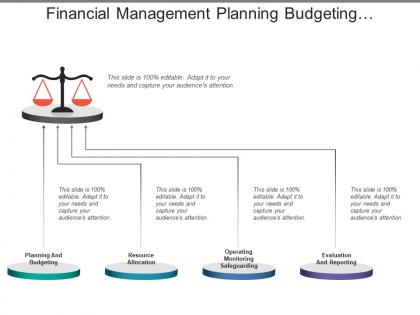
Financial management planning budgeting resource allocation operating




Try Before you Buy Download Free Sample Product
 Impress Your
 Audience
 100%
100% Editable
 Save Hours
 of Time


Heighten expectations with our Financial Management Planning Budgeting Resource Allocation Operating. They will believe in a brighter future.
People who downloaded this PowerPoint presentation also viewed the following :
Financial management planning budgeting resource allocation operating with all 5 slides:
Hatchets get buried forever with our Financial Management Planning Budgeting Resource Allocation Operating. They help foster enduring agreement.





FAQs for Financial management planning budgeting
Key components include cash flow management, budgeting and forecasting, expense tracking, financial reporting, and strategic planning. These elements work together by providing real-time visibility into business performance, enabling data-driven decisions, and ensuring sustainable growth, with many small businesses finding that systematic financial management delivers improved profitability and competitive positioning.
Budgeting techniques enhance financial decision-making by providing structured data analysis, scenario planning capabilities, and performance tracking mechanisms that enable informed resource allocation. Through variance analysis and forecasting models, organizations streamline expense management, identify cost-saving opportunities, and optimize cash flow, with many businesses finding that systematic budgeting delivers improved profitability and strategic competitive advantage.
Cash flow management ensures operational continuity by monitoring incoming and outgoing funds, maintaining adequate liquidity reserves, and timing payments strategically to avoid shortfalls. Through effective cash flow planning, companies can navigate seasonal fluctuations, invest in growth opportunities, and weather unexpected challenges, with many organizations finding that proactive cash flow management ultimately delivers financial stability and competitive resilience.
Technology streamlines financial tracking and reporting through automated data collection, real-time analytics, cloud-based integration, and AI-powered insights that minimize manual errors. Banks and retail companies leverage these solutions to accelerate month-end closings, enhance regulatory compliance, and deliver transparent financial dashboards, ultimately enabling faster decision-making and strategic resource allocation.
Best practices for managing debt include maintaining low credit utilization ratios, making consistent on-time payments, diversifying credit types, monitoring credit reports regularly, and avoiding unnecessary credit inquiries. These strategies enhance financial stability by reducing borrowing costs, improving loan approval rates, and strengthening negotiating power with lenders, ultimately delivering better interest rates and expanded access to capital for strategic business investments.
Financial ratios help assess company performance by measuring liquidity, profitability, efficiency, and leverage through standardized metrics like current ratio, ROE, and debt-to-equity. These analytical tools enable investors, lenders, and managers to benchmark against industry standards, identify operational strengths and weaknesses, and make informed strategic decisions, ultimately delivering clearer insights into financial stability and competitive positioning.
Global financial markets impact local businesses through currency fluctuations, international interest rates, commodity price changes, access to foreign investment, and cross-border trade financing. These interconnections enable businesses to access broader capital markets, diversify revenue streams, and expand internationally, while also requiring strategic risk management, with many companies finding that proactive financial planning delivers competitive advantages in increasingly volatile economic environments.
Organizations leverage financial forecasting to plan for the future by analyzing historical data, market trends, and economic indicators to predict revenue, expenses, and cash flow patterns. This strategic approach enables businesses to make informed investment decisions, allocate resources effectively, and identify potential risks early, with many companies finding that accurate forecasting delivers improved budgeting precision and competitive advantage.
Risk minimization strategies include diversified investment portfolios, comprehensive insurance coverage, emergency fund establishment, thorough market analysis, and strategic debt management. These approaches streamline financial stability by spreading exposure across multiple assets, protecting against unforeseen losses, and enabling data-driven decisions, with many organizations finding that proactive risk assessment ultimately delivers enhanced operational resilience and competitive advantage.
**INPUT**: How does financial management differ between startups and established companies? **OUTPUT**: Startups prioritize cash flow preservation, runway extension, and investor relations, while established companies focus on profit optimization, dividend management, and strategic investments. Through different approaches to budgeting, risk assessment, and capital allocation, startups emphasize survival and growth metrics, whereas mature organizations balance stakeholder returns with operational efficiency, ultimately requiring distinct financial strategies for their respective business lifecycles.
Financial audits and compliance ensure organizational transparency, regulatory adherence, and stakeholder confidence by systematically reviewing financial records, internal controls, and reporting accuracy. These processes enable businesses to identify operational inefficiencies, minimize fraud risks, and maintain investor trust, with many organizations finding that robust audit frameworks ultimately deliver competitive advantages and streamlined resource allocation.
Businesses maximize returns through strategic resource allocation by analyzing ROI metrics, prioritizing high-impact initiatives, and diversifying investments across growth opportunities. Companies increasingly leverage data analytics and scenario planning to optimize budget distribution, with many finding that combining technology investments with workforce development delivers enhanced operational efficiency, competitive positioning, and sustainable profitability across market cycles.
Incorporating sustainability in financial management delivers risk mitigation, cost reduction, enhanced stakeholder trust, regulatory compliance, and long-term value creation. These practices enable organizations to streamline resource allocation, minimize environmental liabilities, and attract ESG-focused investors, with many financial institutions finding that sustainable strategies ultimately drive operational efficiency and competitive advantage.
Employee training in financial literacy enhances organizational performance by improving budget management, reducing financial errors, and enabling better resource allocation decisions across departments. Through comprehensive financial education, employees make more informed spending choices, identify cost-saving opportunities, and contribute to strategic planning initiatives, ultimately delivering improved operational efficiency and stronger bottom-line results for organizations.
**INPUT**: What trends are emerging in financial management for the digital economy? **OUTPUT**: Emerging financial management trends include real-time analytics, automated reporting, blockchain integration, AI-driven forecasting, and cloud-based treasury systems. These technologies streamline operations by enhancing transparency, reducing manual processes, and enabling instant decision-making, with many organizations finding that digital transformation ultimately delivers competitive advantage and operational efficiency.
-
Commendable slides with attractive designs. Extremely pleased with the fact that they are easy to modify. Great work!
-
Very unique, user-friendly presentation interface.