


Financial Revenue Projection And Key Metrics





Try Before you Buy Download Free Sample Product
 Impress Your
Audience
 100%
Editable
 Save Hours
of Time


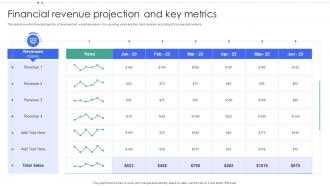
This slide shows the financial projection of revenues that would take place in the upcoming years and their trend analysis according to the projected numbers.
People who downloaded this PowerPoint presentation also viewed the following :
Financial Revenue Projection And Key Metrics with all 7 slides:
Use our Financial Revenue Projection And Key Metrics to effectively help you save your valuable time. They are readymade to fit into any presentation structure.






FAQs for Financial Revenue Projection
Key components include market size analysis, pricing strategy, customer acquisition costs, sales conversion rates, and seasonal variations. These elements enable startups to build realistic forecasts by analyzing target demographics, competitive positioning, and growth trajectories, with many early-stage companies finding that conservative estimates help secure investor confidence while maintaining operational flexibility.
Historical sales data enables revenue forecasting through trend analysis, seasonal pattern identification, growth rate calculations, and market cycle recognition, providing statistical foundations for future projections. By analyzing quarterly performance variations, customer purchasing behaviors, and product lifecycle stages, companies across retail, manufacturing, and financial services can anticipate market fluctuations, optimize inventory planning, and make strategic investment decisions, ultimately delivering more accurate budgets and competitive market positioning.
Economic indicators serve as foundational inputs for revenue projections, with GDP growth rates, inflation metrics, employment data, consumer confidence indices, and interest rates being most critical. These indicators help organizations anticipate market conditions, consumer spending patterns, and operational costs, with many financial institutions and retail companies finding that incorporating leading indicators like housing starts and manufacturing indexes enhances forecast accuracy significantly.
Businesses should update revenue projections quarterly at minimum, with monthly updates during volatile periods or rapid growth phases. Key triggers include significant market shifts, new product launches, major client acquisitions or losses, regulatory changes, and economic fluctuations, with many organizations finding that real-time data integration enables more responsive forecasting and strategic decision-making.
Businesses can validate revenue projections through historical data analysis, market research comparisons, scenario modeling, peer benchmarking, and independent expert reviews. These validation methods enhance accuracy by cross-referencing assumptions against real market conditions, with many organizations finding that combining multiple approaches delivers more reliable forecasts and strategic confidence.
Seasonal trends significantly influence financial revenue projections by creating predictable fluctuations that vary dramatically across industries, requiring specialized forecasting models that account for cyclical patterns, consumer behavior shifts, and market dynamics. Retail businesses typically peak during holiday seasons, while tourism companies experience summer surges and ski resorts thrive in winter, with many organizations finding that incorporating multi-year seasonal data enhances projection accuracy and strategic planning.
Market research is crucial for developing realistic revenue forecasts as it provides essential data on customer demand, market size, competitive pricing, consumer behavior patterns, and industry trends. Through comprehensive market analysis, businesses can validate assumptions about target demographics, seasonal fluctuations, and purchasing cycles, while identifying potential obstacles and opportunities, ultimately creating more accurate financial projections that support strategic decision-making and investor confidence.
Businesses incorporate risks and uncertainties through scenario planning, sensitivity analysis, Monte Carlo simulations, and buffer adjustments to baseline projections. These methodologies enable organizations to model various market conditions, economic downturns, and competitive pressures, with many financial services and retail companies finding that comprehensive risk modeling delivers more accurate forecasting and strategic decision-making capabilities.
Recommended tools include Excel with advanced modeling features, Tableau for interactive dashboards, Power BI for integrated analytics, QuickBooks for small businesses, and specialized platforms like Anaplan or Adaptive Insights. These solutions streamline forecasting by automating calculations, creating dynamic visualizations, and enabling scenario planning, with many organizations finding that cloud-based platforms deliver enhanced collaboration and real-time updates.
Pricing strategies directly influence revenue projections by affecting sales volume, profit margins, customer retention rates, and market positioning across different segments. Businesses should consider competitor pricing, customer price sensitivity, production costs, and market demand elasticity when adjusting prices, with many companies finding that strategic pricing optimization delivers enhanced profitability while maintaining competitive advantage.
Common pitfalls include overestimating market demand, underestimating customer acquisition costs, ignoring seasonal variations, relying on overly optimistic growth assumptions, and failing to account for competitive pressures. These forecasting errors can derail strategic planning by misallocating resources and setting unrealistic expectations, with many organizations finding that conservative, data-driven projections ultimately deliver more sustainable growth outcomes.
Scenario analysis enhances revenue projection robustness by modeling multiple potential outcomes, incorporating market volatility assumptions, and stress-testing key variables like customer demand and pricing fluctuations. Through systematic sensitivity analysis, organizations can identify revenue vulnerabilities, develop contingency strategies, and make more informed investment decisions, with many financial institutions finding that comprehensive scenario modeling significantly improves forecasting accuracy and strategic planning.
Revenue recognition principles significantly impact financial forecasting by determining timing of recorded income, affecting cash flow predictions, budget accuracy, and stakeholder expectations. These accounting standards require organizations to recognize revenue when performance obligations are met, creating complexities in projection models, especially for subscription services, long-term contracts, and multi-element arrangements, ultimately demanding more sophisticated forecasting approaches.
Cross-departmental collaboration improves revenue projection accuracy by combining sales pipeline insights, marketing campaign data, customer success retention metrics, operational capacity constraints, and finance historical analysis. When sales, marketing, customer success, operations, and finance teams share real-time data and assumptions, organizations achieve more comprehensive forecasting models, with many companies finding that integrated approaches reduce projection variance by 20-30%.
Businesses should account for competitive dynamics by analyzing market share trends, pricing pressure patterns, competitor product launches, customer acquisition costs, and industry growth rates. Through scenario modeling, companies can stress-test revenue projections against competitive threats while identifying opportunities for differentiation, ultimately enabling more resilient forecasting that anticipates market shifts and maintains strategic positioning.
-
Impressive templates. Designing a presentation is fun now!
-
I came across many PowerPoint presentations with excellent creatives and I believe they would be beneficial to my work.