

Financial services for small businesses and startups powerpoint presentation slides





Try Before you Buy Download Free Sample Product
 Impress Your
Audience
 100%
Editable
 Save Hours
of Time


A critical aspect of any corporate enterprise is finance and accounting. It is necessary to arrange all your finances and accounts meticulously and meticulously. This is not accomplished at the end of the year alone rather, it should be a year-long process conducted with utmost care and precision. Check out our professionally designed template on Financial Services for Small Businesses and Start-ups that helps analyze the cost incurred on finance outsourcing compared to business accounting. This proposal covers the financial services slides, including company details such as mission, vision, main objectives, professional profile, top clients, top services, etc. It helps reduce operating expenses, improve business core focus, improve quality of work, etc. This template covers the main slides such as reasons to choose financial outsourcing, managing the accounts, workflow, strategies and techniques related to financial outsourcing, etc. business model and analysis are also covered under this proposal. In the end, one can acknowledge facts related to actual business expenses, cost comparison, outsourcing v or s permanent hiring comparison, etc. Book a free demo with our experts and customize this 100 percent editable template based on your specific needs. Download it now.
People who downloaded this PowerPoint presentation also viewed the following :
Content of this Powerpoint Presentation
Slide 1: This slide introduces Financial Services for Small Businesses and Startups. State Your Company Name and begin.
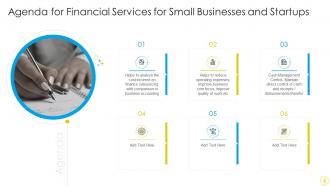
Slide 2: This slide shows Agenda for Financial Services for Small Businesses and Startups.
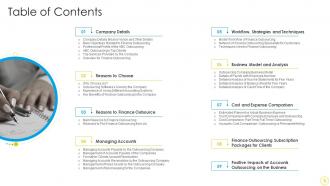
Slide 3: This slide presents Table of Content for the presentation.
Slide 4: This slide shows Table of Content for the presentation.
Slide 5: This slide displays the ABC company details which covers headquarter, Mission, Vision, etc.
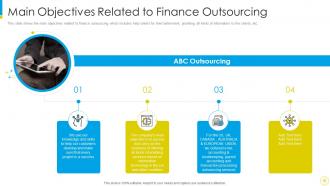
Slide 6: This slide represents the main objectives related to finance outsourcing which includes help clients for their betterment, providing all kinds of information to the clients, etc.
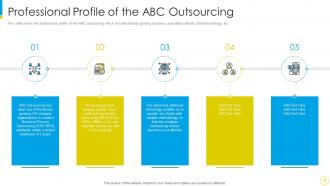
Slide 7: This slide shows the professional profile of the ABC outsourcing which includes fastest growing business, specialties details, latest technology, etc.
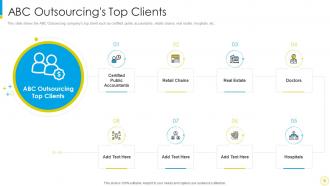
Slide 8: This slide presents the ABC Outsourcing company’s top client such as certified public accountants, retails chains, real estate, hospitals, etc.
Slide 9: This slide shows the top services provided by the company which includes online accounting services, bookkeeping services, etc.
Slide 10: This slide displays the overview for finance outsourcing which includes reduces manpower, reduces infrastructure costs, better management control, etc.
Slide 11: This slide represents Table of Content for the presentation.
Slide 12: This slide shows the main reasons to go for ABC finance outsourcing company such as quality check policy, separate quality control managers, etc.
Slide 13: This slides presents the various outsourcing software's used by the outsourcing company such as QuickBooks, Peachtree, Sage Line 50, etc.
Slide 14: This slides shows the experience of using different account systems such as Oracle financials, SAP, Tally, etc.
Slide 15: This slide displays the key benefits of finance outsourcing to the company which includes improve company focus, improve quality, etc.
Slide 16: This slide represents Table of Content for the presentation.
Slide 17: This slide shows the main reasons to finance outsourcing which includes cut down on costs, better use of time, fewer mistakes, etc.
Slide 18: This slide presents the reasons to pick finance outsourcing from ABC company such as strategic initiatives, tactical issues, etc.
Slide 19: This slide shows Table of Content for the presentation.
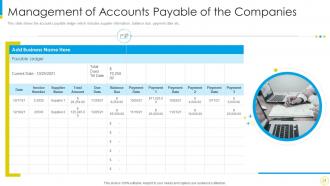
Slide 20: This slide displays the management of accounts payable by outsourcing company which includes supplier invoices with different modules.
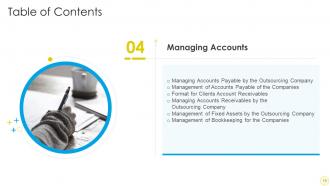
Slide 21: This slide represents Management of Accounts Payable of the Companies.
Slide 22: This slide shows the account receivable format of the company which includes client information, invoices, total amount, date of issue etc.
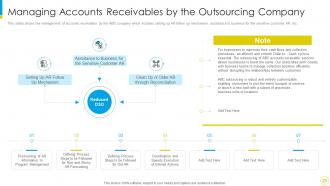
Slide 23: This slide presents Managing Accounts Receivables by the Outsourcing Company.
Slide 24: This slide shows Management of Fixed Assets by the Outsourcing Company.
Slide 25: This slide displays the bookkeeping record of the company which will be maintained by outsourcing employees.
Slide 26: This slide represents Table of Content for the presentation.
Slide 27: This slide shows the model work-flow of finance outsourcing which includes documents, financial systems, secure tunnel, movement of documents, etc.
Slide 28: This slide presents Network of Finance Outsourcing Specialists for Customers.
Slide 29: This slide shows the various techniques used by the outsourcing company.
Slide 30: This slide displays Table of Content for the presentation.
Slide 31: This slides represents the outsourcing company business model which includes understanding the need, pilot project, etc.
Slide 32: This slide shows the details related to employee payroll which includes employee number, name, department, basic salary etc.
Slide 33: This slide presents Detailed Analysis of Income Statements for Five Years.
Slide 34: This slide shows the balance sheet of the company which will be managed by outsourcing company for five years.
Slide 35: This slide displays the cash flow analysis of the company which will be managed by outsourcing company.
Slide 36: This slide represents Table of Content for the presentation.
Slide 37: This slide shows the planned vs actual cost incurred with variance percentage and expense category.
Slide 38: This slide presents Cost Comparison with Company Employee and Outsourcing.
Slide 39: This slide shows the cost comparison of part time employees, full time employees and outsourcing.
Slide 40: This slide displays Accounts Cost Comparison- Outsourcing vs Permanent Hiring.
Slide 41: This slide represents Table of Content for the presentation.
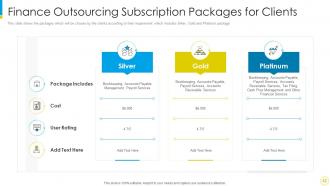
Slide 42: This slide shows Finance Outsourcing Subscription Packages for Clients.
Slide 43: This slide presents Table of Content for the presentation.
Slide 44: This slide shows the positive impacts after the accounts outsourcing on the company.
Slide 45: This slide displays Icons for Financial Services for Small Businesses and Startups.
Slide 46: This slide is titled as Additional Slides for moving forward.
Slide 47: This is Our Mission slide with related imagery and text.
Slide 48: This slide presents Mind Map with related imagery.
Slide 49: This slide shows Circular Diagram with related icons and text.
Slide 50: This slide displays Venn diagram with text boxes.
Slide 51: This slide represents Puzzle with related icons and text.
Slide 52: This slide shows Column Chart with two products comparison.
Slide 53: This slide presents Line Chart with two products comparison.
Slide 54: This is a Timeline slide. Show data related to time intervals here.
Slide 55: This slide displays Roadmap with additional textboxes.
Slide 56: This slide represents 30 60 90 Days Plan with text boxes.
Slide 57: This is a Thank You slide with address, contact numbers and email address.
Financial services for small businesses and startups powerpoint presentation slides with all 57 slides:
Use our Financial Services For Small Businesses And Startups Powerpoint Presentation Slides to effectively help you save your valuable time. They are readymade to fit into any presentation structure.












FAQs for Financial services for small businesses and startups
Critical financial services for launching businesses include business banking accounts, payment processing systems, accounting software, business credit lines, and insurance coverage. These foundational services streamline operations by automating transactions, tracking cash flow, and protecting assets, with many startups finding that early adoption of integrated financial platforms ultimately delivers operational efficiency and positions them for sustainable growth in competitive markets.
Tailored financial solutions improve startup cash flow management by providing flexible credit lines, automated invoicing systems, real-time expense tracking, and predictive analytics tools that align with irregular revenue patterns. These specialized services enable startups to maintain operational liquidity, reduce manual financial processes, and make data-driven spending decisions, ultimately delivering better financial stability and growth acceleration.
Fintech solutions streamline small business financial services by automating accounting, enabling faster loan approvals, providing real-time payment processing, and delivering advanced analytics for cash flow management. These technologies enhance operational efficiency by reducing manual processes, minimizing transaction costs, and improving access to capital, with many small businesses finding that fintech integration ultimately delivers competitive advantages and scalable growth opportunities.
Small businesses should evaluate traditional banks and online providers based on relationship needs, service costs, technology requirements, and growth scalability. While traditional banks offer personalized support and established lending relationships, online providers deliver faster account setup, lower fees, and streamlined digital tools, with many startups finding that hybrid approaches combining both options optimize cash flow management and banking efficiency.
Essential financial tools for startups include cloud-based accounting software like QuickBooks or Xero, expense tracking applications, invoicing platforms, cash flow forecasting tools, and integrated payment processing systems. These technologies streamline financial management by automating transaction recording, generating real-time reports, and providing dashboard visibility into spending patterns, with many growing businesses finding that comprehensive tracking enables better resource allocation and investor-ready financial transparency.
Startups can leverage credit lines and loans to fuel growth by securing working capital for inventory, hiring talent, expanding operations, and investing in technology infrastructure. Through strategic borrowing, many emerging businesses accelerate market entry, scale production capabilities, and seize time-sensitive opportunities, while maintaining cash flow flexibility, ultimately delivering competitive advantage and sustainable expansion in increasingly dynamic markets.
Equity financing involves selling ownership stakes to investors in exchange for capital, while debt financing requires borrowing money that must be repaid with interest, maintaining full business ownership. These approaches present distinct advantages, with equity financing offering strategic partnerships and shared risk, while debt financing preserves control and ownership, ultimately enabling small businesses to choose financing structures that align with their growth objectives and risk tolerance.
Small businesses can utilize financial forecasting to improve decision-making by creating cash flow projections, budget planning models, and scenario analyses that anticipate market changes and seasonal fluctuations. These forecasting tools enable startups and growing companies to optimize resource allocation, secure appropriate funding, and identify potential challenges before they impact operations, ultimately delivering better strategic planning and competitive positioning in an increasingly dynamic business environment.
Common financial pitfalls startups should avoid include inadequate cash flow management, overestimating revenue projections, underestimating operational costs, mixing personal and business finances, and neglecting emergency reserves. These challenges particularly impact early-stage companies in sectors like tech and retail, with many finding that establishing clear financial controls, realistic budgeting, and professional accounting systems ultimately delivers better investor confidence and sustainable growth trajectories.
Financial literacy is crucial for small business owners, enabling better cash flow management, informed investment decisions, accurate financial forecasting, and strategic growth planning. Small business owners can enhance their financial knowledge through online courses, workshops with local business development centers, mentoring programs, and accounting software training, with many entrepreneurs finding that improved financial literacy directly translates to reduced operational costs and more sustainable business growth.
Small businesses should implement multi-factor authentication, encrypted data storage, regular software updates, employee cybersecurity training, and secure payment processing systems to protect financial data. These measures work together by preventing unauthorized access, securing sensitive information, and minimizing human error vulnerabilities, with many financial institutions and small retailers finding that comprehensive cybersecurity strategies ultimately reduce fraud risks while enhancing customer trust.
Small businesses can effectively budget for unexpected expenses by establishing emergency funds equal to 3-6 months of operating costs, implementing rolling cash flow forecasts, and creating separate contingency accounts for different risk categories. Through systematic expense tracking and scenario planning, startups streamline financial preparedness while maintaining operational flexibility, ultimately delivering greater resilience and competitive advantage during market uncertainties.
Working with a financial advisor provides startups with expert guidance on cash flow management, funding strategies, tax optimization, risk assessment, and regulatory compliance. These professionals help entrepreneurs navigate complex financial decisions, secure appropriate funding sources, and establish sustainable business models, while minimizing costly mistakes and maximizing growth opportunities in an increasingly competitive landscape.
Financial technology enhances customer experience by streamlining payment processing, automating invoicing, and providing real-time financial insights through intuitive dashboards. These solutions enable small businesses to offer faster checkout experiences, seamless online transactions, and transparent billing processes, while reducing manual errors and administrative overhead, ultimately delivering improved customer satisfaction and competitive advantage in increasingly digital markets.
Small businesses can access funding through government grants like SBA programs, state economic development initiatives, industry-specific grants, angel investor networks, and crowdfunding platforms. These resources streamline capital acquisition by offering diverse funding structures, mentorship opportunities, and strategic partnerships, with many startups finding that combining multiple funding sources ultimately accelerates growth while minimizing equity dilution.
-
Best Representation of topics, really appreciable.
-
Qualitative and comprehensive slides.
-
Very unique and reliable designs.
-
Topic best represented with attractive design.