

Firewall Network Security Comparison Between Antivirus And Firewall




Try Before you Buy Download Free Sample Product
 Impress Your
Audience
 100%
Editable
 Save Hours
of Time


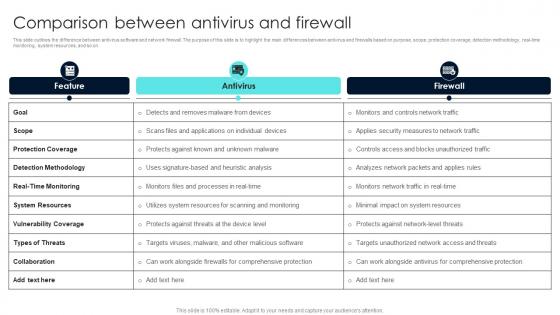
This slide outlines the difference between antivirus software and network firewall. The purpose of this slide is to highlight the main differences between antivirus and firewalls based on purpose, scope, protection coverage, detection methodology, real-time monitoring, system resources, and so on.
People who downloaded this PowerPoint presentation also viewed the following :
Firewall Network Security Comparison Between Antivirus And Firewall with all 9 slides:
Use our Firewall Network Security Comparison Between Antivirus And Firewall to effectively help you save your valuable time. They are readymade to fit into any presentation structure.









FAQs for Firewall Network Security Comparison Between
Firewalls serve as network gatekeepers by monitoring incoming and outgoing traffic, blocking unauthorized access, filtering malicious content, enforcing security policies, and logging network activity for compliance auditing. These security systems streamline protection by preventing cyber threats, controlling application usage, and segmenting network zones, with many organizations finding that modern firewalls ultimately deliver enhanced operational security and regulatory compliance.
Stateful firewalls track connection states and examine packets within the context of established sessions, maintaining memory of ongoing communications and connection history. Stateless firewalls inspect each packet individually without context, filtering based solely on predetermined rules like IP addresses and port numbers, with many organizations finding that stateful inspection delivers enhanced security through comprehensive traffic analysis and threat detection.
Firewalls help mitigate DDoS attacks by filtering malicious traffic, rate limiting connection requests, and blocking suspicious IP addresses, though they work best as part of layered security strategies. While traditional firewalls can handle smaller attacks, organizations increasingly deploy advanced firewall solutions with deep packet inspection and cloud-based DDoS protection, ultimately delivering enhanced network resilience.
Firewalls can effectively enforce corporate policies by controlling network access, blocking unauthorized applications, restricting bandwidth usage, monitoring data transfers, and filtering web content based on predefined rules. Through application control and content filtering, organizations in sectors like finance and healthcare can prevent policy violations, ensure regulatory compliance, and maintain productivity standards, ultimately delivering enhanced security governance and operational control.
Enterprise firewall types include packet filtering firewalls, stateful inspection firewalls, proxy firewalls, next-generation firewalls (NGFW), and web application firewalls (WAF). These technologies enhance network security by monitoring traffic flows, blocking malicious requests, and providing deep packet inspection, with many organizations finding that strategic firewall deployment significantly reduces cyber threats while enabling secure business operations.
Next-generation firewalls enhance security by providing application-layer inspection, intrusion prevention systems, deep packet inspection, user identity awareness, and integrated threat intelligence, compared to traditional firewalls that only examine basic packet headers. These advanced capabilities enable organizations to detect sophisticated malware, control specific applications like social media or file sharing, and prevent advanced persistent threats, with many financial institutions and healthcare organizations finding that NGFWs deliver significantly improved protection while streamlining network management.
Firewalls integrate with security solutions through unified threat management platforms, API connections, shared threat intelligence feeds, centralized logging systems, and automated response coordination. When combined with intrusion detection systems, endpoint protection, and SIEM platforms, organizations streamline security operations, enhance threat visibility, and enable faster incident response, ultimately delivering comprehensive network protection and operational efficiency.
Effective firewall rule configuration includes implementing least privilege access, creating zone-based security policies, regularly auditing rule sets, establishing logging and monitoring protocols, and maintaining clear documentation standards. These practices enhance network protection by minimizing attack surfaces, streamlining traffic management, and enabling rapid threat response, with many organizations finding that systematic rule governance ultimately delivers improved security posture and operational efficiency.
Firewalls manage encrypted HTTPS traffic through SSL/TLS inspection, deep packet inspection, and certificate analysis, while maintaining security protocols throughout the process. These technologies enable organizations to monitor encrypted communications by temporarily decrypting traffic at the firewall level, scanning for threats, then re-encrypting before transmission, ultimately delivering comprehensive protection without compromising data integrity or user privacy.
Firewalls face significant challenges including securing distributed cloud environments, managing complex hybrid network architectures, protecting remote endpoints beyond traditional perimeters, and handling encrypted traffic inspection. These evolving demands require advanced next-generation firewalls that integrate cloud-native security, zero-trust frameworks, and AI-driven threat detection, ultimately enabling organizations to maintain robust protection while supporting flexible, scalable business operations.
Organizations measure firewall effectiveness through traffic analysis, security incident metrics, compliance audit results, performance benchmarks, and penetration testing outcomes. These assessment methods enable businesses to evaluate blocked threats, network latency impacts, and policy effectiveness, with many financial institutions and healthcare providers finding that regular monitoring ultimately delivers enhanced security posture and regulatory compliance.
Firewall legal considerations include data protection compliance, industry-specific regulations, audit requirements, cross-border data transfer restrictions, and incident reporting obligations. Financial services, healthcare, and government sectors face stringent mandates like GDPR, HIPAA, and SOX, with many organizations finding that robust firewall policies enable regulatory compliance while delivering enhanced security postures and competitive advantages.
Firewall technologies most commonly mitigate denial-of-service attacks, malware infiltration, unauthorized access attempts, port scanning, and SQL injection attacks. These security measures enhance network protection by filtering malicious traffic, blocking suspicious connections, and monitoring data packets, with many organizations finding that strategic firewall deployment significantly reduces security breaches while enabling secure business operations.
Firewall performance directly influences network speed through packet inspection latency, throughput limitations, and processing delays that can create bottlenecks in data flow. Modern firewalls with optimized hardware acceleration and intelligent traffic prioritization enable organizations to maintain robust security while preserving network efficiency, ultimately delivering faster user experiences without compromising protection.
Organizations should monitor AI-powered threat detection, zero-trust architecture integration, cloud-native firewall solutions, automated security orchestration, and next-generation inspection capabilities. These emerging technologies enhance protection by adapting to sophisticated attacks, streamlining multi-cloud environments, and reducing response times, with many enterprises finding that proactive firewall evolution delivers significant competitive advantages in increasingly complex digital landscapes.
-
They had the topic I was looking for in a readymade presentation…helped me meet my deadline.
-
Amazing slides! Unique, attractive, and easy to understand.