

Fishbone diagram cause effective relationship powerpoint slide backgrounds




Try Before you Buy Download Free Sample Product
 Impress Your
 Audience
 100%
100% Editable
 Save Hours
 of Time


Bedazzle them with our brilliant Fishbone Diagram Cause Effective Relationship Powerpoint Slide Backgrounds. You will certainly leave them gaping.
People who downloaded this PowerPoint presentation also viewed the following :
Content of this Powerpoint Presentation
Description:
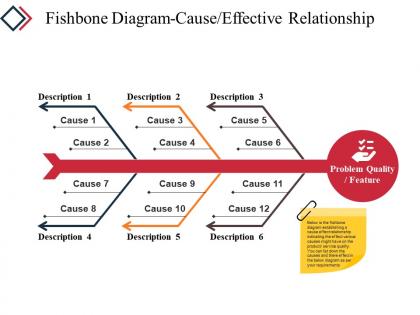
The image is of a PowerPoint slide featuring a Fishbone Diagram, also known as an Ishikawa diagram, which is used to identify, explore, and display the possible causes of a specific problem or quality feature. The central "spine" of the fishbone represents the problem or quality feature to be examined. In this case, the head of the fishbone is labeled "Problem Quality / Feature."
Branching off the spine are lines that lead to categories of potential causes, labeled here as "Description 1" through "Description 6." These descriptions are placeholders where specific categories like "Methods," "Machinery," "People," "Materials," "Measurements," and "Environment" can be inserted, depending on the context of the problem. From each category, smaller lines extend, labeled "Cause 1" through "Cause 12," where specific causes related to each category would be placed.
There's a note on the slide that explains the purpose of the fishbone diagram: "Below is the fishbone diagram establishing a cause/effect relationship indicating the effect various causes might have on the product/service quality. You can list down the causes and their effect in the below diagram as per your requirements."
Use Cases:
Such a diagram can be utilized in various industries for problem-solving and quality improvement purposes:
1. Manufacturing:
Use: Identifying factors affecting product defects.
Presenter: Quality Assurance Manager.
Audience: Production Team.
2. Healthcare:
Use: Analyzing the causes of patient safety incidents.
Presenter: Clinical Risk Manager.
Audience: Medical Staff and Administrators.
3. Information Technology:
Use: Troubleshooting software bugs or system failures.
Presenter: IT Project Lead.
Audience: Development and Testing Teams.
4. Education:
Use: Understanding factors contributing to student performance issues.
Presenter: Academic Researcher.
Audience: Educators and Policy Makers.
5. Automotive:
Use: Investigating the root causes of mechanical failures in vehicles.
Presenter: Engineering Team Lead.
Audience: Design and Engineering Teams.
6. Hospitality:
Use: Assessing reasons for customer satisfaction decline in hotel services.
Presenter: Operations Manager.
Audience: Service Staff and Management.
7. Environmental Services:
Use: Examining causes of environmental non-compliance incidents.
Presenter: Environmental Compliance Officer.
Audience: Environmental Protection Team.
Fishbone diagram cause effective relationship powerpoint slide backgrounds with all 5 slides:
Guide folks on how to avoid being cheated with our Fishbone Diagram Cause Effective Relationship Powerpoint Slide Backgrounds. It helps identify acts of deceit.


FAQs for Fishbone diagram cause effective relationship
The primary purpose of a fishbone diagram in problem-solving is to systematically identify and categorize all potential root causes of a specific problem or effect. This visual tool enables teams to explore contributing factors across categories like people, processes, equipment, materials, and environment, while facilitating comprehensive analysis that prevents overlooking critical issues, ultimately delivering more targeted solutions and faster problem resolution.
Fishbone diagrams enhance quality management by systematically identifying root causes of defects, process failures, and performance issues through structured brainstorming across categories like methods, materials, machinery, and manpower. Manufacturing companies, healthcare facilities, and service organizations use these visual tools to streamline problem-solving workflows, reduce recurring quality issues, and improve continuous improvement initiatives, ultimately delivering more consistent products and enhanced operational efficiency.
The main categories in a fishbone diagram typically include People, Process, Materials, Equipment, Environment, and Methods, though these can be customized based on specific organizational needs and industry requirements. These categories enable teams across manufacturing, healthcare, and service industries to systematically analyze root causes by examining each potential contributing factor, ultimately streamlining problem-solving processes and delivering more targeted solutions.
A fishbone diagram facilitates team collaboration by providing a structured visual framework where team members can collectively brainstorm, categorize potential causes, and contribute diverse perspectives systematically. This collaborative approach ensures comprehensive problem analysis, encourages cross-functional input from different departments, and creates shared ownership of solutions, ultimately delivering more effective problem-solving outcomes and stronger team alignment.
Industries that commonly utilize fishbone diagrams include manufacturing, healthcare, automotive, aerospace, pharmaceuticals, and food processing sectors. These organizations leverage fishbone analysis to systematically identify root causes of quality issues, production delays, and operational inefficiencies, with many finding that this structured approach streamlines problem-solving processes and enhances overall operational efficiency.
Yes, fishbone diagrams excel at identifying root causes in complex systems by systematically breaking down problems into major categories like people, processes, equipment, materials, and environment. Through structured brainstorming, teams in manufacturing, healthcare, and IT services can trace intricate cause-and-effect relationships, ultimately delivering comprehensive problem analysis and targeted solutions that address underlying issues rather than symptoms.
Common pitfalls include rushing the brainstorming process, focusing on blame rather than causes, creating overly complex diagrams, and failing to involve diverse team perspectives. Many organizations find that superficial analysis, inadequate follow-up on identified causes, and poor facilitation undermine effectiveness, ultimately limiting the diagram's ability to deliver meaningful process improvements and sustainable solutions.
Digital tools enhance fishbone diagram creation through automated formatting, real-time collaboration features, interactive templates, and seamless integration with other analytical frameworks. These platforms streamline brainstorming sessions by enabling simultaneous input from multiple team members, while also delivering professional visualizations, easy modifications, and direct export capabilities, ultimately transforming traditional problem-solving processes into more efficient, scalable organizational practices.
Data collection provides the factual foundation that transforms fishbone diagrams from theoretical exercises into actionable problem-solving tools, ensuring each potential cause is validated through evidence rather than assumptions. Through systematic data gathering, teams can prioritize the most statistically significant root causes, measure baseline performance, and track improvement outcomes, with many organizations finding that data-driven fishbone analysis delivers faster resolution times and more sustainable solutions.
Fishbone diagrams integrate seamlessly into Lean and Six Sigma as root cause analysis tools during the Analyze phase, helping teams systematically identify waste sources and process variations. Manufacturing companies use them in DMAIC projects to categorize potential causes by methods, machines, materials, and manpower, while service organizations leverage them for defect reduction initiatives, ultimately streamlining problem-solving and enhancing operational efficiency.
**INPUT**: What are the differences between a fishbone diagram and other cause-and-effect tools? **OUTPUT**: Fishbone diagrams offer visual hierarchy and systematic categorization that distinguishes them from linear cause-and-effect tools like fault trees, scatter plots, or simple brainstorming lists. While other tools focus on statistical correlation or sequential analysis, fishbone diagrams enable teams to systematically explore multiple cause categories simultaneously, ultimately delivering comprehensive problem-solving frameworks that enhance organizational troubleshooting across manufacturing, healthcare, and service industries.
Cultural factors influence fishbone diagrams through communication styles, hierarchical perspectives, problem-solving approaches, and team collaboration patterns that vary across organizations and regions. Teams from different cultural backgrounds may categorize causes differently, emphasize collective versus individual accountability, and interpret root causes through distinct cultural lenses, ultimately requiring facilitators to adapt their approach for more inclusive and comprehensive problem analysis.
Fishbone diagrams can effectively support project management by identifying potential risks, delays, and bottlenecks across categories like resources, processes, technology, and team dynamics. While primarily designed for problem analysis, these visual tools enhance project planning by enabling teams to anticipate challenges systematically, ultimately delivering more comprehensive risk mitigation strategies and improved project outcomes.
Involving stakeholders in fishbone diagram development ensures comprehensive problem analysis by capturing diverse perspectives, expertise, and operational insights from across affected departments. This collaborative approach enhances accuracy, builds consensus around root causes, and increases buy-in for subsequent solutions, with many organizations finding that stakeholder participation ultimately delivers more effective problem-solving outcomes and smoother implementation processes.
Success of fishbone diagram solutions can be measured through key performance indicators, baseline comparisons, stakeholder feedback, and quantifiable metrics aligned with the original problem statement. Organizations typically track operational efficiency improvements, cost reductions, defect rates, and customer satisfaction scores, with many finding that systematic measurement reveals both immediate fixes and long-term process optimizations, ultimately delivering sustainable competitive advantage.
-
Very unique, user-friendly presentation interface.
-
Designs have enough space to add content.