

Fishbone Diagram To Determine The Root Cause Of Problem QCP Templates Set 1




Try Before you Buy Download Free Sample Product
 Impress Your
 Audience
 100%
100% Editable
 Save Hours
 of Time


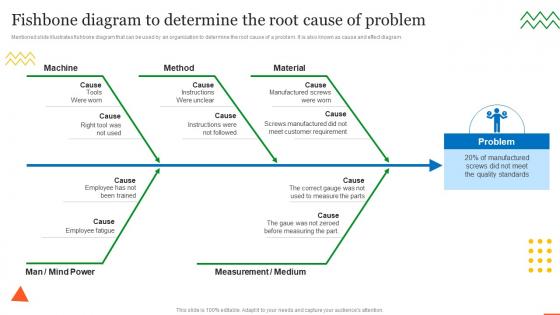
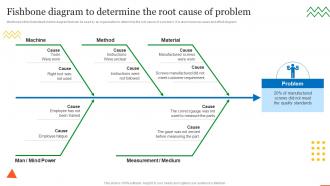
Mentioned slide illustrates fishbone diagram that can be used by an organization to determine the root cause of a problem.It is also known as cause and effect diagram.
People who downloaded this PowerPoint presentation also viewed the following :
Fishbone Diagram To Determine The Root Cause Of Problem QCP Templates Set 1 with all 6 slides:
Use our Fishbone Diagram To Determine The Root Cause Of Problem QCP Templates Set 1 to effectively help you save your valuable time. They are readymade to fit into any presentation structure.





FAQs for Fishbone Diagram To Determine The Root Cause Of Problem QCP
**INPUT**: What are the primary components that make up a fishbone diagram? **OUTPUT**: Fishbone diagrams include the problem statement (head), major cause categories (main bones), subcauses (smaller bones), and the central spine connecting all elements. These components streamline root cause analysis by organizing potential factors into manageable categories like people, processes, materials, and environment, with many organizations finding that this structured approach accelerates problem-solving and enhances team collaboration across departments. **Word count: 60 words**
A fishbone diagram helps identify root causes by systematically categorizing potential factors into structured branches like people, processes, equipment, materials, and environment, ensuring comprehensive analysis. This visual approach enables teams to explore all possible contributing elements methodically, preventing oversight of critical factors, with many organizations finding that this structured brainstorming ultimately delivers more accurate problem diagnosis and targeted solutions.
Fishbone diagrams are most commonly utilized in manufacturing, healthcare, automotive, software development, and financial services industries. These sectors leverage this root cause analysis tool to systematically identify quality issues, operational inefficiencies, and process breakdowns, with many organizations finding that structured problem-solving approaches significantly enhance their troubleshooting capabilities and operational performance.
Fishbone diagrams deliver structured root cause analysis, enhanced team collaboration, comprehensive problem visualization, systematic thinking processes, and reduced oversight of potential causes. These visual tools streamline problem-solving sessions by encouraging diverse perspectives, organizing complex issues into manageable categories, and ensuring thorough exploration, with many organizations finding that teams identify solutions faster and more effectively.
Teams effectively brainstorm potential causes using fishbone diagrams by organizing sessions around major categories like people, processes, materials, and environment, encouraging diverse perspectives from cross-functional members. This structured approach enables systematic exploration of root causes, prevents overlooking critical factors, and facilitates comprehensive problem-solving, with many organizations finding that visual categorization enhances team collaboration and analytical thinking.
Techniques include structured brainstorming with designated facilitators, using sticky notes for anonymous contributions, implementing time-boxed sessions for each category, and encouraging diverse perspectives from cross-functional team members. These approaches streamline idea generation by minimizing groupthink, enhancing participation equality, and ensuring comprehensive root cause exploration, with many organizations finding that facilitated fishbone sessions deliver more actionable insights and faster problem resolution.
Fishbone diagrams offer comprehensive visual mapping of multiple potential causes across categories, while 5 Whys provides deep sequential drilling into single cause chains through iterative questioning. These tools work strategically together, with fishbone diagrams identifying broad cause categories like equipment, people, and processes, and 5 Whys exploring specific pathways, ultimately delivering more thorough analysis.
Teams commonly face challenges including insufficient brainstorming depth, focusing on symptoms rather than root causes, lack of diverse perspectives, and difficulty prioritizing identified factors. These obstacles can be overcome by ensuring cross-functional participation, using structured facilitation techniques, conducting thorough research to validate assumptions, and applying data analysis to rank causes by impact, ultimately delivering more accurate problem-solving outcomes.
Fishbone diagrams can be adapted for project planning by identifying potential obstacles, resource constraints, timeline challenges, and stakeholder issues that might derail project success. Project managers use this approach to proactively address risks across categories like people, processes, technology, and environment, ultimately enabling more comprehensive planning and smoother project execution with fewer unexpected delays.
Effective fishbone diagram categorization involves organizing potential causes into major categories like People, Process, Materials, Equipment, Environment, and Methods. These categories help teams systematically explore root causes by examining human factors, procedural issues, resource quality, and operational conditions, ultimately delivering comprehensive problem analysis and targeted solutions for process improvement.
Fishbone diagrams serve as systematic root cause analysis tools in quality management, enabling teams to identify potential sources of defects, process variations, and operational inefficiencies across categories like methods, materials, machines, and manpower. These visual frameworks streamline problem-solving by organizing brainstorming sessions, facilitating cross-functional collaboration, and ensuring comprehensive issue investigation, ultimately delivering faster resolution times and sustainable process improvements.
Software tools enhance fishbone diagram creation through automated formatting, real-time collaboration features, template libraries, and digital brainstorming capabilities. These platforms streamline root cause analysis by enabling teams to collaborate remotely, integrate with project management systems, and maintain version control, with many organizations finding that digital fishbone tools accelerate problem-solving processes and improve documentation accuracy.
Common pitfalls include rushing the brainstorming process, focusing only on obvious causes, failing to involve diverse team perspectives, creating overly complex diagrams, and neglecting to validate potential causes with data. While these mistakes can limit effectiveness, organizations that encourage collaborative analysis, maintain structured categories, and follow up with systematic investigation find that fishbone diagrams deliver clearer problem identification and faster resolution times.
A fishbone diagram facilitates communication by providing a visual framework that encourages structured brainstorming, ensures all perspectives are heard, and creates shared understanding of problem complexity. Through collaborative mapping sessions, teams systematically explore cause categories together, ultimately delivering enhanced transparency and alignment, with many organizations finding that this visual approach significantly reduces miscommunication and accelerates problem-solving efforts.
Visual enhancements improve fishbone diagrams through color coding for different cause categories, consistent font sizing for hierarchy, spacing optimization, and strategic use of icons or symbols. These improvements streamline problem-solving sessions by enabling faster pattern recognition, clearer team communication, and more efficient root cause identification, with many organizations finding that well-designed diagrams accelerate decision-making processes.
-
Visually stunning presentation, love the content.
-
Great product with effective design. Helped a lot in our corporate presentations. Easy to edit and stunning visuals.