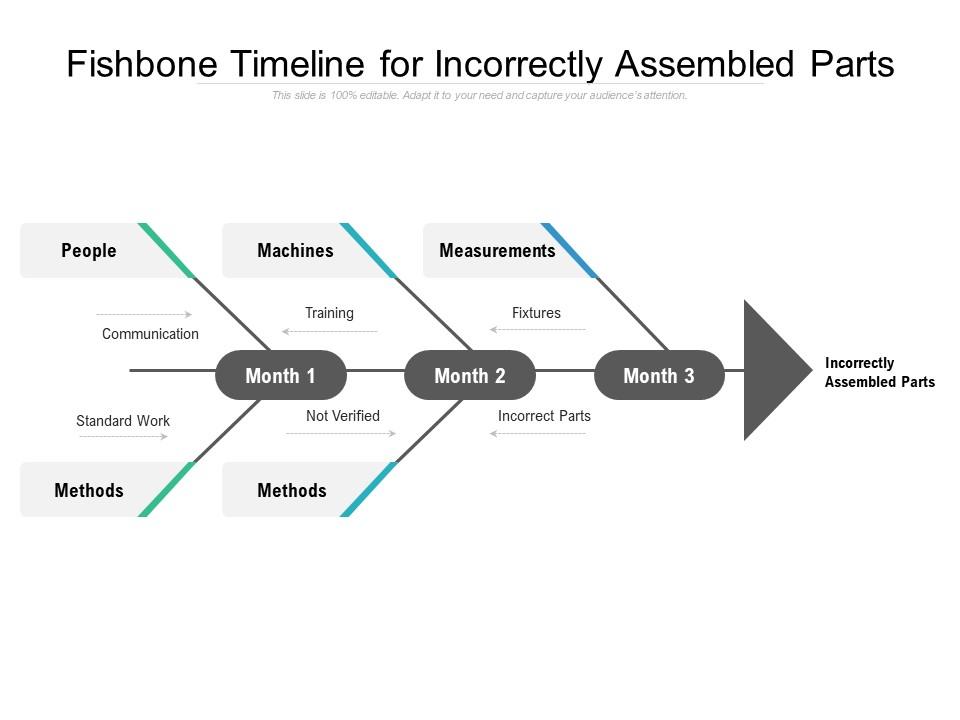
Fishbone timeline for incorrectly assembled parts

Fishbone timeline for incorrectly assembled parts
Slide 1 of 2
Favourites Favourites

Try Before you Buy Download Free Sample Product

Audience Impress Your
Audience
Editable 100%
Editable
Time Save Hours
of Time
The Biggest Sale is ending soon in
0
0
:
0
0
:
0
0
Presenting this set of slides with name Fishbone Timeline For Incorrectly Assembled Parts. This is a three stage process. The stages in this process are Fishbone Timeline, Production Process, Management. This is a completely editable PowerPoint presentation and is available for immediate download. Download now and impress your audience.

People who downloaded this PowerPoint presentation also viewed the following :

FAQs for Fishbone timeline for

A fishbone diagram is a visual problem-solving tool that maps potential causes of an issue across categories like people, processes, materials, and environment, resembling a fish skeleton structure. Manufacturing teams, healthcare organizations, and service companies use this systematic approach to identify root causes, streamline troubleshooting processes, and enhance operational efficiency, ultimately delivering faster problem resolution and improved quality outcomes.

A fishbone diagram consists of the problem statement (fish head), major cause categories (main bones), and specific causes (smaller bones branching off). These components systematically organize potential root causes into categories like methods, materials, manpower, and machinery, enabling teams to conduct thorough problem analysis while identifying actionable solutions for process improvement and quality enhancement.

Fishbone diagrams improve manufacturing quality control by systematically identifying root causes across categories like machinery, materials, methods, manpower, measurements, and environment. Through visual cause-and-effect analysis, manufacturing teams can pinpoint specific defect sources, streamline corrective actions, and implement preventive measures, ultimately reducing waste, minimizing production delays, and enhancing product consistency across operations.

Manufacturing, healthcare, automotive, aerospace, software development, and financial services commonly utilize fishbone diagrams for root cause analysis across quality control and process improvement initiatives. These industries leverage this systematic approach to identify defects in production lines, patient safety issues, software bugs, and service delivery problems, ultimately enhancing operational efficiency and reducing costly errors through structured problem-solving methodologies.

Common pitfalls include rushing through root cause identification, focusing on symptoms rather than underlying issues, limiting team diversity during brainstorming sessions, and creating overly complex diagrams with too many branches. Many organizations find that insufficient preparation, inadequate data collection, and failing to prioritize identified causes ultimately reduces the diagram's effectiveness, while proper facilitation and structured follow-up delivers meaningful problem-solving outcomes.

Fishbone diagrams provide comprehensive visual mapping of multiple potential causes across categories, while 5 Whys focuses on drilling down through sequential cause-and-effect chains to find root causes. These approaches complement each other effectively, with fishbone diagrams offering broader brainstorming capabilities and 5 Whys delivering deeper analysis, enabling organizations to combine both for more thorough problem-solving outcomes.

Yes, fishbone diagrams excel in collaborative team environments by facilitating structured brainstorming, encouraging diverse perspectives, and ensuring systematic problem analysis across all potential cause categories. Teams use these visual tools during cross-functional meetings, quality improvement sessions, and project retrospectives, with each member contributing expertise from their domain, ultimately delivering comprehensive root cause identification and shared ownership of solutions.

Fishbone diagrams excel at analyzing complex problems with multiple potential root causes, including quality defects, process inefficiencies, equipment failures, customer complaints, and safety incidents. These visual tools enable teams across manufacturing, healthcare, and service industries to systematically identify contributing factors like people, processes, equipment, and environment, ultimately streamlining problem-solving and enhancing operational efficiency.

Digital tools enhance fishbone diagrams through automated data collection, real-time collaboration features, and advanced analytics capabilities. These platforms enable teams to populate diagrams with live operational data, facilitate virtual brainstorming sessions across departments, and use AI-powered pattern recognition to identify recurring root causes, ultimately delivering faster problem resolution and more comprehensive analysis than traditional manual methods.

Successful fishbone diagram applications include Toyota's automotive manufacturing for defect reduction, hospitals analyzing patient safety incidents, software companies debugging system failures, and restaurants identifying service delays. These organizations streamline problem-solving by systematically categorizing root causes, enabling faster issue resolution, reducing operational costs, and improving quality outcomes, with many finding that structured cause analysis delivers sustainable competitive advantages.

Fishbone diagrams help project managers identify root causes of delays, quality issues, budget overruns, resource conflicts, and scope creep through systematic analysis. By categorizing potential causes across people, processes, materials, and environment, project teams can proactively address bottlenecks, streamline workflows, and minimize risks, ultimately delivering projects on time and within budget.

Colors and visuals enhance fishbone diagram clarity by differentiating categories, highlighting priority causes, and improving information hierarchy through strategic color coding and iconography. These visual elements streamline complex problem analysis by enabling teams to quickly identify critical pathways, categorize potential causes by department or severity, and maintain focus during collaborative troubleshooting sessions, ultimately delivering faster root cause identification.

Team inputs serve as the foundation for comprehensive fishbone diagrams, bringing diverse perspectives, specialized knowledge, cross-functional insights, and real-world experience to identify potential root causes across all categories. Through collaborative brainstorming sessions, teams from operations, quality control, engineering, and management contribute unique viewpoints that individual analysis might miss, ultimately delivering more thorough problem-solving and sustainable solutions.

Fishbone diagrams enhance brainstorming sessions by providing structured visual frameworks that guide systematic exploration of potential causes, encourage diverse team perspectives, and prevent discussions from becoming unfocused. This organized approach enables teams across industries like manufacturing, healthcare, and software development to identify root causes more efficiently, streamline problem-solving processes, and ultimately deliver comprehensive solutions while fostering collaborative thinking.

Creating an effective fishbone diagram involves defining the problem statement clearly, identifying major cause categories like methods, materials, people, and environment, then brainstorming specific causes within each category through team collaboration. Organizations across manufacturing, healthcare, and service industries find that systematically working from broad categories to detailed root causes, while encouraging diverse perspectives and validating findings with data, ultimately delivers more targeted solutions and faster problem resolution.

Ratings and Reviews

0% of 100
Write a review
Most Relevant Reviews

No Reviews