

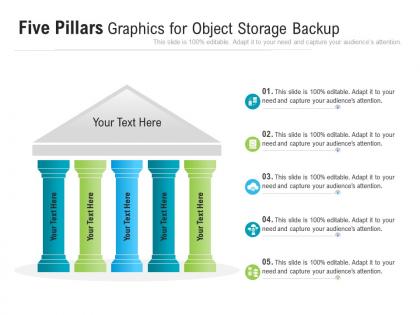
Five pillars graphics for object storage backup infographic template




Try Before you Buy Download Free Sample Product
 Impress Your
Audience
 100%
Editable
 Save Hours
of Time


Our Five Pillars Graphics For Object Storage Backup Infographic Template are topically designed to provide an attractive backdrop to any subject. Use them to look like a presentation pro.
People who downloaded this PowerPoint presentation also viewed the following :
Five pillars graphics for object storage backup infographic template with all 2 slides:
Use our Five Pillars Graphics For Object Storage Backup Infographic Template to effectively help you save your valuable time. They are readymade to fit into any presentation structure.


FAQs for Five pillars graphics for object storage
Object storage for backup offers unlimited scalability, enhanced durability through redundant copies, cost-effective tiered pricing, and seamless cloud integration compared to traditional file or block storage. These advantages enable organizations to streamline their backup processes while reducing infrastructure costs, with many enterprises finding that object storage delivers faster disaster recovery, automated data lifecycle management, and superior protection against hardware failures, ultimately providing more reliable and economical backup solutions.
Object storage enhances backup durability through automatic data replication across multiple geographical locations, erasure coding for error correction, and distributed architecture that eliminates single points of failure. These mechanisms enable organizations to achieve 99.999999999% durability rates while streamlining disaster recovery processes, with many enterprises finding significantly reduced data loss risks and faster restoration times.
Organizations should look for features including scalability to handle growing data volumes, durability with multiple redundancy levels, cost-effective tiering options, encryption capabilities, and seamless integration with existing backup tools. These capabilities enable businesses to streamline their data protection strategies while reducing storage costs, with many enterprises finding that strategic object storage selection delivers enhanced operational efficiency and long-term competitive advantage.
Object storage improves backup processes by automatically scaling storage capacity without infrastructure changes, eliminating the need for manual capacity planning, and reducing costs through pay-as-you-use models. Growing businesses, particularly in e-commerce and healthcare, find that this flexibility enables faster data recovery, seamless expansion across multiple locations, and ultimately delivers operational efficiency while minimizing IT overhead costs.
Best practices for organizing files within object storage include implementing hierarchical naming conventions, utilizing metadata tagging, establishing lifecycle policies, creating logical bucket structures, and maintaining consistent file versioning protocols. These approaches streamline backup operations by enabling faster retrieval, automated archiving, and efficient deduplication processes, with many organizations finding that strategic file organization reduces storage costs while significantly enhancing backup performance and recovery times.
Object storage APIs facilitate integration with existing backup software through standardized REST protocols, S3-compatible interfaces, and cloud-native connectivity that enable seamless data transfer and management. These APIs streamline backup operations by providing automated scheduling, metadata handling, and multi-cloud compatibility, with many enterprises finding that this integration delivers faster recovery times, reduced storage costs, and enhanced scalability across their infrastructure.
Object storage for long-term backup retention typically reduces costs through lower per-gigabyte pricing, elimination of hardware maintenance expenses, and pay-as-you-use scaling models. While initial migration requires investment, organizations across healthcare, financial services, and manufacturing find that automated tiering, reduced physical infrastructure, and elimination of tape management ultimately deliver significant cost savings and operational efficiency over traditional backup methods.
Object storage supports data retrieval speed through parallel processing capabilities, distributed architecture, and intelligent data placement algorithms that minimize latency. These systems enable faster recovery operations by allowing simultaneous access to multiple data chunks, optimizing bandwidth utilization, and implementing strategic caching mechanisms, with many organizations finding that modern object storage delivers significantly faster backup recovery times compared to traditional storage methods.
Versioning in object storage enhances data backup strategies by automatically maintaining multiple copies of files, enabling point-in-time recovery, simplifying compliance requirements, and reducing storage overhead through incremental changes. This approach streamlines recovery processes for organizations across sectors like healthcare and finance, while minimizing data loss risks and ultimately delivering faster restoration times with improved operational resilience.
Encryption plays a critical role in securing object storage backups by providing data protection at rest and in transit, access control through key management, and compliance with regulatory standards. Through advanced encryption protocols, organizations can safeguard sensitive information against unauthorized access, data breaches, and cyber threats, while maintaining operational efficiency and meeting industry compliance requirements across sectors like healthcare and finance.
Geographic distribution of object storage significantly enhances data backup and disaster recovery by enabling cross-region replication, reducing latency, and ensuring compliance with local data regulations. Through strategically placed storage nodes, organizations can automatically replicate critical data across multiple locations, minimize recovery time objectives, and maintain business continuity during regional outages, ultimately delivering resilient disaster recovery capabilities and improved operational reliability.
Organizations face challenges including data migration complexity, integration with existing backup systems, staff training requirements, initial cost considerations, and compatibility concerns with legacy applications. While these present initial hurdles, many enterprises find that strategic planning and phased implementation approaches streamline the transition, ultimately delivering enhanced scalability, cost efficiency, and simplified data management across distributed environments.
Multi-tenancy in object storage enables businesses to create isolated backup environments for different departments while sharing underlying infrastructure, ensuring data segregation, customized retention policies, and department-specific access controls. This approach streamlines backup management by allowing IT teams to allocate distinct storage quotas, implement tailored security protocols, and maintain compliance requirements across departments, ultimately delivering cost efficiency and operational flexibility.
Object storage for backup reduces ecological impact through energy-efficient design, automated data lifecycle management, deduplication technologies, and optimized cooling systems that minimize power consumption. Many data centers leveraging object storage find significant reductions in carbon footprint while delivering scalable backup solutions, with organizations increasingly recognizing these sustainable practices as competitive advantages in environmentally conscious markets.
Regulatory compliance requirements significantly influence object storage selection through data residency mandates, encryption standards, audit trail capabilities, and retention policies. Financial institutions require GDPR-compliant solutions with EU data centers, while healthcare organizations prioritize HIPAA-certified platforms, with many enterprises finding that compliance-ready storage ultimately delivers enhanced security and competitive advantage.
-
Unique design & color.
-
Unique design & color.
-
Use of icon with content is very relateable, informative and appealing.
-
Informative presentations that are easily editable.