


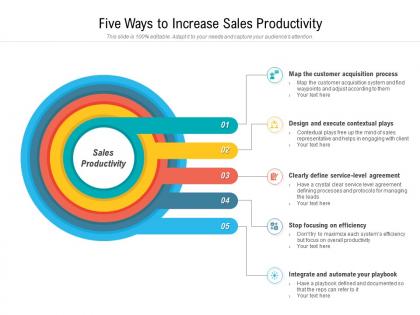
Five ways to increase sales productivity




Try Before you Buy Download Free Sample Product
 Impress Your
 Audience
 100%
100% Editable
 Save Hours
 of Time


Our Five Ways To Increase Sales Productivity are topically designed to provide an attractive backdrop to any subject. Use them to look like a presentation pro.
People who downloaded this PowerPoint presentation also viewed the following :
Five ways to increase sales productivity with all 2 slides:
Use our Five Ways To Increase Sales Productivity to effectively help you save your valuable time. They are readymade to fit into any presentation structure.
FAQs for Five ways to
Sales teams should focus on KPIs including conversion rates, average deal size, sales cycle length, activity metrics like calls and meetings, and revenue per representative. These indicators streamline performance tracking by identifying bottlenecks, optimizing resource allocation, and enhancing forecasting accuracy, with many organizations finding that balanced KPI dashboards ultimately deliver improved quota attainment and competitive advantage.
Sales presentations can be optimized through compelling storytelling, interactive content, personalized value propositions, visual data representation, and strategic objection handling. These approaches enhance client engagement by addressing specific pain points, demonstrating ROI clearly, and creating memorable experiences, with many sales teams finding that well-structured, client-focused presentations reduce sales cycles significantly while improving conversion rates.
Technology significantly enhances sales productivity through CRM systems, sales automation tools, data analytics platforms, AI-powered lead scoring, and mobile sales applications. These solutions streamline prospecting, automate repetitive tasks, and provide real-time insights, with many organizations finding that sales teams can focus more on relationship-building and closing deals, ultimately delivering faster sales cycles and improved conversion rates.
Sales representatives can best prioritize leads by implementing lead scoring systems, analyzing buyer intent signals, focusing on high-value prospects, reviewing past engagement data, and establishing clear qualification criteria. This strategic approach enables sales teams to concentrate efforts on prospects most likely to convert, ultimately reducing sales cycles, improving close rates, and maximizing revenue per representative across organizations.
Sales process streamlining techniques include automation tools, CRM integration, standardized workflows, lead scoring systems, and template-based communications. These approaches enhance productivity by reducing manual tasks, prioritizing high-value prospects, and maintaining consistent messaging, with many sales teams finding that strategic automation ultimately delivers faster conversions and improved customer experiences while preserving relationship quality.
Training is crucial for sales productivity, directly impacting revenue generation, customer relationships, and competitive positioning through enhanced skills, product knowledge, and sales techniques. Well-trained sales teams consistently achieve higher conversion rates, shorter sales cycles, and improved customer satisfaction, with many organizations finding that strategic training investments deliver measurable returns through increased quota attainment and reduced turnover.
Effective sales time management includes prioritizing high-value prospects, time-blocking for specific activities, utilizing CRM automation, setting daily revenue goals, and minimizing administrative tasks through technology. These practices streamline workflows by focusing energy on qualified leads, automating follow-ups, and tracking performance metrics, with many sales professionals finding that structured scheduling ultimately delivers 25-40% productivity gains and faster deal closure.
**INPUT**: How does collaboration within a sales team contribute to overall productivity? **OUTPUT**: Collaboration within sales teams enhances productivity by enabling knowledge sharing, coordinated lead management, and collective problem-solving that accelerates deal closure. Through shared CRM systems and regular team communications, organizations streamline their sales processes, reduce redundant efforts, and leverage collective expertise, with many companies finding that collaborative teams achieve 20-30% higher conversion rates.
Company culture significantly impacts sales productivity by influencing employee motivation, collaboration levels, communication effectiveness, and overall job satisfaction among sales teams. A positive, supportive culture enhances performance through improved morale and streamlined processes, while toxic environments can reduce productivity by up to 40%, with many organizations finding that investing in culture transformation ultimately delivers higher conversion rates and revenue growth.
Feedback loops can be established through regular sales performance reviews, customer satisfaction surveys, CRM data analysis, and cross-departmental collaboration sessions. These mechanisms enable organizations to identify bottlenecks, refine targeting approaches, and optimize conversion strategies, with many companies finding that systematic feedback integration ultimately delivers faster deal closure and enhanced revenue growth.
Effective sales productivity tracking tools include CRM platforms like Salesforce and HubSpot, analytics software such as Tableau and Power BI, call tracking systems, email automation tools, and pipeline management solutions. These technologies streamline performance monitoring by automating data collection, providing real-time insights, and generating comprehensive reports, with many organizations finding that integrated platforms deliver enhanced visibility and significantly faster sales cycle optimization.
Sales teams leverage data analytics by tracking customer behavior patterns, analyzing conversion rates, identifying high-value prospects, monitoring sales cycle trends, and optimizing pipeline management. Through predictive analytics and CRM integration, organizations streamline lead qualification, enhance territory planning, and improve forecasting accuracy, with many sales teams finding that data-driven approaches ultimately deliver higher conversion rates and increased revenue per representative.
Presentations can be tailored through audience-specific messaging, customized value propositions, industry-relevant case studies, appropriate technical depth, and targeted pain point solutions. Sales teams in sectors like healthcare, finance, and manufacturing increasingly personalize content, timing, and delivery methods to match buyer personas, ultimately enhancing engagement rates and accelerating deal closure while building stronger client relationships.
External factors significantly influence sales productivity through shifting customer expectations, economic conditions, competitive pressures, and regulatory changes that affect buying behaviors and decision timelines. Market trends like digital transformation enable sales teams to leverage automation and data analytics, while economic fluctuations impact budget allocations, with many organizations finding that adaptable sales strategies and technology integration help maintain productivity despite external volatility.
Sustaining high sales team motivation involves regular performance recognition, competitive incentive structures, ongoing skills development, clear goal setting, and fostering collaborative team environments. Through consistent coaching, gamification elements, and transparent communication about targets, organizations enhance engagement while providing career advancement opportunities, ultimately delivering improved retention rates and sustained revenue growth across diverse market conditions.
-
Very unique and reliable designs.
-
Very unique, user-friendly presentation interface.
-
Great designs, really helpful.
-
Wonderful templates design to use in business meetings.
-
Informative presentations that are easily editable.
-
Awesome presentation, really professional and easy to edit.
-
Best way of representation of the topic.
-
Awesomely designed templates, Easy to understand.
-
Easily Editable.