

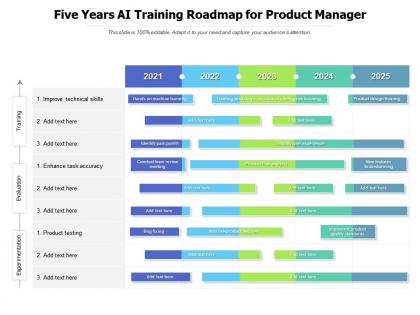
Five years ai training roadmap for product manager




Try Before you Buy Download Free Sample Product
 Impress Your
 Audience
 100%
100% Editable
 Save Hours
 of Time


Visualize your work plan and communicate your ideas impactfully with our pre designed Five Years AI Training Roadmap For Product Manager. Showcase the detailed overview of the project, the key deliverables, and the milestones to be achieved with the help of our fully customizable PowerPoint layout. You can easily emphasize on the project goals and discuss all the activities involved in an easy to comprehend manner by utilizing our professionally designed PPT theme. This roadmap PowerPoint layout is a perfect strategic planning tool that can help in keeping the project on track. With our attractive PowerPoint theme, you can articulate the workflow, track the work progress, and have a clear vision of the goal to be achieved. Download this versatile Five Years AI Training Roadmap For Product Manager and save your hours of work.
People who downloaded this PowerPoint presentation also viewed the following :
Five years ai training roadmap for product manager with all 2 slides:
Use our Five Years AI Training Roadmap For Product Manager to effectively help you save your valuable time. They are readymade to fit into any presentation structure.

FAQs for Five years ai training roadmap
Product managers should understand machine learning algorithms, natural language processing, computer vision, predictive analytics, and data pipeline architecture. These technologies streamline product development by enhancing user personalization, automating customer interactions, and enabling data-driven decision making, with many organizations finding that AI-literate product managers deliver significantly faster feature iterations and competitive advantages.
Product managers can identify AI opportunities by analyzing user pain points, repetitive manual processes, data-rich workflows, and predictive needs within their product ecosystem. Through user journey mapping, data audit processes, and competitive analysis, teams uncover automation possibilities like personalized recommendations, intelligent search functions, and predictive analytics, ultimately delivering enhanced user experiences and operational efficiency.
Product managers can use frameworks like RICE (Reach, Impact, Confidence, Effort), ICE scoring, Kano model, and value-versus-complexity matrices to prioritize AI-driven features effectively. These strategic approaches enable teams to evaluate AI initiatives by assessing user impact, technical feasibility, and business value, with many organizations finding that combining multiple frameworks delivers better resource allocation and ultimately accelerates time-to-market for high-impact AI products.
Data privacy regulations impact AI product development by requiring enhanced data governance frameworks, explicit user consent mechanisms, and transparent algorithmic decision-making processes. These compliance requirements, while initially challenging, ultimately enable product managers to build more trustworthy AI systems, with many organizations finding that proactive privacy measures deliver competitive advantages through increased customer confidence and streamlined regulatory approval processes.
Best practices for collaborating with data scientists and AI engineers include establishing clear communication protocols, defining shared project objectives, creating cross-functional documentation standards, and implementing regular alignment checkpoints. Product managers increasingly find success by learning basic AI terminology, participating in model review sessions, and facilitating stakeholder translations, while data teams benefit from understanding user requirements and business constraints, ultimately delivering more market-relevant AI solutions.
Product managers can measure AI implementation success through key performance indicators including accuracy metrics, user adoption rates, operational efficiency gains, customer satisfaction scores, and ROI calculations. These measurements enable tracking both technical performance and business outcomes, with many organizations finding that combining quantitative metrics like processing speed improvements with qualitative feedback delivers comprehensive insights into AI's strategic impact.
User feedback serves as the critical refinement mechanism for AI functionalities, enabling product managers to identify performance gaps, understand user pain points, validate feature effectiveness, and prioritize enhancement efforts based on real-world usage patterns. Through systematic feedback collection and analysis, organizations continuously optimize their AI systems, delivering more accurate predictions, improved user experiences, and enhanced business outcomes, with many companies finding that user-driven iterations significantly accelerate AI adoption and competitive advantage.
Product managers can leverage AI for market research through sentiment analysis tools, predictive analytics platforms, social media monitoring systems, competitor tracking software, and consumer behavior modeling algorithms. These technologies streamline data collection, identify emerging trends faster, and automate competitive intelligence gathering, with many organizations finding that AI-driven insights enable more strategic product positioning and significantly reduce time-to-market for new features.
Common pitfalls in AI project management include unclear success metrics, inadequate data quality assessment, unrealistic timeline expectations, insufficient stakeholder alignment, and poor change management planning. These challenges can be avoided by establishing measurable KPIs upfront, conducting thorough data audits, setting phased milestones with buffer time, and implementing comprehensive training programs, ultimately delivering scalable AI solutions with sustained organizational adoption.
Product managers ensure ethical AI use through comprehensive bias testing, transparent algorithm documentation, diverse stakeholder consultation, and regular fairness audits throughout development cycles. By implementing clear governance frameworks, establishing cross-functional ethics committees, and conducting ongoing impact assessments, organizations can minimize discriminatory outcomes while maintaining user trust, ultimately delivering responsible innovation that enhances customer experiences and competitive positioning.
Product managers leading AI projects should develop data literacy, technical communication skills, stakeholder management capabilities, user experience design for AI systems, and understanding of AI ethics and bias mitigation. These competencies enable effective collaboration with data scientists and engineers, translating complex AI capabilities into user-focused product features, while managing cross-functional teams to deliver scalable AI solutions that drive measurable business outcomes.
Product managers can create effective data strategies by establishing clear data governance frameworks, identifying relevant data sources, ensuring data quality standards, implementing robust collection processes, and defining analytics requirements that align with AI objectives. Through strategic data architecture planning, organizations streamline model development, enhance predictive accuracy, and accelerate time-to-market for AI products, ultimately delivering competitive advantage and measurable business outcomes.
AI project execution tools for product managers include TensorFlow and PyTorch for model development, cloud platforms like AWS SageMaker and Google AI Platform for deployment, data management systems like Apache Airflow, and MLOps platforms such as MLflow and Kubeflow. These platforms streamline project workflows by automating model training, enabling seamless data pipeline management, and facilitating cross-functional collaboration, ultimately delivering faster time-to-market and improved product performance.
Understanding machine learning algorithms enables product managers to make data-driven decisions by identifying which features drive user engagement, predicting market trends, and optimizing product performance through pattern recognition. This knowledge helps prioritize feature development, allocate resources more effectively, and anticipate customer needs, with many product teams finding that algorithm insights streamline roadmap planning and ultimately deliver more competitive, user-focused products.
Netflix's recommendation engine demonstrates AI-driven personalization at scale, analyzing viewing patterns to enhance user engagement and reduce churn rates significantly. Amazon's product recommendation system, Spotify's playlist algorithms, and Airbnb's dynamic pricing models showcase how AI streamlines product decisions, optimizes user experiences, and delivers competitive advantages through data-driven insights across diverse industries.
No Reviews