

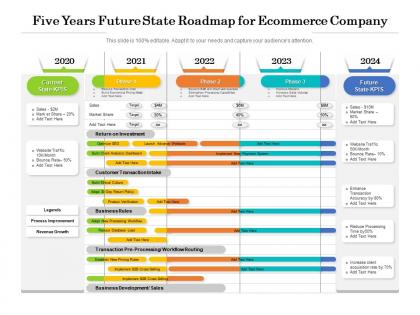
Five years future state roadmap for ecommerce company




Try Before you Buy Download Free Sample Product
 Impress Your
 Audience
 100%
100% Editable
 Save Hours
 of Time


Utilize our pre build Five Years Future State Roadmap For Ecommerce Company to present your plan of action in the most effective way. Reduce the paperwork and showcase how different activities are linked to each other by incorporating this attention grabbing PowerPoint theme. This completely editable roadmap PPT layout is suitable to fit all your needs and to have a structured outline of the entire process flow using color coding. Provide guidelines to your teammates about the progression process by employing our PPT theme. Team members can easily be designated into teams by accessing the work milestones to be accomplished within the timeframe. You can easily modify the PowerPoint slide according to real time situations. Download our stunning Five Years Future State Roadmap For Ecommerce Company, and you are good to go to prove your expertise in strategic planning.
People who downloaded this PowerPoint presentation also viewed the following :
Five years future state roadmap for ecommerce company with all 2 slides:
Use our Five Years Future State Roadmap For Ecommerce Company to effectively help you save your valuable time. They are readymade to fit into any presentation structure.
FAQs for Five years future state roadmap
Creating a successful ecommerce roadmap involves market research, competitive analysis, platform selection, user experience design, and performance metrics definition. These strategic components work together by identifying target audiences, optimizing customer journeys, and establishing scalable infrastructure, with many retailers finding that comprehensive roadmaps reduce development costs while accelerating time-to-market and enhancing customer experiences.
Market analysis influences ecommerce strategy by identifying customer preferences, competitive gaps, pricing opportunities, and emerging trends within target segments. Through comprehensive market research, businesses can optimize product positioning, enhance user experience design, and develop targeted marketing campaigns, ultimately delivering higher conversion rates and customer satisfaction while gaining competitive advantage in increasingly crowded digital marketplaces.
Customer feedback serves as a critical foundation for ecommerce roadmap development, informing product priorities, user experience improvements, feature development, and strategic direction through direct insights into customer pain points and preferences. This feedback enables retailers to align their technological investments with actual user needs, optimize conversion rates, and enhance customer satisfaction, with many ecommerce businesses finding that feedback-driven roadmaps deliver significantly higher ROI and competitive advantage.
Technology trends significantly reshape ecommerce roadmaps by driving personalization capabilities, automation requirements, and customer experience expectations that demand strategic pivots and resource reallocation. Emerging technologies like AI-powered recommendations, voice commerce, and augmented reality shopping experiences require retailers to continuously adapt their development priorities, with many finding that staying ahead of these trends ultimately delivers competitive advantage and enhanced customer engagement.
Common ecommerce roadmap pitfalls include overambitious timelines, neglecting mobile optimization, insufficient user experience testing, poor integration planning, and inadequate budget allocation for ongoing maintenance. These oversights often result in delayed launches, frustrated customers, and reduced conversion rates, with many retailers finding that thorough stakeholder alignment and phased implementation approaches ultimately deliver more sustainable growth and competitive advantage.
Mobile commerce integration is critically important in ecommerce roadmaps, as mobile devices now account for over 50% of online transactions, requiring responsive design, mobile-optimized checkout processes, and app development strategies. With retailers like Target and Starbucks finding that mobile-first approaches significantly enhance customer engagement and conversion rates, businesses without mobile integration increasingly risk losing competitive advantage in today's mobile-driven marketplace.
Key ecommerce roadmap metrics include conversion rates, customer acquisition cost, average order value, customer lifetime value, and revenue growth trajectory. These indicators enable businesses to assess operational efficiency, marketing effectiveness, and strategic progress, with many retail organizations finding that tracking cart abandonment rates, mobile optimization performance, and customer retention alongside financial metrics ultimately delivers comprehensive visibility into roadmap success and competitive positioning.
SEO best practices integrate into ecommerce strategy through keyword-optimized product descriptions, strategic content marketing, technical site optimization, and data-driven performance tracking. These approaches enhance organic visibility by improving search rankings, reducing customer acquisition costs, and driving qualified traffic, with many retailers finding that consistent SEO implementation ultimately delivers sustainable growth and competitive market positioning.
A phased approach in ecommerce roadmap implementation delivers reduced risk, improved resource allocation, faster time-to-market for core features, enhanced stakeholder buy-in, and continuous learning opportunities. This strategic methodology enables organizations to validate assumptions early, adapt to market feedback, and scale systematically, with many retailers finding that incremental rollouts minimize disruption while maximizing operational efficiency and customer satisfaction.
Businesses align ecommerce roadmaps with objectives by establishing clear KPIs, integrating cross-departmental goals, prioritizing customer journey optimization, and ensuring technology investments support revenue targets. This strategic alignment enables companies to streamline operations, enhance customer experiences, and accelerate growth, with many retail organizations finding that synchronized roadmaps deliver measurable competitive advantage.
User experience enhancement strategies include personalized product recommendations, streamlined checkout processes, mobile-responsive design, advanced search functionality, and AI-powered chatbots for customer support. These approaches deliver significant improvements by reducing cart abandonment rates, accelerating purchase decisions, and increasing customer satisfaction, with many ecommerce platforms finding that strategic UX investments ultimately drive higher conversion rates and competitive advantage.
Determining the right ecommerce platform requires evaluating your roadmap's scalability requirements, integration needs, budget constraints, and growth timeline against platform capabilities like customization flexibility, payment processing, and mobile optimization. Through strategic assessment, businesses can match platforms to their expansion plans, customer experience goals, and operational complexity, with many retailers finding that aligning platform strengths with roadmap priorities ultimately delivers sustainable growth and competitive advantage.
Ecommerce roadmap budgeting best practices include prioritizing high-impact features, allocating 20-30% contingency funds, phasing investments across quarters, conducting thorough cost-benefit analysis, and separating operational from development expenses. These approaches enable businesses to balance immediate revenue opportunities with long-term growth investments, while maintaining financial flexibility for emerging technologies and market changes that drive competitive advantage.
A strong logistics strategy integrates into ecommerce roadmaps through supply chain optimization, inventory management systems, fulfillment center placement, last-mile delivery solutions, and returns processing automation. These components streamline operations by reducing shipping costs, minimizing delivery times, and enhancing customer satisfaction, with many retailers finding that strategic logistics placement ultimately delivers competitive advantage and scalable growth.
Emerging ecommerce trends include AI-powered personalization, voice commerce, augmented reality shopping experiences, social commerce integration, and sustainability-focused initiatives. These technologies streamline customer journeys, enhance product discovery, and automate inventory management, with many retailers finding that strategic combinations of these trends deliver improved conversion rates, reduced operational costs, and significantly stronger competitive positioning.
-
Easily Understandable slides.
-
Unique research projects to present in meeting.
-
Use of different colors is good. It's simple and attractive.
-
Much better than the original! Thanks for the quick turnaround.