


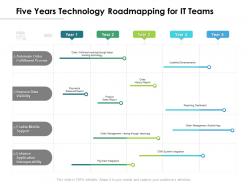
Five years technology roadmapping for it teams





Try Before you Buy Download Free Sample Product
 Impress Your
 Audience
 100%
100% Editable
 Save Hours
 of Time


A well thought out action plan makes execution easier and increases the possibility of success significantly. Ensure hitting all the milestones within the deadlines by introducing our fully customizable Five Years Technology Roadmapping For IT Teams. Streamline the work related information, budget, timeframe, key deliverable, landmarks, and major steps involved, all in one place to give an organized overview of the project by utilizing our PowerPoint theme. Minimize time lag and increase work efficiency by providing insight into the process with our comprehensively researched roadmap PowerPoint layout. Color coding helps in highlighting the process and grabs the attention of the audience. Download our handy Five Years Technology Roadmapping For IT Teams to identify the possible problem areas in a much shorter time and propose solutions. Have a productive brainstorming session with your workforce by utilizing our action plan visualization tool.
People who downloaded this PowerPoint presentation also viewed the following :
Five years technology roadmapping for it teams with all 2 slides:
Use our Five Years Technology Roadmapping For IT Teams to effectively help you save your valuable time. They are readymade to fit into any presentation structure.
FAQs for Five years technology roadmapping
Key components of an effective technology roadmap include current state assessment, future vision definition, strategic initiatives mapping, timeline establishment, and resource allocation planning. These elements work together by aligning technology investments with business objectives, identifying capability gaps, and prioritizing implementation phases, ultimately enabling organizations to systematically modernize their infrastructure while maximizing operational efficiency and competitive advantage.
A technology roadmap aligns with strategic goals by mapping technological investments to business objectives, identifying capability gaps, and establishing clear timelines for implementation. This strategic alignment enables organizations to prioritize resource allocation, mitigate risks, and accelerate innovation initiatives, with many enterprises finding that structured roadmaps deliver competitive advantage and measurable ROI.
Technology roadmap development methodologies include scenario planning, gap analysis, SWOT assessment, stakeholder workshops, and horizon scanning techniques. These approaches streamline strategic planning by aligning technology investments with business objectives, identifying implementation timelines, and prioritizing resource allocation, with many organizations finding that structured methodologies ultimately deliver clearer innovation pathways and competitive advantage.
Organizations prioritize technologies in their roadmap by evaluating business impact, implementation complexity, resource requirements, strategic alignment, and competitive advantage potential. Through systematic assessment frameworks, companies analyze cost-benefit ratios, technical feasibility, and market timing, with many finding that stakeholder input and pilot testing ultimately deliver clearer prioritization decisions and strategic technology investments.
Stakeholder feedback provides critical insights into user needs, market demands, and operational constraints that directly influence technology roadmap priorities and timelines. This input helps organizations align technical investments with business objectives, identify potential roadblocks early, and ensure solutions deliver meaningful value across departments, ultimately enhancing adoption rates and strategic outcomes.
Technology roadmaps should be reviewed quarterly and updated annually, with major revisions triggered by significant market shifts, regulatory changes, or strategic pivots. Many organizations find that quarterly reviews enable rapid adaptation to emerging technologies and competitive pressures, while annual updates ensure alignment with long-term business objectives, ultimately delivering sustained innovation and competitive advantage.
Common pitfalls include lack of stakeholder alignment, unrealistic timelines, insufficient resource planning, poor change management, and neglecting market dynamics. These challenges can derail strategic initiatives by creating conflicting priorities, missed deadlines, and budget overruns, with many organizations finding that regular reviews and cross-functional collaboration ultimately deliver more adaptable and successful technology implementations.
Emerging technologies can be assessed through strategic evaluation criteria including market readiness, alignment with business objectives, implementation complexity, competitive advantage potential, and ROI projections. Organizations typically analyze these factors through pilot programs, stakeholder consultations, and risk assessments, with many technology leaders finding that systematic evaluation frameworks streamline decision-making while minimizing investment risks.
Technology roadmap tools include Microsoft Visio, ProductPlan, Aha!, Roadmunk, and Lucidchart, along with project management platforms like Monday.com and Smartsheet. These solutions streamline strategic planning by enabling collaborative visualization, timeline management, and stakeholder alignment, with many organizations finding that integrated platforms significantly enhance cross-functional communication and accelerate decision-making processes.
A technology roadmap supports innovation by aligning emerging technologies with business objectives, identifying strategic investment opportunities, and creating structured pathways for R&D initiatives. Through systematic planning and resource allocation, organizations can anticipate market trends, reduce development risks, and accelerate time-to-market for new products, ultimately delivering competitive advantage and sustainable growth in increasingly dynamic markets.
Technology roadmap success metrics include milestone achievement rates, budget adherence, time-to-market acceleration, system performance improvements, and stakeholder satisfaction scores. These measurements enable organizations to track strategic alignment, resource efficiency, and competitive positioning, with many enterprises finding that combining quantitative performance data with qualitative business impact assessments ultimately delivers comprehensive roadmap optimization and sustained technological advantage.
Technology roadmaps focus on underlying technical capabilities, infrastructure, and platforms that enable multiple products, while product roadmaps outline specific features and enhancements for individual offerings. Technology roadmaps guide strategic technical decisions across organizations, helping companies align technical investments with business goals, ultimately delivering scalable foundations that support multiple product initiatives and competitive advantage.
Scalability considerations include infrastructure capacity, modular architecture design, resource allocation planning, performance benchmarking, and integration capabilities with existing systems. Organizations must evaluate cloud elasticity, database scaling options, and API flexibility, while balancing immediate needs with future growth projections, ultimately ensuring technology investments can seamlessly expand alongside business demands.
Cross-departmental collaboration in technology roadmap development can be facilitated through structured workshops, shared digital platforms, regular stakeholder meetings, and clear communication protocols that align business objectives with technical capabilities. Through collaborative planning sessions and integrated project management tools, organizations streamline decision-making, enhance resource allocation, and ensure comprehensive buy-in, ultimately delivering cohesive technology strategies that support enterprise-wide goals.
Best practices for communicating technology roadmaps include creating visual timelines, using stakeholder-specific messaging, maintaining regular update cycles, focusing on business outcomes rather than technical details, and establishing clear feedback mechanisms. These approaches enhance transparency and alignment by translating complex technical plans into strategic narratives, with many organizations finding that interactive presentations and quarterly reviews ultimately deliver stronger stakeholder buy-in and project success.
No Reviews