


Five years training roadmap for new product development by manager




Try Before you Buy Download Free Sample Product
 Impress Your
 Audience
 100%
100% Editable
 Save Hours
 of Time


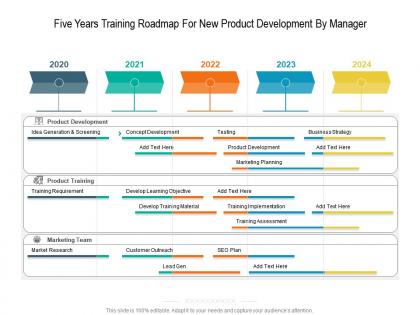
The success rate of business plans is hugely dependent on the plan of action, and this editable Five Years Training Roadmap For New Product Development By Manager rightly serves the purpose. Encapsulate all the information related to the project in a well structured manner to obtain maximum efficiency by incorporating our stunning PowerPoint theme. State the critical deliverable, steps involved, time frame, workforce allocation, and lots more in an easy to understand manner by utilizing this pre designed roadmap PowerPoint layout. You can also prioritize your tasks and discuss the problem areas with your colleagues by incorporating this tailor made PPT layout. Empower your work plan by employing this professionally designed PPT theme. Entrepreneurs can download Five Years Training Roadmap For New Product Development By Manager as a beneficial communication tool that facilitates in collaborating with different tasks and achieve targets.
People who downloaded this PowerPoint presentation also viewed the following :
Five years training roadmap for new product development by manager with all 2 slides:
Use our Five Years Training Roadmap For New Product Development By Manager to effectively help you save your valuable time. They are readymade to fit into any presentation structure.

FAQs for Five years training roadmap for new product
The key stages in new product development include idea generation, concept development and testing, business analysis, product development, market testing, and commercialization. These stages streamline innovation by systematically validating concepts, assessing market viability, and refining prototypes, with many organizations finding that structured roadmaps accelerate time-to-market while minimizing risks and development costs.
Cross-functional teams enhance collaboration during product development by establishing shared communication channels, implementing integrated project management systems, and creating unified decision-making frameworks. Through regular cross-departmental workshops and collaborative platforms, organizations streamline feedback loops, accelerate problem-solving, and minimize development bottlenecks, with many companies finding that structured collaboration reduces time-to-market significantly.
Market research plays a pivotal role in product innovation by identifying unmet customer needs, validating concepts, analyzing competitive landscapes, and predicting market trends. Through comprehensive data analysis and consumer insights, companies can streamline their development processes, minimize risks, and enhance product-market fit, with many organizations finding that research-driven innovation ultimately delivers higher success rates and sustainable competitive advantage.
Effective techniques include brainstorming sessions, customer feedback analysis, competitor research, trend analysis, and cross-functional workshops to generate diverse product concepts. These approaches streamline innovation by combining market insights, user needs, and internal capabilities, with many organizations finding that structured ideation processes, coupled with scoring matrices for feasibility and market potential, ultimately deliver stronger product portfolios and competitive advantage.
Understanding customer needs during development involves conducting user interviews, analyzing behavioral data, creating detailed customer personas, implementing feedback loops, and utilizing market research surveys. Through these methodologies, development teams can identify specific pain points, validate assumptions, and iterate solutions early, while many organizations find that continuous customer engagement throughout development phases ultimately delivers more targeted products and stronger market fit.
Prototyping and testing tools include 3D printing, CAD software, wireframing platforms, A/B testing frameworks, and user experience analytics. These methodologies streamline development by enabling rapid iteration, gathering real-time feedback, and minimizing costly design revisions, with many organizations finding that strategic prototyping ultimately delivers faster time-to-market and enhanced customer satisfaction.
Risk management in new product development requires systematic identification, assessment, and mitigation strategies throughout each development phase, including market validation, technical feasibility studies, resource allocation planning, and competitive analysis. By implementing stage-gate reviews, cross-functional risk committees, and contingency planning, organizations streamline decision-making while minimizing costly delays, ultimately delivering products with higher market success rates and stronger competitive positioning.
Key metrics for new product launch success include revenue growth, market share capture, customer acquisition rates, user adoption speed, and customer satisfaction scores. These indicators enable organizations to assess market penetration, operational efficiency, and competitive positioning, with many companies finding that combining financial metrics with customer experience data ultimately delivers comprehensive insights for strategic decision-making.
Ensuring alignment requires establishing cross-functional communication channels, shared KPIs, collaborative planning sessions, and integrated timeline management throughout the development cycle. Through regular stakeholder meetings and unified project management platforms, organizations streamline coordination between technical teams and marketing departments, ultimately delivering cohesive product launches and consistent messaging that enhances market penetration.
Best practices for gathering user feedback include conducting structured surveys, hosting focus groups, implementing beta testing programs, analyzing usage analytics, and establishing continuous feedback loops through customer support channels. These methods enable organizations to identify user pain points, validate feature priorities, and refine product functionality, with many companies finding that systematic feedback integration significantly reduces development costs while enhancing user satisfaction and market competitiveness.
Agile methodologies improve the product development lifecycle by enabling iterative development cycles, continuous customer feedback integration, and rapid prototyping capabilities. Through sprint-based frameworks, organizations streamline time-to-market, enhance cross-functional collaboration, and minimize development risks, with many technology companies and manufacturing firms finding that agile approaches deliver 30-40% faster product launches while maintaining quality standards.
Ethical considerations include user privacy protection, environmental sustainability, accessibility compliance, data security measures, and fair labor practices throughout manufacturing. These principles enhance brand reputation, reduce regulatory risks, and build customer trust, with many organizations finding that ethical development practices ultimately deliver competitive advantages while minimizing legal vulnerabilities in increasingly conscious markets.
Companies foster innovation culture by encouraging experimentation, rewarding creative risk-taking, providing dedicated time for exploration, establishing cross-functional collaboration channels, and implementing structured ideation processes. Through innovation labs, hackathons, and fail-fast methodologies, organizations like Google and 3M enable teams to pursue breakthrough concepts while maintaining operational excellence, ultimately delivering competitive advantage and accelerated product development cycles.
Sustainability drives modern product development through eco-friendly materials, circular design principles, lifecycle assessments, and waste reduction strategies. Companies increasingly integrate environmental considerations throughout development cycles, with organizations in automotive, electronics, and consumer goods finding that sustainable practices reduce costs, enhance brand reputation, and meet evolving consumer demands while delivering competitive advantage.
Technology streamlines development processes through cloud-based collaboration platforms, automated testing tools, AI-powered analytics, digital prototyping software, and integrated project management systems. These solutions enhance team coordination, accelerate iteration cycles, and reduce time-to-market significantly, with many organizations finding that strategic technology integration delivers faster innovation, lower development costs, and improved competitive positioning.
-
Excellent products for quick understanding.