

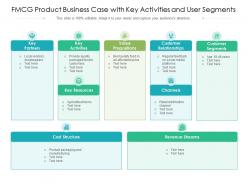
Fmcg product business case with key activities and user segments





Try Before you Buy Download Free Sample Product
 Impress Your
Audience
 100%
Editable
 Save Hours
of Time


Our FMCG Product Business Case With Key Activities And User Segments are topically designed to provide an attractive backdrop to any subject. Use them to look like a presentation pro.
People who downloaded this PowerPoint presentation also viewed the following :
Fmcg product business case with key activities and user segments with all 2 slides:
Use our FMCG Product Business Case With Key Activities And User Segments to effectively help you save your valuable time. They are readymade to fit into any presentation structure.

FAQs for Fmcg product business case with key activities
Key strategies for FMCG market entry include competitive pricing, strategic distribution partnerships, targeted consumer segmentation, brand positioning, and localized product adaptation. These approaches enable companies to establish market presence by leveraging retail networks, understanding consumer preferences, and building brand recognition, with many organizations finding that combining digital marketing with traditional distribution channels delivers faster market penetration and sustainable competitive advantage.
FMCG companies can leverage consumer insights through market research analytics, social media monitoring, purchase behavior analysis, focus groups, and predictive modeling to inform product development decisions. These data-driven approaches enable brands to identify emerging trends, optimize formulations, and develop targeted products that resonate with specific demographics, ultimately delivering faster time-to-market and enhanced competitive positioning.
Digital marketing enables FMCG brands to achieve targeted customer engagement, real-time market insights, cost-effective advertising, enhanced brand visibility, and data-driven decision making. Through social media campaigns, influencer partnerships, and personalized content strategies, companies like Unilever and Nestlé streamline customer acquisition while reducing traditional advertising costs, ultimately delivering faster market penetration and stronger consumer loyalty.
Sustainability is increasingly critical in FMCG, driving consumer loyalty, regulatory compliance, and operational efficiency through eco-friendly packaging, supply chain optimization, and waste reduction initiatives. Companies like Unilever and P&G integrate sustainable sourcing, renewable energy, and circular economy principles into their operations, ultimately delivering cost savings, enhanced brand reputation, and competitive advantage in an environmentally conscious marketplace.
FMCG supply chain challenges include demand volatility, inventory optimization, multi-tier supplier coordination, cold chain requirements, and regulatory compliance across diverse markets. These complexities are amplified by seasonal fluctuations and perishable goods management, with many retailers and manufacturers finding that streamlined technology integration and strategic partnerships ultimately deliver enhanced efficiency and competitive advantage.
Data analytics enhances FMCG sales forecasting by analyzing historical sales patterns, seasonal trends, consumer behavior data, market conditions, and promotional impacts to generate more accurate predictions. Through machine learning algorithms and predictive modeling, companies like Unilever and Nestlé streamline inventory management, optimize production planning, and reduce stockouts, ultimately delivering improved supply chain efficiency and enhanced customer satisfaction.
Consumer behavior significantly impacts FMCG pricing strategies through demand elasticity, brand loyalty patterns, price sensitivity analysis, and purchasing frequency data. This behavioral insight enables companies to implement dynamic pricing, premium positioning for loyal segments, and promotional strategies that maximize revenue while maintaining market share, with many retailers finding that data-driven pricing approaches enhance both customer satisfaction and profitability.
Effective promotional strategies for new FMCG products include sampling campaigns, digital advertising, influencer partnerships, trade promotions, and strategic retail placement. These approaches work by building brand awareness, encouraging trial purchases, and securing shelf space, with many consumer goods companies finding that integrated campaigns combining in-store experiences with social media engagement ultimately deliver faster market penetration and stronger initial sales momentum.
FMCG brands build long-term customer loyalty through personalized experiences, consistent quality delivery, omnichannel engagement strategies, and value-driven brand positioning that resonates with consumer lifestyles. By leveraging data analytics for targeted campaigns, implementing loyalty programs, and maintaining transparent communication, brands like Unilever and P&G create emotional connections that transcend price competition, ultimately delivering sustained market share and enhanced customer lifetime value.
Key trends shaping FMCG's future include sustainability initiatives, direct-to-consumer channels, personalized products, AI-driven supply chains, and health-conscious formulations. These developments enable brands to enhance customer engagement, streamline operations, and reduce environmental impact, with companies like Unilever and P&G finding that sustainable packaging and data analytics ultimately deliver competitive advantage in an increasingly conscious marketplace.
Omnichannel retail strategies influence FMCG purchasing decisions by creating seamless customer experiences across digital and physical touchpoints, personalizing product recommendations through data integration, and enabling convenient shopping options like click-and-collect or same-day delivery. These strategies enhance consumer engagement and loyalty, with many retailers finding that synchronized inventory, targeted promotions, and consistent messaging across channels ultimately drive higher conversion rates and increased basket values.
Packaging innovations enhance FMCG product appeal by improving visual aesthetics, ensuring product freshness, providing convenience features, and supporting sustainability goals. These strategic enhancements drive consumer purchasing decisions through eye-catching designs, resealable formats, and eco-friendly materials, with many brands finding that innovative packaging significantly differentiates products and builds customer loyalty.
Partnerships and collaborations enable FMCG companies to access new distribution channels, leverage complementary brand strengths, share marketing costs, and penetrate untapped geographic markets more efficiently. Through strategic alliances with retailers, logistics providers, and local distributors, companies like Unilever and Nestlé streamline market entry, reduce operational risks, and accelerate growth while delivering enhanced consumer reach and competitive advantage.
E-commerce growth presents both significant challenges and opportunities for traditional FMCG retailers, requiring strategic digital transformation, omnichannel integration, and enhanced supply chain capabilities. While many retailers face increased competition and margin pressure, those adapting successfully streamline operations, expand market reach, and deliver superior customer experiences, ultimately gaining competitive advantage in an increasingly digital marketplace.
Regulatory challenges in FMCG vary significantly across regions, with Europe emphasizing strict labeling and sustainability standards, Asia-Pacific focusing on import restrictions and local content requirements, and North America prioritizing FDA compliance and safety protocols. These regional variations require FMCG companies to develop flexible compliance strategies, adapt product formulations for local markets, and maintain robust regulatory teams, ultimately delivering competitive advantage through faster market entry and reduced operational risks.
-
Use of different colors is good. It's simple and attractive.