

Food Fraud Vulnerability Assessment With Mitigation Plan




Try Before you Buy Download Free Sample Product
 Impress Your
Audience
 100%
Editable
 Save Hours
of Time


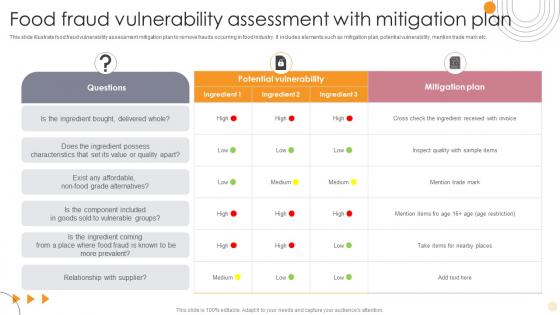
This slide illustrate food fraud vulnerability assessment mitigation plan to remove frauds occurring in food industry. It includes elements such as mitigation plan, potential vulnerability, mention trade mark etc.
People who downloaded this PowerPoint presentation also viewed the following :
Food Fraud Vulnerability Assessment With Mitigation Plan with all 6 slides:
Use our Food Fraud Vulnerability Assessment With Mitigation Plan to effectively help you save your valuable time. They are readymade to fit into any presentation structure.






FAQs for Food Fraud Vulnerability Assessment
The most common types of food fraud include ingredient substitution, dilution, mislabeling, counterfeiting, and adulteration with cheaper alternatives. These fraudulent practices particularly impact high-value sectors like seafood, olive oil, honey, and organic products, with many food manufacturers finding that comprehensive vulnerability assessments help identify risks early, ultimately protecting brand reputation and ensuring consumer safety.
Businesses can identify supply chain vulnerabilities through comprehensive risk mapping, supplier audits, historical data analysis, third-party certifications review, and ingredient traceability assessments. These evaluations help companies pinpoint high-risk suppliers, complex sourcing networks, and economically motivated substitution opportunities, with many food manufacturers finding that regular vulnerability assessments significantly reduce fraud exposure while strengthening supplier relationships.
Technology streamlines food fraud detection through blockchain traceability, DNA testing, spectroscopy analysis, IoT sensors, and AI-powered monitoring systems. These solutions enhance supply chain transparency by tracking ingredients from origin to consumer, automating quality checks, and identifying anomalies in real-time, ultimately delivering faster detection and stronger consumer protection.
Vulnerability assessments integrate into existing food safety programs by incorporating fraud risk evaluation into HACCP plans, supplier audits, and quality control protocols. Companies can embed vulnerability checkpoints throughout their supply chain monitoring, ingredient verification processes, and documentation systems, ultimately enhancing overall food safety frameworks while streamlining compliance and reducing both traditional safety risks and economic fraud exposure.
Assessing raw material authenticity requires implementing supplier verification protocols, conducting regular laboratory testing for chemical markers, establishing traceability systems, and performing physical inspections of incoming ingredients. These verification methods enable food manufacturers to identify potential fraud through spectroscopy analysis, DNA testing, and supply chain audits, with many processors finding that comprehensive authentication programs significantly reduce contamination risks while enhancing consumer trust and regulatory compliance.
Food fraud incidents significantly erode consumer trust by creating uncertainty about product authenticity, safety, and brand reliability, often leading to decreased purchasing behavior and heightened skepticism. Through transparent vulnerability assessments and proactive fraud prevention, food companies can rebuild confidence by demonstrating commitment to quality control, ultimately delivering enhanced brand loyalty and competitive advantage in increasingly trust-conscious markets.
Food fraud carries significant legal implications including regulatory penalties, product recalls, consumer lawsuits, criminal charges, and severe reputational damage that can devastate market position. Companies mitigate these risks through comprehensive supply chain auditing, robust authentication testing, detailed documentation systems, and proactive compliance programs, with many food manufacturers finding that strategic vulnerability assessments ultimately deliver enhanced consumer trust and competitive advantage.
Cultural differences in food production and labeling significantly increase fraud vulnerability by creating inconsistent standards, varying regulatory frameworks, and diverse consumer expectations across regions. These disparities enable fraudsters to exploit gaps between markets, with products from countries having less stringent oversight often mislabeled when entering stricter regulatory environments, ultimately requiring harmonized international standards and enhanced cross-border verification systems.
Staff conducting food fraud vulnerability assessments require comprehensive training in risk analysis methodologies, supply chain mapping, fraud detection techniques, regulatory compliance standards, and data analysis tools. Organizations should provide access to industry databases, fraud incident reports, supplier verification systems, and specialized software platforms, with many food companies finding that cross-functional training combining quality assurance, procurement, and security expertise delivers more thorough assessments and stronger fraud prevention strategies.
Inter-organizational collaboration combats food fraud by enabling shared intelligence networks, coordinated monitoring systems, and standardized verification protocols across supply chains. Through strategic partnerships between manufacturers, retailers, regulators, and testing laboratories, organizations enhance detection capabilities, reduce response times, and strengthen traceability measures, ultimately delivering comprehensive fraud prevention and improved consumer safety across the food industry.
Food fraud regulatory frameworks include FDA's Food Safety Modernization Act, EU's Food Information Regulation, Codex Alimentarius standards, GFSI benchmarked schemes, and national traceability requirements. These frameworks influence vulnerability assessments by establishing mandatory hazard analysis protocols, requiring supply chain transparency documentation, and mandating regular risk evaluations, with many food manufacturers finding that compliance-driven assessments ultimately deliver enhanced brand protection and consumer trust.
Small businesses can assess food fraud risk through supplier questionnaires, industry fraud databases, basic supply chain mapping, and joining food safety networks for shared intelligence. These cost-effective approaches enable restaurants, local grocers, and food manufacturers to identify vulnerable ingredients, verify supplier credentials, and implement targeted monitoring, ultimately protecting brand reputation while avoiding expensive third-party audits.
Third-party auditing provides independent verification of food fraud vulnerability assessments through objective supply chain evaluations, documentation reviews, and compliance monitoring. These audits enhance credibility by validating internal assessments, identifying blind spots in fraud prevention strategies, and ensuring regulatory compliance, with many food manufacturers finding that external auditing delivers greater stakeholder confidence and comprehensive risk mitigation.
Consumer feedback can identify potential food fraud risks through taste, texture, packaging inconsistencies, and unusual pricing patterns reported via surveys, social media monitoring, and complaint analysis systems. This crowdsourced intelligence enables food companies to detect emerging fraud schemes, validate supply chain integrity, and enhance quality control processes, while regulatory agencies increasingly leverage consumer insights to strengthen oversight and protect market authenticity.
**INPUT**: What are the best practices for documenting and reporting food fraud incidents once identified? **OUTPUT**: Best practices include immediate incident documentation, chain of custody preservation, regulatory notification, stakeholder communication, and comprehensive root cause analysis. Through systematic reporting protocols, food companies maintain detailed evidence records, coordinate with authorities like FDA or USDA, and implement corrective measures, ultimately strengthening supply chain integrity and regulatory compliance while minimizing future vulnerabilities.
-
Time saving slide with creative ideas. Help a lot in quick presentations..
-
Definitely recommend SlideTeam to all who need help with PowerPoint presentations. Their design team can create anything you need.