

Food Packaging Industry Technology Evolution




Try Before you Buy Download Free Sample Product
 Impress Your
 Audience
 100%
100% Editable
 Save Hours
 of Time


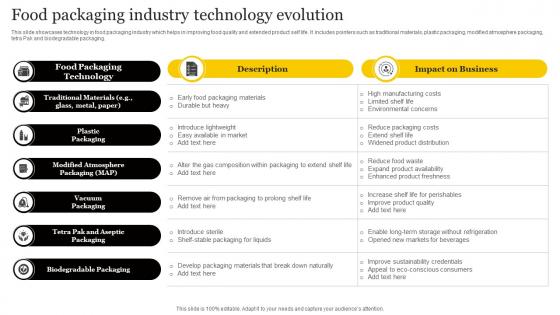
This slide showcases technology in food packaging industry which helps in improving food quality and extended product self life. It includes pointers such as traditional materials, plastic packaging, modified atmosphere packaging, tetra Pak and biodegradable packaging.
People who downloaded this PowerPoint presentation also viewed the following :
Food Packaging Industry Technology Evolution with all 9 slides:
Use our Food Packaging Industry Technology Evolution to effectively help you save your valuable time. They are readymade to fit into any presentation structure.








FAQs for Food Packaging
Key milestones include vacuum packaging (1940s), aluminum cans (1950s), plastic containers (1960s), microwave-safe materials (1970s), aseptic packaging (1980s), and smart packaging with sensors (2000s). These innovations have revolutionized food preservation, distribution, and consumer convenience across retail, restaurant, and manufacturing sectors, ultimately delivering extended shelf life, reduced waste, and enhanced food safety in an increasingly global marketplace.
Material science advancements have revolutionized food packaging through biodegradable polymers, smart barrier films, active packaging systems, nanotechnology applications, and antimicrobial coatings. These innovations enhance product shelf life, reduce environmental impact, and improve food safety, with grocery retailers and food manufacturers finding that advanced materials deliver significant cost savings while meeting increasingly stringent sustainability requirements.
Sustainable packaging drives food packaging technology's future through biodegradable materials, reduced plastic waste, enhanced recyclability, and circular economy principles. These innovations enable food manufacturers to meet consumer environmental demands, comply with regulatory requirements, and reduce operational costs, while retailers increasingly find that eco-friendly packaging delivers competitive advantage and improved brand loyalty.
Minimalism in food packaging has revolutionized preservation strategies by emphasizing smarter materials, advanced barrier technologies, and strategic design optimization rather than excessive layers. Through biodegradable films, nano-coatings, and vacuum-sealing innovations, food manufacturers streamline packaging while enhancing shelf life, reducing waste, and delivering superior freshness, with many retailers finding that minimalist approaches ultimately boost both sustainability credentials and consumer appeal.
Smart packaging technologies have revolutionized food storage and consumption through active packaging systems, intelligent sensors, time-temperature indicators, modified atmosphere packaging, and interactive QR codes. These innovations enhance food safety by monitoring freshness in real-time, extending shelf life through controlled environments, and providing consumers with detailed product information, while enabling retailers to minimize waste and deliver superior customer experiences in an increasingly competitive marketplace.
Government regulations significantly shape food packaging technology development by establishing safety standards, material restrictions, environmental compliance requirements, and labeling mandates that manufacturers must meet before market entry. While these regulations can slow initial implementation, they ultimately drive innovation toward safer, more sustainable solutions, with companies in pharmaceuticals, dairy, and processed foods finding that regulatory compliance often delivers enhanced consumer trust, reduced liability risks, and competitive advantages in increasingly health-conscious markets.
Innovations reducing food waste include smart packaging with sensors monitoring freshness, modified atmosphere packaging extending shelf life, edible coatings, vacuum sealing technology, and biodegradable materials with enhanced barrier properties. These technologies streamline supply chains by providing real-time spoilage alerts, extending product lifecycles, and enabling better inventory management, with grocery retailers and food manufacturers finding significantly reduced waste and improved profitability.
Biodegradable and compostable materials are revolutionizing food packaging by reducing environmental impact, meeting consumer sustainability demands, and enabling circular economy practices. These innovations streamline waste management processes while delivering cost-effective solutions, with many food manufacturers, restaurants, and retail chains finding that sustainable packaging enhances brand reputation and customer loyalty in an increasingly eco-conscious marketplace.
Manufacturers face cost increases, supply chain disruptions, performance concerns, regulatory compliance requirements, and consumer acceptance challenges when transitioning to eco-friendly packaging solutions. While sustainable materials often cost more initially, many food companies find that streamlined operations, enhanced brand reputation, and meeting regulatory demands ultimately deliver competitive advantages and improved customer loyalty.
Consumer awareness has significantly shaped food packaging evolution by driving demand for sustainable materials, transparent labeling, convenience features, and health-conscious designs. With consumers increasingly prioritizing environmental impact and product transparency, companies have developed biodegradable packaging, clear ingredient displays, and innovative preservation technologies, ultimately delivering enhanced brand loyalty and competitive advantage in an increasingly conscious marketplace.
Digital printing technology has revolutionized food packaging by enabling on-demand customization, shorter production runs, variable data printing, and rapid prototyping capabilities. Through advanced inkjet and digital systems, food brands streamline personalized packaging, seasonal campaigns, and regional variations, while reducing waste and inventory costs, ultimately delivering enhanced consumer engagement and faster time-to-market advantages.
Food safety and packaging integrity are integrated through barrier technologies, antimicrobial coatings, smart sensors, tamper-evident seals, and traceability systems that monitor contamination and freshness throughout distribution. These design practices enable manufacturers to deliver extended shelf life, reduce food waste, and enhance consumer confidence, with pharmaceutical and fresh produce sectors finding that integrated safety technologies ultimately streamline compliance while delivering superior protection.
Future food packaging technologies include smart sensors for real-time freshness monitoring, biodegradable nanomaterials, active packaging with antimicrobial properties, edible coatings, and blockchain-integrated traceability systems. These innovations streamline supply chain transparency, enhance food safety, and minimize environmental impact, with retail chains and food manufacturers increasingly finding that smart packaging delivers operational efficiency while meeting consumer demands for sustainability and quality assurance.
Consumer trends towards convenience have revolutionized food packaging through resealable closures, portion-controlled formats, microwave-safe materials, easy-open features, and on-the-go designs. These innovations streamline meal preparation, enhance product freshness, and deliver better user experiences, with retailers increasingly finding that convenience-focused packaging drives customer loyalty and competitive advantage in today's fast-paced marketplace.
Packaging suppliers drive food industry innovation by developing sustainable materials, smart packaging technologies, barrier solutions, and automation systems that extend shelf life and enhance consumer experiences. Through strategic partnerships with food manufacturers, suppliers enable cost reduction, improved food safety, and competitive differentiation, with many companies finding that supplier collaboration accelerates time-to-market for innovative products.
-
Use of different colors is good. It's simple and attractive.
-
SlideTeam never fails to surprise me with its amazing PPT designs. Thanks team for providing me with your constant support!