

Footfall Analysis To Evaluate Shopping Center Execution Of Mall Loyalty Program To Attract Customer MKT SS V




Try Before you Buy Download Free Sample Product
 Impress Your
Audience
 100%
Editable
 Save Hours
of Time


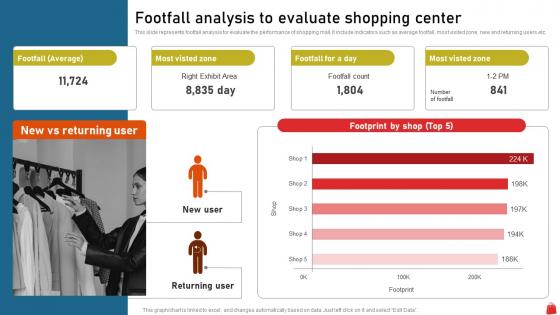
This slide represents footfall analysis for evaluate the performance of shopping mall. It include indicators such as average footfall, most visited zone, new and returning users etc.
People who downloaded this PowerPoint presentation also viewed the following :
Footfall Analysis To Evaluate Shopping Center Execution Of Mall Loyalty Program To Attract Customer MKT SS V with all 10 slides:
Use our Footfall Analysis To Evaluate Shopping Center Execution Of Mall Loyalty Program To Attract Customer MKT SS V to effectively help you save your valuable time. They are readymade to fit into any presentation structure.










FAQs for Footfall Analysis To Evaluate Shopping Center Execution Of Mall Loyalty Program To Attract Customer
Key footfall metrics include visitor count, dwell time, conversion rates, peak traffic hours, zone popularity, repeat visitor frequency, and customer journey paths. These analytics enable retailers to optimize store layouts, staffing schedules, and product placements, with many retail chains finding that strategic footfall analysis delivers enhanced customer experiences and significantly improved sales performance.
Footfall analysis impacts store layout by revealing customer movement patterns, high-traffic zones, dwell times, and conversion hotspots throughout retail spaces. Through heat mapping and path tracking technologies, retailers optimize product placement, enhance checkout positioning, and redesign navigation flows, with many stores finding that strategic layout adjustments boost sales conversion rates and customer engagement significantly.
Technologies for capturing footfall data include Wi-Fi tracking, Bluetooth beacons, thermal sensors, video analytics, mobile app GPS, and infrared counters. These solutions enhance retail operations by providing real-time visitor insights, optimizing staff allocation, and measuring marketing campaign effectiveness, with many retailers finding that strategic footfall analysis ultimately delivers improved customer experiences and increased operational efficiency.
Footfall analysis helps optimize staff allocation by identifying peak traffic patterns, predicting customer volumes, and mapping high-demand areas within retail spaces. Through real-time data tracking, retailers can strategically position staff during busy periods, reduce customer wait times, and enhance service quality, with many stores finding that data-driven scheduling improves operational efficiency while significantly boosting customer satisfaction.
Footfall analysis reveals customer behavior patterns through traffic flow tracking, dwell time measurement, peak hour identification, zone popularity assessment, and conversion rate analysis. These insights enable retailers to optimize store layouts, staffing schedules, and product placement strategies, while enhancing customer experiences and maximizing revenue potential across different retail environments.
Footfall trends can be accurately predicted by analyzing historical patterns through seasonal variations, day-of-week fluctuations, weather correlations, and event-driven spikes using advanced analytics and machine learning algorithms. These predictive models enable retailers, shopping centers, and transportation hubs to optimize staffing levels, inventory management, and operational resources, ultimately delivering improved customer experiences and reduced operational costs while maximizing revenue opportunities.
Outdoor footfall collection faces weather interference, GPS accuracy limitations, and privacy regulations, while indoor environments present Wi-Fi signal inconsistencies, complex layouts, and device detection challenges. However, retailers and venue operators increasingly find that combining multiple technologies like sensors, cameras, and mobile analytics delivers comprehensive insights, with many shopping centers and outdoor retail spaces successfully overcoming these obstacles through strategic technology integration.
Footfall analysis informs marketing strategies by identifying peak traffic periods, customer flow patterns, demographic insights, and promotional effectiveness metrics. This data enables retailers to optimize campaign timing, targeted promotions, and resource allocation, with many businesses finding that strategic placement and scheduling based on footfall trends ultimately delivers higher conversion rates and improved ROI.
Footfall analysis presents both privacy and consent challenges, requiring transparent data collection policies, anonymization protocols, secure storage practices, and clear customer notifications about tracking methods. While retailers increasingly leverage these insights for operational efficiency, ethical implementation involves balancing business intelligence needs with individual privacy rights, ultimately delivering better customer experiences without compromising personal data security.
Footfall analysis measures retail campaign success by tracking visitor numbers, dwell times, conversion rates, and peak traffic patterns before, during, and after campaigns. Through location analytics and customer journey mapping, retailers can correlate marketing efforts with actual store visits, optimize promotional timing, and calculate campaign ROI, ultimately delivering data-driven insights that enhance future marketing strategies.
Footfall patterns directly influence conversion rates by revealing customer behavior, peak traffic times, dwell duration, navigation paths, and purchase intent indicators. Through advanced analytics, retailers can optimize store layouts, staffing schedules, and promotional timing, with many finding that strategic placement of high-conversion products in heavy-traffic areas significantly enhances sales performance.
Footfall analysis integrates with sales and inventory data through advanced analytics platforms that combine customer traffic patterns, purchase behaviors, and stock levels in real-time dashboards. Retailers use this strategic combination to optimize staffing during peak hours, adjust inventory based on traffic forecasts, and identify conversion opportunities, ultimately delivering enhanced operational efficiency and improved customer experiences.
Footfall analysis provides insights into customer behavior patterns, peak traffic times, popular store areas, dwell duration, and conversion rates across different zones. Through heat mapping and movement tracking, retailers can optimize store layouts, staff allocation, and product placement strategies, while identifying bottlenecks and underutilized spaces, ultimately enhancing customer flow and shopping experiences.
Cultural and regional differences significantly impact footfall patterns through varying shopping behaviors, seasonal preferences, holiday calendars, and social customs across markets. International retailers must adapt store hours, peak-day strategies, and customer flow management to local patterns, with many finding that Asian markets favor evening shopping while European customers prefer weekend visits, ultimately enabling more targeted operational strategies and enhanced customer experiences.
Footfall analysis influences store location decisions by evaluating pedestrian traffic patterns, peak visiting hours, demographic profiles, competitor proximity, and seasonal variations in specific areas. Through comprehensive data analysis, retailers can identify high-potential locations, optimize rent negotiations, and predict revenue potential, with many retail chains finding that data-driven location strategies significantly reduce investment risks while maximizing customer accessibility and sales performance.
-
Exclusive and extensive collection of templates. Really helped me create a professional presentation in just no time.
-
Content of slide is easy to understand and edit.