

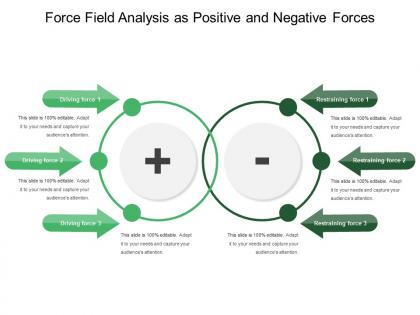
Force field analysis as positive and negative forces




Try Before you Buy Download Free Sample Product
 Impress Your
 Audience
 100%
100% Editable
 Save Hours
 of Time


Gain a greater dimension with our Force Field Analysis As Positive And Negative Forces. Your efforts will have a broader effect.
People who downloaded this PowerPoint presentation also viewed the following :
Force field analysis as positive and negative forces with all 5 slides:
Chances of good fortune are few and far between. Our Force Field Analysis As Positive And Negative Forces allow you to grab them all.




FAQs for Force field analysis as positive
Force field analysis in strategic planning includes driving forces, restraining forces, current state assessment, desired future state, and force strength evaluation. These components work together by identifying change enablers, mapping resistance points, and prioritizing interventions, with many organizations finding that this systematic approach streamlines decision-making and enhances strategic implementation success.
Force field analysis focuses specifically on driving and restraining forces affecting a proposed change, while SWOT analysis examines internal strengths, weaknesses, and external opportunities, threats more broadly. Force field analysis provides targeted change management insights by quantifying resistance and support factors, enabling organizations to develop specific strategies for overcoming barriers and leveraging momentum, ultimately delivering more focused implementation planning than SWOT's general strategic assessment.
Force field analysis proves most beneficial when organizations face complex change initiatives, strategic decisions, or process improvements where multiple competing factors exist. It's particularly valuable during mergers, technology implementations, or policy changes, with many companies finding that systematically mapping driving and restraining forces enables better stakeholder alignment, resource allocation, and ultimately delivers more successful change outcomes.
Force field analysis proves highly effective for personal development by identifying driving forces that support goals and restraining forces that create obstacles, enabling individuals to strategically strengthen motivators while addressing barriers. Career professionals, students, and entrepreneurs increasingly use this framework to navigate challenges like skill development, habit formation, and life transitions, ultimately delivering clearer self-awareness and more strategic personal growth approaches.
Stakeholder involvement ensures comprehensive identification of driving and restraining forces, provides diverse perspectives on change impacts, and builds crucial buy-in for implementation strategies. Through collaborative workshops and structured interviews, organizations gather authentic insights from employees, customers, and partners, while simultaneously creating ownership and reducing resistance to proposed changes.
Organizations identify driving and restraining forces through stakeholder interviews, data analysis, brainstorming sessions, and systematic evaluation frameworks that assess impact and influence levels. These methods enable teams to map internal capabilities, external market pressures, resource constraints, and competitive advantages, with many finding that comprehensive force identification streamlines decision-making and ultimately delivers more strategic, sustainable organizational changes.
Quantification techniques include numerical scoring systems, weighted ranking matrices, stakeholder impact assessments, probability-outcome calculations, and cost-benefit analyses for each force. These methods enable organizations to prioritize change strategies systematically, with many consulting firms and project management teams finding that structured scoring delivers clearer resource allocation decisions and more strategic implementation roadmaps.
Cultural factors significantly influence force field analysis by shaping how stakeholders perceive driving and restraining forces, communicate feedback, and prioritize change initiatives based on organizational values and behavioral norms. In multinational corporations and diverse teams, cultural differences affect risk tolerance, decision-making processes, and resistance patterns, with many organizations finding that culturally-aware analyses deliver more accurate assessments and sustainable implementation strategies.
Common pitfalls include oversimplifying complex forces, failing to quantify their relative strengths, ignoring stakeholder perspectives, and focusing only on obvious factors while missing subtle influences. Organizations often rush the analysis without adequate research or stakeholder input, with many finding that successful force field analysis requires diverse team involvement, regular updates as conditions change, and balanced consideration of both internal capabilities and external market pressures to ensure strategic accuracy.
Technology enhances force field analysis effectiveness by automating data collection, providing real-time visualization dashboards, and enabling collaborative input from distributed teams. Advanced analytics platforms can identify hidden patterns in driving and restraining forces, while AI-powered tools help predict outcomes and simulate scenarios, ultimately delivering faster decision-making and more accurate strategic planning for organizations.
Force field analysis facilitates change management by identifying driving and restraining forces, mapping stakeholder positions, assessing resource requirements, and revealing potential resistance points before implementation begins. Through systematic evaluation of these factors, organizations can develop targeted strategies to strengthen supportive forces while addressing barriers, ultimately enabling smoother transitions and higher success rates across departments.
Organizations can strengthen driving forces through strategic resource allocation, stakeholder engagement initiatives, process optimization, training programs, and communication enhancement strategies. These approaches work by amplifying positive momentum, securing leadership buy-in, and removing operational barriers, with many companies finding that systematically reinforcing identified drivers accelerates change implementation and delivers sustained competitive advantage.
Visualization tools enhance force field analysis understanding by transforming complex data into clear charts, graphs, and interactive dashboards that highlight driving and restraining forces. These visual representations enable stakeholders to quickly identify force magnitudes, relationships, and patterns, with many organizations finding that visual force field maps facilitate better strategic decision-making and stakeholder alignment.
Force field analysis serves as a foundational tool within organizational change theory, providing a systematic framework for identifying driving forces that support change and restraining forces that resist it. This relationship enables change managers to strategically address barriers, leverage supportive elements, and create sustainable transformation plans, with many organizations finding that this structured approach significantly enhances their change success rates and minimizes implementation resistance.
Force field analysis insights inform strategic initiatives by identifying recurring patterns in driving and restraining forces, revealing organizational change capacity, and highlighting critical stakeholder influence points. These strategic assessments enable leadership teams to proactively design change management approaches, allocate resources more effectively, and build coalition support, with many organizations finding that systematic force mapping significantly improves initiative success rates.
-
Presentation Design is very nice, good work with the content as well.
-
Good research work and creative work done on every template.