

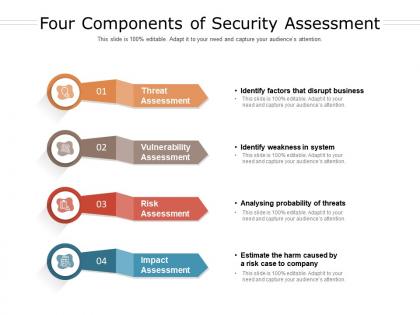
Four components of security assessment




Try Before you Buy Download Free Sample Product
 Impress Your
Audience
 100%
Editable
 Save Hours
of Time


Our Four Components Of Security Assessment are explicit and effective. They combine clarity and concise expression.
People who downloaded this PowerPoint presentation also viewed the following :
Four components of security assessment with all 2 slides:
Give your audience a fulfilling experience. They will find our Four Components Of Security Assessment elevating.


FAQs for Four components
**INPUT**: What are the key components involved in a comprehensive security assessment? **OUTPUT**: Key components include vulnerability scanning, penetration testing, risk analysis, compliance auditing, and threat modeling processes. These assessments streamline security by identifying weaknesses, evaluating potential impacts, and prioritizing remediation efforts, with many organizations finding that comprehensive evaluations ultimately deliver enhanced protection and regulatory compliance across their operations. [Word count: 50 words]
Organizations effectively prioritize risks by evaluating likelihood, potential impact, exploitability, and business criticality of each vulnerability identified during assessment. Through risk matrices and scoring frameworks, companies across sectors like banking, healthcare, and retail can systematically address high-severity threats first, ultimately ensuring optimal resource allocation and strengthened security posture.
Threat modeling serves as a foundational component that systematically identifies potential attack vectors, assesses vulnerabilities across systems and processes, and prioritizes security risks based on their likelihood and impact. This proactive approach enables organizations to allocate resources strategically, implement targeted countermeasures, and strengthen defenses before incidents occur, ultimately delivering enhanced security posture and reduced operational risk.
Compliance requirements significantly shape security assessment components by mandating specific controls, documentation standards, audit trails, and reporting frameworks aligned with regulations like GDPR, HIPAA, or SOX. These requirements drive organizations to incorporate specialized vulnerability scanning, risk categorization, and remediation tracking into their assessments, ultimately ensuring regulatory adherence while strengthening overall security posture and operational resilience.
**INPUT**: What methods can be employed to gather information for a security assessment? **OUTPUT**: Information gathering methods for security assessments include network scanning, vulnerability assessments, penetration testing, social engineering evaluation, and compliance audits. These techniques enable organizations to identify system weaknesses, assess threat vectors, and evaluate security controls, with many financial institutions and healthcare providers finding that comprehensive assessments ultimately deliver enhanced protection and regulatory compliance. **Word count: 54 words**
Vulnerability scanning uses automated tools to identify known security weaknesses across systems, while penetration testing involves manual exploitation attempts to simulate real-world attacks. Through automated scanning, organizations quickly catalog potential vulnerabilities across their infrastructure, while penetration testing validates actual exploitability and business impact, ultimately delivering comprehensive security insights that enhance both defensive capabilities and strategic risk management.
Incorporating automated tools into security assessment processes delivers faster vulnerability detection, continuous monitoring capabilities, comprehensive coverage across complex systems, reduced human error, and significant cost efficiencies. These technologies streamline security operations by enabling real-time threat identification, scaling assessments across enterprise environments, and freeing security teams to focus on strategic analysis, ultimately delivering enhanced protection and operational efficiency.
Organizations ensure security assessment relevance by conducting regular reviews, updating threat models to reflect emerging risks, and incorporating new technologies and vulnerabilities into their evaluation frameworks. Through continuous monitoring, periodic reassessment schedules, and integration with threat intelligence feeds, companies maintain current security postures while adapting to evolving cyber landscapes, ultimately delivering sustained protection and competitive advantage.
**INPUT**: What steps should be taken to validate the findings of a security assessment? **OUTPUT**: Validating security assessment findings requires independent verification through penetration testing, cross-referencing with multiple scanning tools, and confirming vulnerabilities through manual testing. Organizations should engage third-party security experts, compare results against industry benchmarks, and conduct stakeholder reviews, ultimately ensuring accurate risk prioritization and effective remediation strategies.
Security assessments help address insider threats by implementing behavior analytics, access monitoring, privilege reviews, and anomaly detection systems that identify suspicious activities from within organizations. Through continuous monitoring and risk profiling, companies can detect unusual data access patterns, unauthorized system usage, and policy violations early, while establishing stronger access controls and employee vetting processes that ultimately minimize internal security risks.
Common security assessment challenges include incomplete asset inventories, legacy system vulnerabilities, limited resources, stakeholder resistance, and complex regulatory requirements. These obstacles can be mitigated through automated discovery tools, phased assessment approaches, and comprehensive documentation strategies, with many organizations finding that proactive planning and cross-departmental collaboration ultimately streamline processes while enhancing overall security posture.
Organizations should conduct comprehensive security assessments annually, with quarterly reviews of critical systems, monthly vulnerability scans, and continuous monitoring of high-risk assets. This layered approach enables businesses to identify emerging threats, address vulnerabilities proactively, and maintain regulatory compliance, while many financial institutions and healthcare organizations find that frequent assessments significantly reduce breach risks and enhance operational resilience.
A comprehensive security assessment report should include executive summary, vulnerability analysis, risk prioritization matrix, compliance status evaluation, network architecture review, and detailed remediation recommendations. These components work together by providing stakeholders with actionable insights, clear risk context, and strategic implementation pathways, with many organizations finding that structured reporting accelerates security improvements and demonstrates measurable compliance progress.
Organizational culture and employee training significantly impact security assessment effectiveness by determining staff cooperation levels, security awareness depth, and incident reporting accuracy. Organizations with strong security cultures and comprehensive training programs typically reveal more vulnerabilities during assessments, enable faster remediation implementation, and achieve better long-term security outcomes, ultimately strengthening their overall risk management capabilities.
Organizations should adapt security assessments by implementing continuous monitoring, threat intelligence integration, automated vulnerability scanning, regular penetration testing, and behavioral analytics to detect emerging attack patterns. Through dynamic assessment frameworks, companies can identify zero-day vulnerabilities, advanced persistent threats, and social engineering tactics, while updating security protocols quarterly, ultimately maintaining robust defenses against sophisticated cybercriminals targeting modern business infrastructures.
No Reviews