

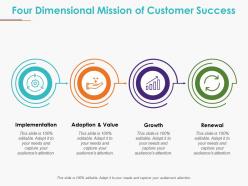
Four dimensional mission of customer success ppt examples professional





Try Before you Buy Download Free Sample Product
 Impress Your
Audience
 100%
Editable
 Save Hours
of Time


Identify factual elements with our Four Dimensional Mission Of Customer Success Ppt Examples Professional. Ensure you display authenticated information.
People who downloaded this PowerPoint presentation also viewed the following :
Four dimensional mission of customer success ppt examples professional with all 5 slides:
Our Four Dimensional Mission Of Customer Success Ppt Examples Professional guarantee applause. The audience will definitely clap for you.


FAQs for Four dimensional mission of customer success
A successful four-dimensional customer success strategy encompasses proactive relationship management, data-driven health monitoring, strategic value delivery, and continuous lifecycle optimization. These interconnected components enable organizations to anticipate customer needs, prevent churn through predictive analytics, and scale retention efforts, with many SaaS companies finding that this holistic approach ultimately delivers higher renewal rates and expanded revenue opportunities.
Organizations measure customer success effectiveness through comprehensive metrics spanning operational KPIs like retention rates and health scores, financial indicators including revenue expansion and lifetime value, relationship assessments via satisfaction surveys and engagement tracking, and strategic evaluations of market positioning. Through integrated analytics dashboards, companies can correlate cross-dimensional performance, with many finding that balanced measurement across all four dimensions delivers deeper customer insights and sustainable competitive advantage.
Data analytics serves as the foundation for all four dimensions by enabling predictive insights, personalized experiences, proactive issue resolution, and strategic decision-making. Through advanced analytics platforms, organizations can identify at-risk accounts, optimize onboarding processes, and measure success metrics across touchpoints, ultimately delivering enhanced customer retention and expanding revenue opportunities while streamlining operational efficiency.
Customer journey mapping within the four dimensions involves analyzing touchpoints across acquisition, onboarding, expansion, and retention phases, identifying pain points, moments of value delivery, and emotional transitions at each stage. This comprehensive approach enables organizations to visualize customer experiences holistically, optimize interventions strategically, and align resources effectively, with many companies finding that dimensional mapping reduces churn while accelerating expansion opportunities.
Common challenges include aligning cross-functional teams around unified customer metrics, integrating disparate data sources for comprehensive customer insights, scaling personalized engagement across growing customer bases, and balancing proactive outreach with operational efficiency. These implementation hurdles often require significant cultural shifts and technology investments, with many organizations finding that gradual deployment across specific customer segments delivers measurable improvements in retention rates and expansion revenue while building internal capabilities.
Technology supports the four dimensions of customer success through automation, analytics, personalization platforms, and integration tools that streamline onboarding, enhance ongoing support, and predict customer needs. These solutions enable businesses to deliver proactive engagement, faster issue resolution, and data-driven insights across all touchpoints, with many organizations finding that strategic technology implementation ultimately reduces churn while accelerating customer growth and satisfaction.
Best practices for aligning customer success teams include establishing shared metrics across departments, implementing regular cross-functional meetings, creating unified customer journey mapping, and developing integrated communication workflows. Through strategic coordination between sales, marketing, support, and product teams, organizations streamline customer experiences, reduce operational silos, and enhance retention rates, with many companies finding that this four-dimensional approach ultimately delivers stronger customer relationships and accelerated revenue growth.
Customer feedback loops contribute to the four-dimensional mission by enabling continuous improvement across onboarding, adoption, retention, and expansion phases through real-time insights, sentiment analysis, and behavioral data collection. These loops streamline issue resolution, enhance product development, and deliver proactive support strategies, with many organizations finding that systematic feedback integration ultimately drives higher satisfaction scores, reduces churn rates, and accelerates revenue growth.
Customer success managers in a four-dimensional framework require analytical skills for data interpretation, communication abilities for stakeholder engagement, strategic thinking for long-term planning, and technical proficiency for platform management. These competencies enable managers to navigate customer health monitoring, relationship building, growth identification, and retention strategies simultaneously, with many organizations finding that this skill combination ultimately delivers enhanced customer experiences and sustainable revenue growth.
A four-dimensional customer success approach improves retention by addressing customer health metrics, proactive engagement strategies, value realization tracking, and predictive analytics simultaneously, creating comprehensive visibility into customer lifecycle stages. This strategic combination enables organizations to identify at-risk accounts earlier, deliver personalized interventions, and demonstrate measurable value consistently, with many companies finding that integrated approaches reduce churn rates by 25-40% while enhancing long-term customer relationships.
Customer lifetime value integrates into the four-dimensional customer success mission by informing retention strategies, guiding expansion opportunities, measuring long-term relationship health, and driving proactive engagement initiatives. This strategic combination enables organizations to prioritize high-value accounts, optimize resource allocation, and deliver personalized experiences, with many companies finding that CLV-driven approaches ultimately enhance customer satisfaction while maximizing revenue growth and competitive advantage.
Innovative customer engagement strategies include personalized onboarding journeys, proactive health scoring systems, gamified product adoption programs, AI-powered recommendation engines, and community-driven success platforms. These approaches enhance engagement by delivering tailored experiences, predicting customer needs, and fostering peer connections, with many organizations finding that strategic combination of technology and human touchpoints ultimately drives higher retention and expansion rates.
Organizations can effectively prioritize customer success initiatives by evaluating each opportunity against the four key dimensions: customer health metrics, business impact potential, resource requirements, and strategic alignment with long-term goals. This systematic approach enables companies to focus on high-impact activities that deliver measurable outcomes, with many finding that prioritizing initiatives showing strong cross-dimensional value ultimately drives sustained revenue growth and competitive advantage.
Empathy enables deeper customer understanding, trust-building, and personalized experiences across all four dimensions of customer success strategy by actively listening, anticipating needs, and responding authentically to concerns. Through empathetic interactions, organizations streamline relationship management, enhance customer satisfaction, and ultimately deliver stronger retention rates, with many companies finding that emotionally connected customers demonstrate significantly higher lifetime value.
Customer education serves as a foundational pillar across all four dimensions by empowering users with knowledge, skills, and best practices needed to maximize product value and achieve desired outcomes. Through comprehensive training programs, resource libraries, and ongoing support initiatives, organizations enhance user adoption, reduce support costs, and accelerate time-to-value, with many companies finding that educated customers demonstrate higher retention rates and expansion opportunities.
-
Best way of representation of the topic.
-
Great product with effective design. Helped a lot in our corporate presentations. Easy to edit and stunning visuals.