

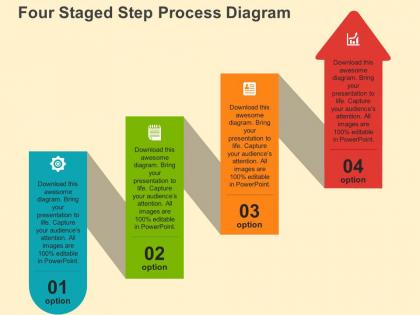
Four staged step process digram flat powerpoint design




Try Before you Buy Download Free Sample Product
 Impress Your
Audience
 100%
Editable
 Save Hours
of Time


Our Four Staged Step Process Digram Flat Powerpoint Design are a contemporary educational aid. They adhere to the current framework.
People who downloaded this PowerPoint presentation also viewed the following :
Four staged step process digram flat powerpoint design with all 4 slides:
Stand out from the crowd. Dynamic Four Staged Step Process Digram Flat Powerpoint Design design lets you make a statement in your presentations.


FAQs for Four staged step process digram
Four-staged step process diagrams enhance presentation clarity by breaking complex workflows into digestible segments, improving audience comprehension, enabling logical flow visualization, and facilitating better decision-making discussions. These visual tools streamline communication across departments, with many organizations finding that structured process diagrams reduce meeting times, increase stakeholder alignment, and ultimately deliver more actionable outcomes in strategic planning sessions.
A four-staged step process diagram enhances audience understanding by breaking complex workflows into digestible sequential phases, creating visual clarity through logical progression, and eliminating cognitive overload that dense text presentations often cause. Organizations across sectors like manufacturing, healthcare, and financial services find that these structured visual frameworks streamline training processes, improve knowledge retention, and enable faster decision-making by presenting intricate procedures in an accessible, step-by-step format.
Four-staged step process diagrams are most commonly utilized in manufacturing, healthcare, software development, project management, and financial services industries. These sectors leverage structured workflows to streamline operations, ensure compliance, and maintain quality control, with many organizations finding that visual process mapping enhances team coordination and reduces operational errors.
Essential elements include clear sequential numbering, descriptive stage titles, visual flow indicators, consistent formatting, and outcome specifications for each phase. These components streamline complex workflows by establishing logical progression, defining measurable milestones, and ensuring stakeholder alignment, with many organizations finding that well-designed process diagrams significantly enhance operational efficiency and reduce implementation errors.
Color theory enhances four-staged step process diagrams by using sequential color schemes, contrasting hues for differentiation, warm-to-cool progressions for flow guidance, and complementary accent colors for emphasis. Through strategic color application, organizations streamline visual communication, reduce cognitive load, and accelerate comprehension across departments, with many finding that consistent color coding ultimately delivers clearer presentations and faster stakeholder decision-making.
Common mistakes include overcomplicating steps with excessive detail, using inconsistent visual formatting across stages, unclear directional flow between phases, and failing to validate the sequence with actual users or stakeholders. These errors undermine diagram effectiveness by creating confusion rather than clarity, with many organizations finding that simple, visually consistent designs with clear progression indicators ultimately deliver better comprehension and smoother process implementation across teams.
The simplicity of a four-staged step process diagram enhances communication by breaking complex workflows into digestible segments, reducing cognitive load, and creating clear visual pathways that audiences can easily follow. This streamlined approach enables teams across industries like manufacturing, healthcare, and project management to quickly grasp sequential operations, minimize misunderstandings, and accelerate decision-making processes, ultimately delivering improved collaboration and operational efficiency.
Recommended software tools for creating four-staged step process diagrams include Microsoft Visio, Lucidchart, Canva, Adobe Illustrator, and PowerPoint. These platforms streamline diagram creation by offering customizable templates, drag-and-drop functionality, and professional formatting options, with many organizations finding that tools like Lucidchart and Canva deliver enhanced collaboration features and brand consistency for strategic presentations.
Storytelling techniques can be integrated by creating narrative flow between stages, using character journeys, conflict-resolution arcs, and emotional progression that guides audiences through each step. This approach transforms static process diagrams into compelling narratives, with many organizations finding that story-driven presentations enhance audience engagement, improve information retention, and ultimately deliver more persuasive business communications.
Four-staged step processes are successfully implemented across software development lifecycles, customer onboarding workflows, quality control procedures, project management methodologies, and strategic planning frameworks. These structured approaches streamline operations by breaking complex initiatives into manageable phases, ensuring consistent execution, and enabling clear progress tracking, with many organizations finding that systematic four-stage processes reduce errors and accelerate project completion.
Audience feedback shapes four-staged step process diagrams by identifying unclear transitions, highlighting missing critical steps, and revealing implementation challenges across different organizational contexts. Through surveys, focus groups, and user testing, presenters can refine visual flow, adjust terminology for specific industries like healthcare or manufacturing, and enhance clarity, ultimately delivering more effective communication tools that resonate with diverse stakeholders.
Typography significantly influences readability, hierarchy, and visual flow in four-staged step process diagrams through strategic font selection, sizing, and spacing. Effective typography guides viewers through sequential steps while ensuring clarity across different presentation contexts, with many organizations finding that consistent typographic choices enhance comprehension, reduce cognitive load, and ultimately deliver more impactful business communications.
A four-staged step process diagram supports project management frameworks by providing clear phase delineation, milestone tracking, resource allocation guidelines, and progress visualization throughout project lifecycles. Through structured visual representation, project managers streamline team communication, enhance stakeholder understanding, and maintain timeline adherence, while enabling systematic risk assessment and deliverable management, ultimately delivering improved project outcomes and organizational efficiency.
**INPUT**: What strategies can be employed to adapt a four-staged step process diagram for virtual presentations? **OUTPUT**: Virtual presentation strategies include progressive disclosure techniques, interactive polling integration, breakout room activities, animated transitions, and audience engagement checkpoints throughout each stage. These approaches enhance comprehension by maintaining viewer attention, facilitating real-time feedback, and creating collaborative touchpoints, with many presenters finding that segmented delivery and strategic pauses ultimately deliver stronger audience retention and participation rates.
**INPUT**: How does the design of a four-staged step process diagram differ for technical versus non-technical audiences? **OUTPUT**: Four-staged process diagrams for technical audiences emphasize detailed specifications, data flows, system integrations, and precise terminology, while non-technical versions prioritize simplified visuals, outcome-focused language, and broader strategic context. Technical diagrams streamline complex workflows through granular detail and operational precision, whereas business-focused designs enhance stakeholder understanding by highlighting key milestones, decision points, and measurable results, ultimately delivering clearer communication across organizational levels.
-
Attractive design and informative presentation.
-
Great product with effective design. Helped a lot in our corporate presentations. Easy to edit and stunning visuals.