

Front End Technologies Of Presentation Layer In Application Architecture




Try Before you Buy Download Free Sample Product
 Impress Your
Audience
 100%
Editable
 Save Hours
of Time


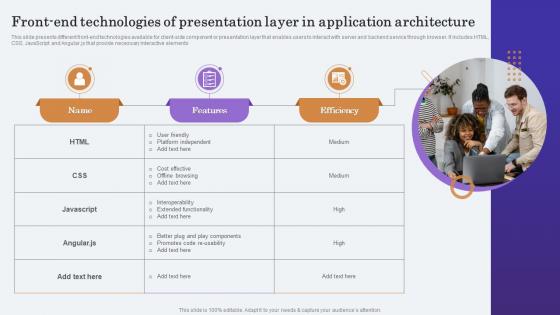
This slide presents different front end technologies available for client side component or presentation layer that enables users to interact with server and backend service through browser. It includes HTML, CSS, JavaScript and Angular.js that provide necessary interactive elements
People who downloaded this PowerPoint presentation also viewed the following :
Front End Technologies Of Presentation Layer In Application Architecture with all 6 slides:
Use our Front End Technologies Of Presentation Layer In Application Architecture to effectively help you save your valuable time. They are readymade to fit into any presentation structure.






FAQs for Front End Technologies Of Presentation Layer
Modern front-end development centers on component-based architecture, responsive design, performance optimization, accessibility compliance, and state management consistency. These principles enable developers to create scalable, maintainable applications through reusable components, cross-device compatibility, and streamlined user experiences, with many organizations finding that strategic implementation delivers faster development cycles and enhanced customer satisfaction.
React uses a component-based architecture with virtual DOM for efficient rendering, Angular employs a comprehensive MVC framework with TypeScript integration, and Vue combines reactive data binding with flexible templating systems. These frameworks streamline development by offering different approaches to state management, component organization, and performance optimization, with many enterprises finding that framework selection ultimately depends on project complexity, team expertise, and scalability requirements.
Responsive design ensures websites adapt seamlessly across devices through flexible grids, fluid images, and CSS media queries, creating consistent user experiences regardless of screen size. This approach enhances accessibility and engagement while reducing development costs, with many e-commerce and service platforms finding that responsive implementation significantly improves conversion rates and customer satisfaction across mobile, tablet, and desktop environments.
CSS preprocessors enhance styling by introducing variables, mixins, functions, nested rules, and modular imports that streamline development workflows. Through tools like Sass and Less, developers create more maintainable codebases, reduce repetitive styling tasks, and accelerate project timelines, while enabling better organization and scalability for complex web applications across industries.
Component-based architecture offers advantages including enhanced reusability, improved maintainability, faster development cycles, better testing capabilities, and simplified collaboration across development teams. While this approach requires initial setup investment and careful state management, many organizations find that it ultimately delivers reduced development costs, accelerated project timelines, and more scalable applications that adapt efficiently to evolving business requirements.
Front-end technologies significantly impact website performance through optimized code delivery, efficient resource management, and streamlined rendering processes. Modern frameworks like React and Vue.js enable faster loading through code splitting and lazy loading, while CSS optimization and JavaScript minification reduce file sizes, ultimately delivering enhanced user experiences and improved search engine rankings that drive competitive advantage.
Best practices for optimizing images and assets include using appropriate file formats like WebP or AVIF, implementing responsive images with srcset attributes, compressing files without quality loss, lazy loading below-the-fold content, and leveraging Content Delivery Networks. These optimization techniques streamline page load times, enhance user experiences across devices, and improve search engine rankings, with many e-commerce and media organizations finding that faster-loading sites significantly increase conversion rates and customer engagement.
Developers ensure accessibility by implementing semantic HTML structures, providing comprehensive alt text for images, maintaining proper color contrast ratios, enabling keyboard navigation, and conducting regular accessibility audits. These practices streamline user experiences across diverse abilities, with many organizations finding that accessible applications ultimately deliver broader market reach and enhanced usability for all users.
Essential front-end debugging tools include browser developer tools, React Developer Tools, Redux DevTools, Webpack Bundle Analyzer, and ESLint for code quality. These technologies streamline troubleshooting by enabling real-time code inspection, performance monitoring, and error tracking, with many development teams finding that integrated debugging environments ultimately deliver faster development cycles and more reliable user experiences.
Front-end development is evolving toward hybrid approaches that combine client-side interactivity with server-side rendering for improved performance, SEO optimization, and faster initial page loads. Frameworks like Next.js and Nuxt.js enable developers to seamlessly integrate both approaches, with many e-commerce and content platforms finding that this strategic combination delivers enhanced user experiences and better search visibility.
Key considerations include authentication protocols, error handling mechanisms, data caching strategies, rate limiting compliance, and response time optimization. These integration elements streamline user experiences by ensuring secure data transmission, maintaining application performance, and delivering seamless functionality, with many organizations finding that strategic API implementation ultimately enhances operational efficiency and competitive advantage.
Progressive Web Apps revolutionize front-end development by combining web accessibility with native app functionality, enabling offline capabilities, push notifications, and app-like user experiences. This strategic approach streamlines development costs while enhancing user engagement, with many retailers and media companies finding that PWAs deliver faster load times, improved mobile performance, and increased conversion rates across diverse platforms.
Front-end security best practices include input validation, secure authentication, HTTPS implementation, Content Security Policy headers, and regular dependency updates. These measures streamline protection by preventing XSS attacks, securing data transmission, and minimizing vulnerabilities, with many financial services and healthcare organizations finding that comprehensive front-end security ultimately delivers enhanced user trust and regulatory compliance.
Version control systems benefit front-end development teams by enabling collaborative code management, tracking changes across projects, and maintaining comprehensive development histories. These systems streamline workflows through branch management, conflict resolution, and seamless integration capabilities, with many development teams finding that proper version control ultimately delivers faster deployment cycles, reduced errors, and enhanced project transparency across complex front-end applications.
Emerging front-end technologies include WebAssembly for high-performance applications, Progressive Web Apps enhancing mobile experiences, AI-powered development tools, micro-frontends for scalable architectures, and advanced CSS features like container queries. These technologies streamline development workflows, enhance user experiences, and enable faster deployment cycles, with many organizations finding that early adoption delivers significant competitive advantages in increasingly digital markets.
-
SlideTeam offers so many variations of designs and topics. It’s unbelievable! Easy to create such stunning presentations now.
-
Thank you for offering such helpful pre-designed templates. They are really beneficial to me in my job.