

Funding Pitch Deck For Education And Learning Company Ppt Template





Try Before you Buy Download Free Sample Product
 Impress Your
 Audience
 100%
100% Editable
 Save Hours
 of Time


Our Funding Pitch Deck For Education And Learning Company Ppt Template are topically designed to provide an attractive backdrop to any subject. Use them to look like a presentation pro.
People who downloaded this PowerPoint presentation also viewed the following :
Content of this Powerpoint Presentation
Slide 1: The slide represents Funding pitch deck for education and learning company . State your company name.
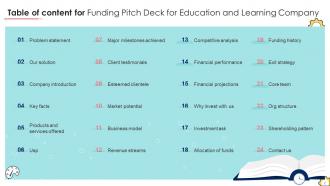
Slide 2: The slide displays Table of contents for presentation.
Slide 3: The slide again renders Title of contents.
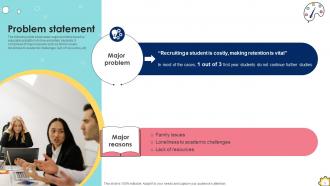
Slide 4: The slide showcases major problems faced by educational platform to hire and retain students.
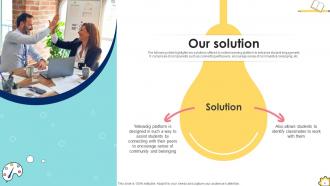
Slide 5: The slide highlights key solutions offered by online learning platform to enhance student engagement.
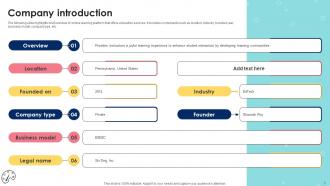
Slide 6: The slide gives brief overview of online learning platform that offers education services.
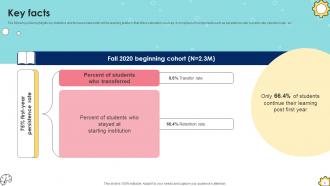
Slide 7: The slide highlights key statistics and fact associated with online learning platform that offers education services.
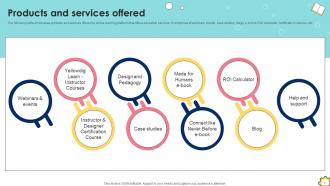
Slide 8: The slide shows products and services offered by online learning platform that offers education services.
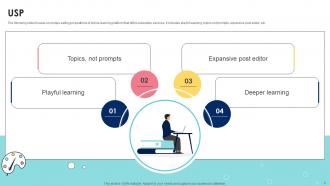
Slide 9: The slide focuses on unique selling propositions of online learning platform that offers education services.
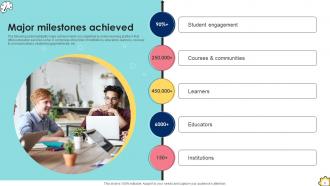
Slide 10: The slide highlights major achievements accomplished by online learning platform that offers education services so far.
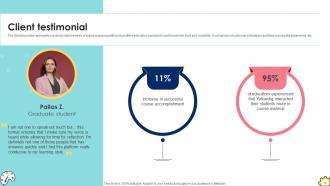
Slide 11: The slide represents some top client reviews of online learning platform that offers education services to build customer trust and credibility.
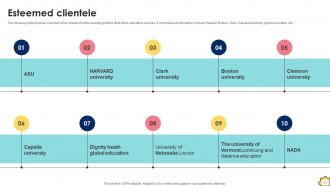
Slide 12: The slide provides overview of top clients of online learning platform that offers education services.
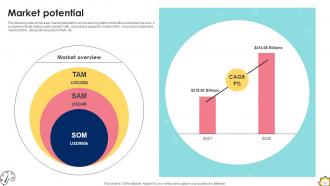
Slide 13: The slide showcases market potential for online learning platform that offers education services.
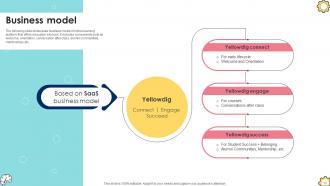
Slide 14: The slide depicts business model of online learning platform that offers education services.
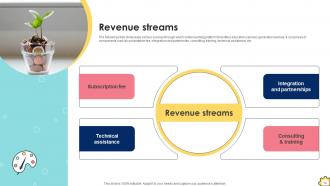
Slide 15: The slide showcases various sources through which online learning platform that offers education services generates revenue.
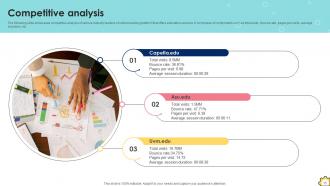
Slide 16: The slide highlights competitive analysis of various industry leaders of online learning platform that offers education services.
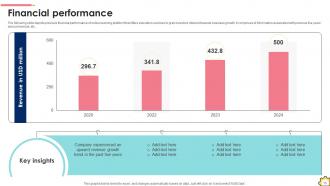
Slide 17: The slide depicts previous financial performance of online learning platform that offers education services to grab investors interest.
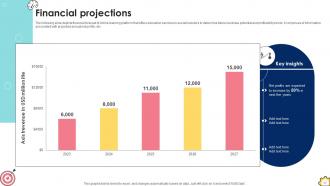
Slide 18: The slide illustrates financial forecast of online learning platform that offers education services to assist investors.
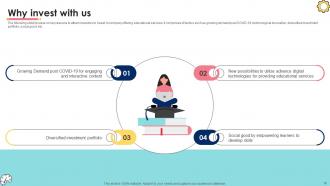
Slide 19: The slide focuses on key reasons to attract investors to invest in company offering educational services.
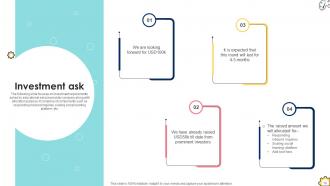
Slide 20: The slide focuses on investment requirements asked by educational service provider company along with allocation purpose.
Slide 21: The slide renders how and where the raised amount will be invested by online learning platform that offers education services.
Slide 22: The slide showcases previous investment history of online learning platform that offers education services.
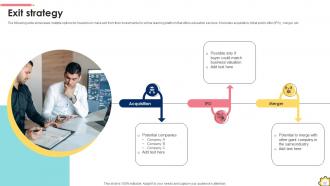
Slide 23: The slide shows multiple options for investors to make exit from their investments for online learning platform.
Slide 24: The slide depicts key members of educational service provider company’s executive team.
Slide 25: The slide represents organizational structure of online learning platform that offers education services.
Slide 26: The slide presents composition of shareholding and ownership pattern of online learning platform that offers education services.
Slide 27: This is a slide with address, contact numbers and email address.
Slide 28: This slide shows all the icons included in the presentation.
Slide 29: This slide is titled as Additional Slides for moving forward.
Slide 30: This is Our Team slide with names and designation.
Slide 31: This slide provides 30 60 90 Days Plan with text boxes.
Slide 32: This slide shows Post It Notes. Post your important notes here.
Slide 33: This is an Idea Generation slide to state a new idea or highlight information, specifications etc.
Funding Pitch Deck For Education And Learning Company Ppt Template with all 41 slides:
Use our Funding Pitch Deck For Education And Learning Company Ppt Template to effectively help you save your valuable time. They are readymade to fit into any presentation structure.












FAQs for Funding Pitch Deck For Education And Learning
So for your education pitch deck, start with the problem you're solving - what gap exists? Then your solution and what students actually learn from it. Market size matters, plus who you're targeting. Show how you're different from competitors and explain your revenue model. Traction is huge - any pilot data or user numbers you have. Team section should highlight real teaching experience (investors eat that up). Financial projections and timeline for rollout are obvious musts. Oh, and don't skip partnership strategy - how will you actually get into schools? Keep it under 12 slides though. These people have zero patience. Focus on real impact over making it look fancy.
Honestly, data viz can make or break your education pitch. Investors need to *see* the problem - like a heat map showing which neighborhoods kids are struggling in, or before/after charts that highlight the achievement gap. Way more powerful than just rattling off statistics. I always tell people to focus on maybe 2-3 really strong visuals instead of cramming every chart you've ever made into the deck. A graph showing 40% reading improvement? That's the stuff that gets funders excited. Make them feel the urgency and visualize your impact potential right away.
Start with one real kid's story - like Sarah stuck with beat-up textbooks vs. Sarah actually excited about learning with your tool. That before/after hits different than just throwing numbers at people. Follow the problem-solution-impact thing, but keep it personal. Investors sit through boring pitch after boring pitch, so emotion actually works. Show the teacher's lightbulb moment or when a parent realizes their kid finally gets math. Then zoom out to your bigger vision. Oh, and practice like you're just telling your friend about this cool thing you built - not doing some formal presentation. Way more natural that way.
Honestly, you need hard numbers that paint a clear picture. Track stuff like graduation rates, test score improvements, college enrollment bumps, job placement after your program wraps up. Before/after data is gold - way better than vague "we help students" fluff. Also count your reach: how many kids served, schools you're working with, communities touched. Longitudinal data is chef's kiss if you can swing it. Five-year career tracking? That's the stuff that makes investors actually care. Oh, and start collecting everything now - you don't want to be scrambling later when they inevitably ask for proof.
Look, investors absolutely need to see where every dollar's going - they hate when founders are vague about money, especially in edtech where it's already hard to measure success. Break down your spending: curriculum, teacher training, tech costs, whatever. Show clear ROI projections too. Honestly, detailed budgets make their due diligence so much easier, which they'll appreciate. Don't be like those founders who just handwave at numbers during pitches. Spell out your assumptions clearly in the deck. It shows you actually think strategically about money instead of just burning through it randomly.
Definitely go with hard numbers - stuff like "graduation rates jumped 40%" or "got 200 kids into college who wouldn't have made it otherwise." Student quotes are gold if you've got them, way more powerful than just throwing stats around. Before/after photos work really well too, or simple charts showing the actual impact. I'd honestly skip the vague "improved outcomes" language completely - it sounds like corporate BS. Instead, get specific about exactly how many students you helped and what changed for them. Maybe throw in a quick story about one kid if you can. People connect with real stories way more than data dumps.
Honestly, you gotta show investors you're not just winging it. Map out your biggest risks first - market shifts, competitors, regulatory stuff, whatever could torpedo your plan. Then spell out how you'd handle each one. I learned this the hard way, but always include a Plan B because... well, Murphy's Law exists. Financial cushions are clutch. So are partnerships that spread the risk around. Oh, and build in checkpoints where you can pivot if things go sideways early on. Investors don't want blind optimism - they want to see you can roll with the punches when reality hits.
Honestly, you need three main things to make investors care. First, prove there's actually a problem - show them crappy graduation rates or how kids in certain areas can't access decent education. Then hit them with your impact numbers - like how much student scores improved or completion rates jumped after using your thing. Growth stuff matters too (user adoption, retention, all that). I know it sounds obvious, but the winning combo is showing a huge problem plus solid proof you can fix it. That's literally what makes them write checks. Start small with the hockey stick growth - even tiny upward trends work early on.
Okay so you've got two totally different audiences here, but it's not as tricky as it seems. Public investors are all about that social impact angle - show them how you're fixing broken systems and scaling solutions. Private money wants the business stuff: revenue streams, market size, competitive edge. But honestly? There's way more overlap than people think. Both want proof your thing actually works and won't die in two years. Structure your pitch to hit the problem first, then split it - dedicate sections to social returns and financial returns. Just make sure you're speaking their language in each part. Way easier than trying to blend everything into one confusing mess.
Don't go full professor mode on them - investors want ROI, not your dissertation on learning theory. Skip the academic jargon and research citations. Market size matters way more than pedagogy theories. Your problem can't be super niche either (sorry, but left-handed calculus kids won't get you funded). They need to see broader potential. Financial projections? Keep them real. Education's slow as hell, so don't promise crazy growth by year two. That's just setting yourself up to look stupid later. Show actual metrics and whatever traction you've got instead.
Honestly, you've gotta tailor everything to whoever's paying. Grants? Hit them with impact stories and how many students you'll help - they eat that stuff up. VCs want revenue numbers and how big you can scale this thing. Angels are weird, they're kinda in the middle (especially ed-tech ones). Government money means tons of paperwork and proving you meet their standards. Same idea, totally different pitch each time. I'd dig into what these people funded before so you know what gets them excited. It's like dating but with spreadsheets.
Dude, visual stuff is everything for education data. Bar charts work great for budget breakdowns, pie charts for funding sources. Line graphs are perfect for showing how student outcomes change over time. Throw in some icons too - graduation caps, books, school buildings to represent different programs. Honestly, investors zone out the second they see a wall of spreadsheet numbers. Keep your colors consistent and don't cram too much text on each slide. Short sentences work better than paragraphs of explanation. You want them nodding along, not struggling to read tiny font. Focus on what story the data's actually telling rather than dumping every number you've got.
Dude, you NEED testimonials for education pitches. Investors see a million "game-changing" edtech ideas that bomb in actual classrooms. Without real proof, your pitch is toast. Get teachers, students, AND administrators talking about specific results - not just "wow this rocks" generic stuff. Video hits harder than text, but honestly both work. I'd grab maybe 4-5 solid ones before you go in there. Oh and make sure they mention actual outcomes, like test scores or engagement metrics. Sounds obvious but you'd be surprised how many people skip this step.
Definitely play up personalized learning and skills-based stuff - investors are all over that right now. The remote learning boom isn't going anywhere, and corporate training budgets are massive these days. Here's what's weird though - sustainability in education is actually becoming a selling point? Never saw that coming. Impact investing is hot, so mention how you're tackling funding gaps in underserved areas. AI and learning analytics are where the serious money's flowing too. Don't just pitch features - show how you fit into these bigger trends. That's what gets VCs excited.
Lead with the problem you're fixing in education - make it impossible to ignore. Then boom, hit them with your solution in one sentence. Include market size and timing after that. Honestly? Put your financial ask and ROI projections right up front because that's what investors scan for anyway. The whole thing should be 2-3 paragraphs tops. Think movie trailer vibes - you want them hungry for the full pitch but every single word needs to build urgency. Don't give away everything, just enough to make them feel like they'll miss out if they don't keep reading.
-
Graphics are very appealing to eyes.
-
I discovered this website through a google search, the services matched my needs perfectly and the pricing was very reasonable. I was thrilled with the product and the customer service. I will definitely use their slides again for my presentations and recommend them to other colleagues.