

Funding requirement and allocation of funds investment pitch book overview ppt infographics




Try Before you Buy Download Free Sample Product
 Impress Your
 Audience
 100%
100% Editable
 Save Hours
 of Time


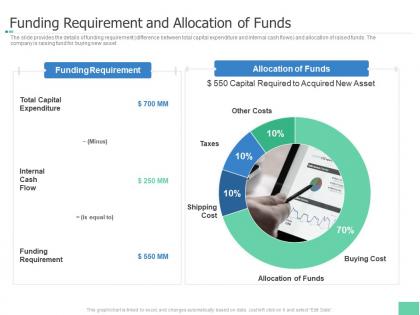
The slide provides the details of funding requirement difference between total capital expenditure and internal cash flows and allocation of raised funds. The company is raising fund for buying new asset
People who downloaded this PowerPoint presentation also viewed the following :
Funding requirement and allocation of funds investment pitch book overview ppt infographics with all 2 slides:
Use our Funding Requirement And Allocation Of Funds Investment Pitch Book Overview Ppt Infographics to effectively help you save your valuable time. They are readymade to fit into any presentation structure.

FAQs for Funding requirement and allocation of funds investment pitch book
Key factors influencing nonprofit funding allocation effectiveness include strategic alignment with mission objectives, transparent budget processes, stakeholder engagement protocols, measurable impact metrics, and adaptive resource management systems. These frameworks enable organizations to optimize donor contributions, demonstrate accountability to beneficiaries and funders, and scale programs efficiently, with many nonprofits finding that strategic allocation ultimately delivers greater community impact and sustainable operational growth.
Funding allocation directly determines public sector project success by ensuring adequate resources for personnel, infrastructure, technology, and operational requirements throughout implementation phases. Strategic allocation enables government agencies to deliver essential services efficiently, meet citizen expectations, and achieve policy objectives, while inadequate funding often results in project delays, reduced scope, and compromised outcomes that ultimately affect public trust.
Organizations use methodologies including cost-benefit analysis, ROI calculations, strategic alignment matrices, risk assessment frameworks, and portfolio optimization models. These approaches enable systematic evaluation by comparing potential returns, assessing strategic fit, and balancing risk portfolios, with many financial institutions finding that combining quantitative metrics with strategic priorities ultimately delivers more effective resource allocation and competitive advantage.
Transparency in funding allocation significantly enhances donor trust by providing clear visibility into how contributions are utilized, enabling stakeholders to track impact and outcomes. When organizations demonstrate open processes through detailed reporting, real-time updates, and accessible impact metrics, donors become more engaged and committed, with many nonprofits and foundations finding that transparent practices ultimately deliver increased retention rates and stronger long-term partnerships.
Data analysis enhances funding allocation strategies by identifying performance patterns, predicting investment outcomes, and revealing resource gaps across portfolios. Through predictive analytics and risk modeling, organizations streamline decision-making processes, minimize misallocated resources, and maximize return potential, with many financial institutions finding that data-driven approaches deliver significantly improved allocation efficiency and competitive advantage.
Organizations measure ROI of funding decisions through financial metrics like net present value, payback periods, and cost-benefit ratios, alongside performance indicators such as revenue growth, market share expansion, and operational efficiency gains. These measurement frameworks enable companies to track actual outcomes against projected returns, assess resource allocation effectiveness, and make data-driven adjustments for future investments, ultimately delivering strategic advantage.
Common funding allocation pitfalls include lack of strategic alignment, inadequate risk assessment, over-concentration in single areas, insufficient performance tracking, and poor stakeholder communication. These missteps often result from rushed decision-making processes and limited cross-departmental collaboration, with many organizations finding that systematic evaluation frameworks and regular allocation reviews significantly enhance resource efficiency and strategic outcomes.
Differing stakeholder priorities complicate funding allocation by creating competing demands for resources, conflicting strategic objectives, and varied risk tolerance levels across departments and leadership teams. These competing interests often result in prolonged decision-making processes, resource fragmentation, and suboptimal allocation strategies, with many organizations finding that establishing clear governance frameworks and transparent evaluation criteria helps streamline consensus-building while maintaining strategic focus.
**INPUT**: What innovative funding models can enhance flexibility in funding allocation? **OUTPUT**: Innovative funding models include outcome-based financing, flexible grant structures, pooled funding mechanisms, milestone-driven releases, and dynamic budget reallocation systems. These approaches enhance organizational agility by allowing real-time adjustments based on performance metrics, changing priorities, and emerging opportunities, with many institutions finding that such flexibility ultimately delivers better resource optimization and project outcomes. [Word count: 56 words]
Government agencies typically allocate funding through structured processes involving legislative approval, competitive grant cycles, and regulatory compliance requirements, while private foundations operate with greater flexibility, strategic focus, and streamlined decision-making processes. These different approaches enable government agencies to ensure transparency and accountability across diverse public sectors, while private foundations can pivot quickly toward innovative initiatives, ultimately delivering faster deployment for targeted causes and more comprehensive coverage for broad societal needs.
Socioeconomic inequality significantly impacts funding allocation by creating disparities where affluent communities receive more resources through higher property taxes, private donations, and political influence, while disadvantaged areas face systematic underfunding. This cycle perpetuates unequal access to essential services, with many community organizations finding that strategic partnerships and targeted grant programs help bridge these funding gaps, ultimately delivering more equitable resource distribution.
Technology streamlines funding allocation for grantmakers by automating application reviews, enabling data-driven decision making, and providing real-time performance tracking across portfolios. Through AI-powered screening tools and integrated management platforms, foundations and government agencies can process applications faster, identify high-impact opportunities more accurately, and monitor outcomes continuously, ultimately delivering more strategic resource distribution.
Organizations can ensure equitable funding allocation through community needs assessments, demographic data analysis, inclusive stakeholder engagement, transparent criteria development, and regular impact monitoring. These strategies enable institutions to identify underserved populations, eliminate systemic biases, and track resource distribution effectively, with many nonprofits and government agencies finding that data-driven approaches ultimately deliver more balanced outcomes and stronger community trust.
External economic factors significantly influence funding allocation by affecting interest rates, market volatility, regulatory changes, and investor confidence across sectors. During economic uncertainty, healthcare and utilities typically receive stable funding while technology and retail face reduced investment, with many organizations finding that diversified allocation strategies and flexible budget frameworks help navigate fluctuating conditions while maintaining competitive advantage.
Stakeholder feedback serves as a critical input for future funding decisions, providing insights into program effectiveness, resource gaps, strategic priorities, and operational challenges. Through surveys, consultations, and performance reviews, organizations can identify which initiatives deliver the strongest ROI, address emerging needs, and align allocations with stakeholder expectations, ultimately enhancing program outcomes and stakeholder satisfaction.
-
Great product with highly impressive and engaging designs.
-
Awesome presentation, really professional and easy to edit.
-
Qualitative and comprehensive slides.