

Funds Usage Ppt Template





Try Before you Buy Download Free Sample Product
 Impress Your
Audience
 100%
Editable
 Save Hours
of Time


This pitch deck provides a summary of how much amount is required for investment in the startup company. We can calculate the startup expenses, operating capital, and from where the money has been invested in the business. Our fund usage slides will assist you in documenting your investment needs. These templates have an organized structure and elements to arrange your finances according to investment. This section focuses on capitalization and funds usage which summarizes the financial needs for a minimum of one year into the future or until the business cash flow becomes positive. In this PowerPoint template, we have outlined the costs in different categories such as startup costs, working capital, and financial projections of the organization. We have also catered the sources of the funds which may include investments from friends and family, loans or outside investments, and own investments. This PPT exhibits how funds should be allocated to different business areas in order to maximize gain. Download our 100 percent customized template now.
People who downloaded this PowerPoint presentation also viewed the following :
Content of this Powerpoint Presentation
Slide 1: This slide display the title Funds Usage.
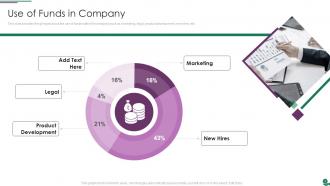
Slide 2: This slide provides the glimpse about the use of funds within the company.
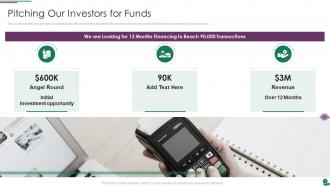
Slide 3: This slide provides the glimpse about the funds which are being pitched to the investors.
Slide 4: This slide provides the glimpse about the investment funding for our business.
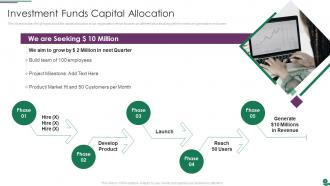
Slide 5: This slide provides the glimpse about the capital allocation of our organization.
Slide 6: This slide provides the glimpse about the phases of investment funds.
Slide 7: This slide provides the glimpse about the raising investments in business.
Slide 8: This slide provides the glimpse about the fundraiser event details with funds usage.
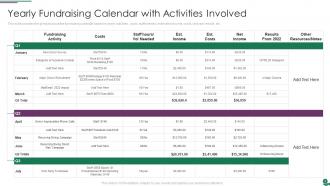
Slide 9: This slide provides the glimpse about the fundraising calendar based on yearly activities.
Slide 10: This slide provides the glimpse about the raising of pre seed and seed funding rounds.
Slide 11: This slide provides the glimpse about the different startup funding rounds and company’s development stages.
Slide 12: This slide provides the glimpse about Raising Funds Using Seed Gradient.
Slide 13: This slide provides the glimpse about Pre Seed Funding Program and Process.
Slide 14: This slide provides the glimpse about Visualizing Stages of Startup Funding.
Slide 15: This slide provides the glimpse about the phases of startup development with funding amount.
Slide 16: This slide provides the glimpse about Raising and Utilization of Funds.
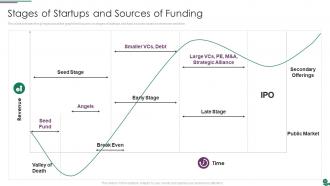
Slide 17: This slide provides the glimpse about Stages of Startups and Sources of Funding.
Slide 18: This is the icons slide.
Slide 19: This slide presents title for additional slides.
Slide 20: This slide displays Venn.
Slide 21: This slide display 30 60 90 Days Plan.
Slide 22: This slide display Roadmap.
Slide 23: This slide display Post it Notes.
Slide 24: This slide exhibits yearly timeline of company.
Slide 25: This slide exhibits Idea Generation.
Slide 26: This slide display Magnifying Glass.
Slide 27: This is thank you slide & contains contact details of company like office address, phone no., etc.
Funds Usage Ppt Template with all 32 slides:
Use our Funds Usage Ppt Template to effectively help you save your valuable time. They are readymade to fit into any presentation structure.

















FAQs for Funds
Key factors include mission alignment, program effectiveness, administrative efficiency, donor restrictions, and regulatory compliance requirements. Non-profit organizations must balance immediate program needs with long-term sustainability, ensuring funds maximize community impact while maintaining operational capacity, with many finding that strategic allocation across direct services, capacity building, and reserve funds ultimately delivers greater organizational resilience and measurable outcomes.
Budgeting strategies enhance funds usage effectiveness by establishing clear spending priorities, tracking cash flow patterns, and allocating resources to high-impact activities. Through strategic budgeting approaches, small businesses streamline operational costs, minimize unnecessary expenses, and maximize return on investment, while enabling better financial forecasting and resource planning, ultimately delivering improved profitability and sustainable growth in competitive markets.
Common fund management mistakes include inadequate budget planning, poor cash flow forecasting, lack of expense tracking, insufficient financial controls, and failure to align spending with strategic priorities. Organizations often struggle with overallocation to non-essential areas, delayed financial reporting, and inadequate stakeholder communication, with many finding that implementing robust financial oversight systems significantly enhances operational efficiency and strategic decision-making.
Measuring fund utilization impact involves tracking key performance indicators like budget variance, milestone completion rates, resource allocation efficiency, and return on investment metrics. Through comprehensive financial dashboards and regular auditing processes, organizations can assess cost-per-deliverable ratios, timeline adherence, and quality benchmarks, ultimately enabling better resource planning and improved project success rates across future initiatives.
Transparency ensures effective fund usage by providing clear visibility into financial allocations, expenditure tracking, and performance outcomes, enabling stakeholders to make informed decisions and maintain accountability. Through detailed reporting and real-time monitoring systems, organizations streamline resource allocation, minimize waste, and enhance stakeholder trust, ultimately delivering improved operational efficiency and stronger financial governance across all business functions.
Technology improves tracking and reporting of fund usage by implementing automated monitoring systems, real-time analytics dashboards, blockchain-based transparency tools, and integrated financial platforms. These solutions enhance accuracy through digital audit trails, automated compliance reporting, and predictive analytics, while streamlining workflows for financial institutions, government agencies, and nonprofits, ultimately delivering greater accountability and operational efficiency.
Best practices for reallocating funds mid-project include conducting thorough impact assessments, maintaining transparent stakeholder communication, documenting all changes formally, prioritizing critical path activities, and establishing clear approval workflows. These approaches enable project managers to navigate budget shifts strategically while preserving project objectives, with many organizations finding that structured reallocation processes ultimately deliver enhanced resource efficiency and stakeholder confidence.
Stakeholder engagement significantly influences public sector funds usage by ensuring transparent allocation decisions, identifying community priorities, and reducing project delays through early consensus building. Through structured consultation processes, government agencies can optimize resource allocation, minimize costly revisions, and deliver projects that better serve public needs, ultimately enhancing accountability and public trust.
Key fund performance metrics include total return, alpha, beta, Sharpe ratio, and expense ratios, alongside risk-adjusted measures like standard deviation and maximum drawdown. These metrics enable investors to evaluate returns, volatility, and management efficiency across different asset classes, with many institutional investors finding that combining quantitative analysis with qualitative assessments delivers more comprehensive investment decisions.
Economic changes significantly impact strategic fund allocation by forcing organizations to reassess risk tolerance, shift investment priorities, and reallocate resources toward recession-resistant sectors or growth opportunities. During economic uncertainty, companies typically reduce discretionary spending while increasing investments in operational efficiency and digital transformation, with many finding that strategic reallocation ultimately delivers competitive advantages.
Grant funds offer reduced financial risk, access to larger capital pools, enhanced credibility, and preserved cash flow, while self-funding provides complete control, faster implementation, and retained ownership of outcomes. Many organizations find that combining both approaches strategically enables them to scale initiatives more effectively, with grants supporting research and development phases while self-funding accelerates market-ready implementations.
Organizations should prioritize funding requests by evaluating strategic alignment with business objectives, potential return on investment, and operational urgency across departments. Through comprehensive assessment frameworks, companies can balance immediate needs with long-term growth initiatives, ensuring resource allocation drives competitive advantage while maintaining operational efficiency and supporting cross-departmental collaboration for sustainable organizational success.
Legal and regulatory considerations impacting funds usage include compliance frameworks, fiduciary duties, disclosure requirements, audit standards, and sector-specific regulations like banking laws or securities regulations. These requirements streamline transparency and accountability while ensuring proper resource allocation, with many financial institutions and nonprofits finding that robust compliance frameworks ultimately deliver enhanced stakeholder trust and operational efficiency.
Cultural differences significantly influence funds management through varying risk tolerance, investment horizons, regulatory frameworks, and decision-making processes. While Western markets often emphasize individual portfolio diversification and quarterly performance, Asian markets frequently prioritize long-term family wealth preservation and collective investment strategies, with Middle Eastern funds incorporating Islamic finance principles, ultimately requiring culturally-adapted approaches for effective global fund management.
**INPUT**: What innovative funding models are emerging in the current economic landscape? **OUTPUT**: Emerging funding models include revenue-based financing, crowdfunding platforms, peer-to-peer lending, tokenization through blockchain, and hybrid debt-equity structures. These innovative approaches streamline capital access by reducing traditional barriers, enabling faster deployment, and offering flexible repayment terms, with many startups and growing businesses finding that diversified funding strategies ultimately deliver greater financial resilience and competitive positioning. [Word count: 60 words]
-
It’s really cool, and you can find pretty much everything you could need for your work or school.
-
Understandable and informative presentation.