

Future Of Sports Nutrition And Health Applications To Monitor Athlete Performance IoT SS




Try Before you Buy Download Free Sample Product
 Impress Your
 Audience
 100%
100% Editable
 Save Hours
 of Time


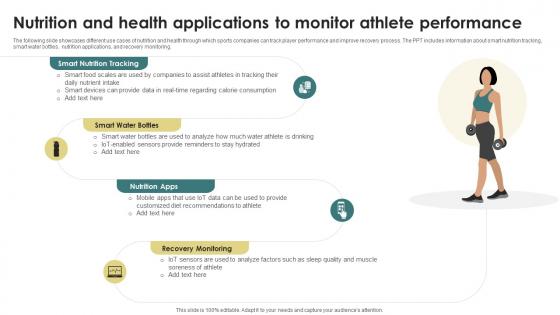
The following slide showcases different use cases of nutrition and health through which sports companies can track player performance and improve recovery process. The PPT includes information about smart nutrition tracking, smart water bottles, nutrition applications, and recovery monitoring.
People who downloaded this PowerPoint presentation also viewed the following :
Future Of Sports Nutrition And Health Applications To Monitor Athlete Performance IoT SS with all 9 slides:
Use our Future Of Sports Nutrition And Health Applications To Monitor Athlete Performance IoT SS to effectively help you save your valuable time. They are readymade to fit into any presentation structure.








FAQs for Future Of Sports Nutrition And Health Applications To Monitor Athlete
**INPUT**: What emerging technologies are shaping the future of sports nutrition? **OUTPUT**: Emerging technologies include wearable biosensors, AI-powered nutrition algorithms, personalized supplement delivery systems, real-time metabolic monitoring devices, and genetic testing platforms. These innovations streamline athletic performance optimization by delivering personalized nutrition recommendations, automating supplement timing, and tracking real-time physiological responses, with professional sports teams and fitness institutions finding enhanced recovery times and competitive advantages. [Word count: 58 words]
Wearable health monitoring devices enhance athletic performance by tracking heart rate variability, sleep quality, hydration levels, and muscle fatigue in real-time. Through continuous biometric analysis, athletes can optimize training intensity, prevent overexertion, and accelerate recovery protocols, with professional sports teams and fitness organizations finding these insights deliver measurably improved performance outcomes.
Artificial intelligence analyzes individual athlete data, including metabolic rates, training intensity, recovery patterns, and performance metrics, to create highly customized nutrition recommendations. Through machine learning algorithms, sports nutritionists and fitness professionals can optimize meal timing, macronutrient ratios, and supplement protocols, ultimately delivering enhanced performance outcomes and faster recovery times.
Genetic integration will revolutionize athletic nutrition through personalized meal plans, supplement protocols, and recovery strategies tailored to individual DNA profiles, metabolic pathways, and nutrient processing capabilities. Through advanced genomic testing, sports nutritionists can optimize protein synthesis, carbohydrate utilization, and micronutrient absorption for each athlete, ultimately delivering enhanced performance and faster recovery times.
Ethical concerns include athlete privacy violations, data ownership disputes, informed consent complexities, potential discrimination based on health metrics, and unauthorized data sharing with third parties. While advanced monitoring enhances performance and safety, sports organizations must establish transparent data governance policies, secure storage protocols, and clear athlete rights frameworks, with many professional leagues finding that ethical data practices ultimately build trust and competitive advantage.
Sports teams leverage data analytics to optimize nutrition programs by analyzing player metabolic data, performance metrics, recovery patterns, and dietary intake tracking to create personalized meal plans. Through wearable technology and biochemical monitoring, teams can identify nutritional deficiencies, predict energy requirements for specific training phases, and adjust supplementation strategies in real-time, ultimately delivering enhanced performance outcomes and reduced injury rates.
**INPUT**: What trends are driving the demand for plant-based nutrition in sports? **OUTPUT**: Key trends include growing environmental consciousness among athletes, enhanced recovery benefits from anti-inflammatory plant compounds, improved digestive tolerance, and increasing scientific research validating plant protein effectiveness. These factors are revolutionizing sports nutrition by delivering sustainable performance solutions, reducing environmental impact, and enabling faster recovery times, with many professional teams and individual athletes finding that plant-based approaches ultimately enhance both athletic performance and long-term health outcomes.
Hydration technology plays a crucial role in maximizing athletic performance by providing real-time electrolyte monitoring, personalized fluid intake recommendations, and precise sweat rate analysis. Through smart sensors and wearable devices, athletes can optimize their hydration strategies, prevent performance-degrading dehydration, and maintain peak physical output, with professional sports teams and endurance athletes increasingly finding that data-driven hydration delivers measurable competitive advantages.
Emerging meal replacement innovations include personalized macro-nutrient profiles based on genetic testing, time-release protein matrices for sustained amino acid delivery, microencapsulated vitamins for enhanced bioavailability, and AI-optimized formulations tailored to specific sports demands. These advanced products enable athletes to achieve precise nutritional timing, optimize recovery windows, and maintain consistent energy levels, with many professional sports organizations finding that customized meal replacements significantly enhance performance outcomes and reduce nutritional guesswork.
Mental health integration involves incorporating stress monitoring, sleep quality assessment, cognitive performance tracking, mood analysis, and nutritional psychiatry principles into comprehensive athlete wellness programs. These frameworks enable sports professionals to identify performance anxiety, optimize recovery protocols, and develop personalized nutrition strategies that support both physical and psychological well-being, ultimately delivering enhanced athletic performance and long-term career sustainability.
Social media significantly influences athletes' nutrition choices through peer recommendations, influencer endorsements, trending supplements, and visual food content that shapes dietary decisions. While this creates opportunities for nutrition education and community support, it also presents challenges with misinformation and unrealistic standards, with many athletes finding that balanced, evidence-based approaches ultimately deliver better performance outcomes.
Advancements in food preservation technology include high-pressure processing, modified atmosphere packaging, natural antimicrobial coatings, freeze-drying innovations, and smart packaging systems. These technologies streamline product stability by reducing oxidation, preventing microbial growth, and maintaining nutritional integrity, with many sports nutrition manufacturers finding that enhanced preservation ultimately delivers longer shelf life, reduced waste, and improved cost efficiency across distribution channels.
Cultural and regional differences significantly influence sports nutrition adoption through varying dietary traditions, regulatory frameworks, economic accessibility, and cultural attitudes toward supplementation and performance enhancement. While Western markets often embrace innovative supplements and personalized nutrition, many Asian and traditional cultures prioritize food-based approaches and herbal remedies, with organizations increasingly recognizing that successful nutrition programs must integrate local preferences, ultimately delivering culturally-sensitive solutions and broader market acceptance.
Real-time health monitoring during competitive events delivers insights into athlete cardiovascular performance, hydration levels, muscle fatigue patterns, metabolic efficiency, and injury risk indicators. Through wearable sensors and biometric tracking, sports medicine teams can optimize performance strategies, prevent dangerous overexertion, and enhance recovery protocols, with many professional leagues finding that immediate data access ultimately improves both athlete safety and competitive outcomes.
Recovery protocols can be enhanced through personalized nutrition algorithms, real-time biomarker monitoring, targeted supplement delivery systems, sleep optimization technology, and inflammatory response tracking. These advancements enable athletes and fitness enthusiasts to streamline recovery by reducing downtime, preventing overtraining, and optimizing performance windows, with many sports organizations finding that data-driven recovery delivers competitive advantages and injury prevention.
-
It's always a delight to see new templates from you! I am extremely pleased with the fact that they are easy to modify and fit any presentation layout in seconds!
-
“One of the best experiences with SlideTeam for my presentation.Everything on time, communication is efficient and price is reasonable. All good in one place.”