

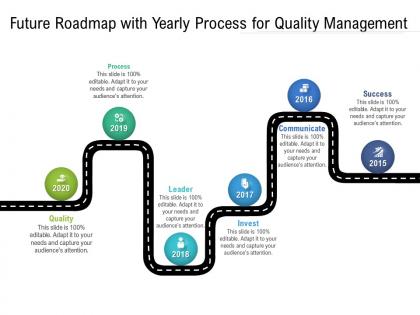
Future roadmap with yearly process for quality management




Try Before you Buy Download Free Sample Product
 Impress Your
 Audience
 100%
100% Editable
 Save Hours
 of Time


Add to your impressive credentials with our Future Roadmap With Yearly Process For Quality Management. Improve your ability to guide folks.
People who downloaded this PowerPoint presentation also viewed the following :
Future roadmap with yearly process for quality management with all 2 slides:
Improve your ability to guide folks with our Future Roadmap With Yearly Process For Quality Management. It will add to your impressive credentials.
FAQs for Future roadmap with yearly process
Key components include quality objectives alignment, process mapping and standardization, performance metrics and KPIs, resource allocation planning, and continuous improvement frameworks. These elements work together by establishing clear accountability structures, enabling data-driven decision making, and creating systematic approaches to quality enhancement, with many organizations finding that integrated roadmaps deliver measurable operational improvements and sustained competitive advantage.
Organizations align their quality management roadmap with strategic business objectives by establishing clear performance metrics, integrating quality goals into business planning processes, and ensuring cross-functional collaboration between quality teams and executive leadership. This strategic alignment enables companies across manufacturing, healthcare, and financial services to reduce operational costs, accelerate product development cycles, and enhance customer satisfaction, ultimately delivering competitive advantage and sustainable growth in increasingly demanding markets.
Leadership drives quality management roadmap success by establishing clear vision, allocating necessary resources, fostering organizational culture change, and maintaining consistent commitment throughout implementation phases. Through strategic communication and accountability measures, leaders enable cross-functional collaboration, minimize resistance to process improvements, and ensure sustainable adoption, with many organizations finding that executive sponsorship ultimately determines whether quality initiatives deliver measurable operational improvements and competitive advantage.
Performance metrics can be integrated into a quality management roadmap through KPI dashboards, real-time monitoring systems, benchmarking frameworks, automated reporting tools, and continuous feedback loops. These measurement approaches streamline quality tracking by establishing clear baselines, identifying improvement opportunities, and enabling data-driven decisions, with many organizations finding that integrated metrics ultimately deliver enhanced operational efficiency and sustained competitive advantage.
Companies typically face challenges including unclear quality objectives, insufficient stakeholder buy-in, resource constraints, resistance to process changes, and difficulty measuring progress effectively. These obstacles can be overcome by establishing clear communication channels, securing executive sponsorship, implementing phased rollouts with quick wins, and creating comprehensive training programs, with many organizations finding that regular milestone reviews and cross-functional collaboration ultimately deliver sustainable quality improvements and operational excellence.
Organizations should review their quality management roadmap quarterly for tactical adjustments and annually for strategic updates, with additional reviews triggered by major business changes, regulatory updates, or market shifts. Many manufacturing and healthcare organizations find that this balanced approach enables continuous improvement while maintaining operational stability, ultimately delivering sustained quality performance and competitive advantage in increasingly dynamic markets.
Technology enhances quality management roadmaps through automated monitoring systems, real-time analytics platforms, AI-driven predictive maintenance, IoT sensors for continuous data collection, and cloud-based collaboration tools. These technologies streamline compliance tracking, accelerate defect identification, and enable proactive quality interventions, with manufacturing and healthcare organizations finding that integrated digital solutions ultimately deliver faster response times and sustained operational excellence.
Employee engagement in quality management roadmaps can be fostered through clear communication of quality objectives, regular training programs, cross-functional collaboration opportunities, recognition systems for quality improvements, and involving staff in continuous improvement initiatives. These approaches streamline adoption by creating ownership, enhancing skills, and building accountability across teams, with many organizations finding that engaged employees ultimately deliver superior quality outcomes and sustained competitive advantage.
Essential tools include statistical process control software, quality management systems (QMS), Six Sigma methodologies, lean manufacturing principles, and continuous improvement frameworks like Kaizen. These approaches streamline operations by standardizing processes, reducing waste, and enhancing product consistency, with many manufacturing and service organizations finding that integrated quality systems ultimately deliver improved customer satisfaction and competitive advantage.
Organizations ensure continuous improvement in quality management through regular audits, employee feedback systems, performance metrics tracking, process optimization reviews, and benchmarking against industry standards. These practices enable companies to identify inefficiencies, streamline operations, and enhance customer satisfaction, with many manufacturing and service organizations finding that systematic quality reviews ultimately deliver reduced costs, faster delivery times, and sustained competitive advantage.
Stakeholder involvement ensures quality management roadmaps address real operational needs, regulatory requirements, and customer expectations while securing organizational buy-in for implementation success. Through collaborative input from departments like manufacturing, compliance, and customer service, organizations develop comprehensive strategies that balance quality standards with business objectives, ultimately delivering sustainable improvements and competitive advantage across all operational areas.
Risk management integrates into quality management roadmaps by identifying potential vulnerabilities, establishing mitigation protocols, and creating contingency frameworks throughout each implementation phase. Through systematic risk assessment, organizations can prioritize critical quality initiatives, allocate resources strategically, and build resilient processes that minimize disruptions while ensuring consistent service delivery and competitive advantage.
Key metrics include defect rates, customer satisfaction scores, process cycle times, cost of quality, employee engagement levels, and compliance audit results. These KPIs enable organizations to track operational efficiency, customer retention, and regulatory adherence across manufacturing, healthcare, and financial services sectors, with many companies finding that comprehensive measurement frameworks ultimately deliver competitive advantage and sustained quality improvements.
Feedback loops can be effectively incorporated through regular customer surveys, employee quality assessments, process performance metrics, supplier evaluations, and continuous improvement reviews. These mechanisms enable organizations to identify quality gaps quickly, adjust processes dynamically, and enhance product standards, with many manufacturing and service companies finding that systematic feedback integration ultimately delivers improved customer satisfaction and operational excellence.
Organizations can communicate quality management roadmaps through multi-channel approaches including town halls, departmental briefings, digital dashboards, regular progress updates, and interactive workshops. These strategies enhance transparency and engagement by connecting individual roles to broader quality goals, establishing feedback loops, and celebrating milestone achievements, with many companies finding that consistent, two-way communication significantly improves roadmap adoption and employee buy-in.
No Reviews