

Generative Ai Role In Customer Service Automation





Try Before you Buy Download Free Sample Product
 Impress Your
Audience
 100%
Editable
 Save Hours
of Time


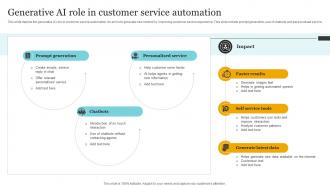
This slide depicts the generative AI role in customer service automation. Its aim is to generate new content by improving customer service experience. This slide include prompt generation, use of chatbots and personalised service.
People who downloaded this PowerPoint presentation also viewed the following :
Generative Ai Role In Customer Service Automation with all 9 slides:
Use our Generative Ai Role In Customer Service Automation to effectively help you save your valuable time. They are readymade to fit into any presentation structure.








FAQs for Generative Ai Role In
Key ethical considerations include bias in training data, intellectual property infringement, transparency about AI-generated content, authenticity concerns, and potential job displacement for creative professionals. These challenges present both risks and opportunities, with many organizations finding that establishing clear guidelines, ensuring diverse datasets, and maintaining human oversight ultimately delivers responsible innovation while preserving creative integrity and competitive advantage.
Businesses integrate generative AI into marketing through automated content creation, personalized customer messaging, dynamic ad generation, predictive analytics, and social media management. These technologies streamline campaign development by producing targeted copy, visual assets, and customer insights at scale, with many retail and financial services companies finding that AI-driven personalization ultimately delivers higher engagement rates and improved conversion outcomes.
Generative AI revolutionizes creative industries by automating composition, generating visual concepts, personalizing content recommendations, and streamlining production workflows across music, film, and digital art. While enhancing creative efficiency and enabling rapid prototyping, it presents both collaboration opportunities and authenticity challenges, with many studios and artists finding that strategic integration ultimately delivers faster content creation and broader creative exploration possibilities.
Generative AI significantly complicates intellectual property rights by blurring ownership lines between human creators, AI developers, and training data sources. While AI-generated content raises questions about copyright eligibility and fair use, many organizations are finding that clear licensing agreements, attribution protocols, and strategic IP policies help navigate these challenges, ultimately enabling innovation while protecting creative assets.
**INPUT**: What are the best practices for evaluating the quality and originality of content generated by AI? **OUTPUT**: Best practices include implementing human oversight workflows, using plagiarism detection tools, establishing content scoring rubrics, conducting bias audits, and performing factual verification processes. These evaluation methods streamline quality assurance by ensuring accuracy, maintaining brand voice consistency, and protecting intellectual property, with many organizations finding that systematic review protocols ultimately deliver higher content standards and reduced compliance risks. *[Word count: 58 words]*
Educators can utilize generative AI tools through personalized tutoring systems, automated content creation, adaptive assessment platforms, interactive simulations, and intelligent feedback mechanisms. These technologies streamline lesson planning, enhance student engagement through customized learning paths, and enable real-time performance tracking, with many schools finding that AI-powered tools ultimately deliver more efficient teaching workflows and significantly improved student comprehension rates.
**INPUT**: What are the potential dangers of misinformation when using generative AI technologies? **OUTPUT**: Misinformation dangers include fabricated content appearing authentic, biased outputs from flawed training data, hallucinations presenting false information confidently, and rapid spread through automated systems. While these challenges require careful oversight, organizations increasingly implement verification protocols, human review processes, and transparency measures, ultimately delivering more reliable AI applications with proper governance frameworks in place. **Word count: 58 words**
Generative AI enhances e-commerce personalization by analyzing customer behavior, purchase history, and preferences to create tailored product recommendations, dynamic content, and customized interfaces. Through machine learning algorithms, retailers deliver personalized marketing campaigns, individualized pricing strategies, and targeted promotional content, ultimately improving customer engagement and conversion rates while reducing cart abandonment across digital platforms.
Generative AI assists data analysis through automated pattern detection, predictive modeling, synthetic data generation, anomaly identification, and advanced visualization creation. These capabilities enable organizations to uncover hidden insights, accelerate decision-making processes, and enhance forecasting accuracy across sectors like finance, healthcare, and retail, ultimately delivering faster analytics and competitive intelligence advantages.
Developers face challenges including acquiring high-quality industry-specific datasets, ensuring regulatory compliance, managing computational costs, and addressing domain-specific bias issues when training generative models. These obstacles require strategic data partnerships, specialized expertise, and significant resource allocation, with many organizations finding that collaborative approaches between AI teams and industry experts ultimately deliver more effective, compliant solutions.
Generative AI enhances product design efficiency by automating concept generation, optimizing material usage, and accelerating iteration cycles through rapid prototyping simulations. These technologies streamline workflows by reducing manual design work, enabling faster testing of multiple variants, and minimizing physical prototype costs, with manufacturing companies finding significantly shorter development timelines and enhanced innovation capabilities.
Transparency measures include model documentation, algorithmic auditing, bias testing, output provenance tracking, and clear disclosure of AI-generated content. Organizations implement these through comprehensive governance frameworks, regular performance reviews, and stakeholder feedback loops, with many financial services and healthcare institutions finding that systematic monitoring enhances trust while delivering competitive advantage.
Cultural differences significantly influence generative AI outputs through language nuances, cultural contexts, regional preferences, and societal values embedded in training data. Organizations expanding globally find that AI models trained on Western datasets may misinterpret cultural references, communication styles, and consumer behaviors, ultimately requiring localized training approaches and cultural adaptation strategies for effective market penetration.
Future generative AI advancements include multimodal capabilities combining text, voice, and visual processing, autonomous reasoning systems, personalized customer interaction engines, and real-time decision-making frameworks. These technologies streamline operations by automating complex workflows, enhancing customer experiences, and accelerating innovation cycles, with many organizations finding that early adoption delivers significant competitive advantages in increasingly dynamic markets.
Organizations address biases in generative AI through diverse training datasets, regular algorithmic auditing, and inclusive development teams. By implementing bias detection tools, establishing ethical AI governance frameworks, and continuously monitoring outputs, companies like financial institutions and healthcare providers can minimize discriminatory patterns while ensuring fair, equitable AI-driven decision-making across their operations.
-
I can say with full confidence that all your business, academic, or professional work requirements will be sufficed with SlideTeam. Their gallery is as rich as 2Million+!!
-
“Excellent service from the customer support team when I wanted a slide that was a bit different from those on their standard menu. Super helpful.”