

Global Wine Industry Report Powerpoint Presentation Slides IR





Try Before you Buy Download Free Sample Product
 Impress Your
Audience
 100%
Editable
 Save Hours
of Time


The global wine market is expected to be USD 484.91 billion by 2030, with a CAGR of 5.52percent. Get our professionally designed Global Wine Industry Report - Industry Segmentation PowerPoint presentation. It presents a comprehensive Industry Report. Firstly, the Wine market size PPT templates cover critical aspects, including market size, showcasing the exponential growth and market potential. Furthermore, the Trends and Challenges PPT slides present the latest trends shaping the industry. A detailed competitor analysis is also added, helping to understand where the organization stands in the market. Lastly, the presentation concludes with a Porter, SWOT, and PESTLE analysis that offers strategic perspectives on gaining a competitive edge. Download this 100percent editable and customizable PowerPoint, compatible with Google Slides, to streamline your presentation process.
People who downloaded this PowerPoint presentation also viewed the following :
Content of this Powerpoint Presentation
Slide 1: This slide introduces Global Wine Industry Report. State your company name and begin.
Slide 2: This is an Agenda slide. State your agendas here.
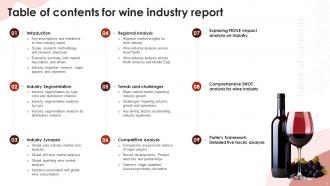
Slide 3: This slide shows Table of Content for the presentation.
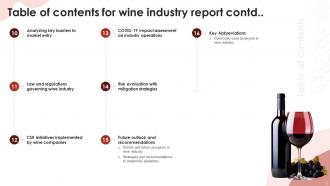
Slide 4: This slide continues showing Table of Content for the presentation.
Slide 5: This slide shows title for topics that are to be covered next in the template.
Slide 6: This slide represents key considerations and limitations while building the wine industry report.
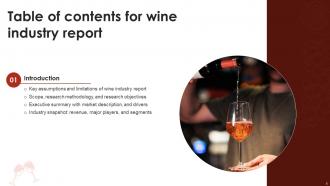
Slide 7: This slide shows the overview of the wine industry report. It sets the stage for subsequent content by introducing the key topics covered in the report.
Slide 8: This slide presents a concise overview of the wine industry, serving as a valuable resource for industry professionals, investors, and policymakers.
Slide 9: This slide provides a glimpse of key highlights of the wine industry, enabling executives to grasp the main findings quickly.
Slide 10: This slide shows title for topics that are to be covered next in the template.
Slide 11: This slide showcases the wine industry segmentation based on attributes such as type, distribution channel, color, and region.
Slide 12: This slide identify and understand the segments within the wine industry based on types, such as still, sparkling and fortified.
Slide 13: This slide highlights the global wine industry segmentation based on distribution channel.
Slide 14: This slide shows title for topics that are to be covered next in the template.
Slide 15: This slide depicts the global wine industry market size analysis from 2022 to 2030 along with its key insights.
Slide 16: This slide highlights a comprehensive overview of the still wine industry.
Slide 17: This slide outlines the analysis of global sparkling wine market. The purpose of This slide is to identify key trends enabling stakeholders to make informed decisions.
Slide 18: This slide presents a comprehensive overview of quantitative data and trends related to the consumption of wine.
Slide 19: This slide displays a comprehensive overview of quantitative data and trends related to the consumption of wine.
Slide 20: This slide shows title for topics that are to be covered next in the template.
Slide 21: This slide illustrate regional segmentation of wine industry and provide regional dynamics and assist stakeholders.
Slide 22: This slide highlights current state of wine industry in Asia Pacific. The purpose of this slide is to provide insights on wine market landscape, trends etc.
Slide 23: This slide also highlights current state of wine industry in Asia Pacific.
Slide 24: This slide showcases the wine industry analysis of North America, middle east and Africa region.
Slide 25: This slide shows title for topics that are to be covered next in the template.
Slide 26: This slide presents the latest trends in the global wine industry. It helps stakeholders in identifying the major market shifts or any disruptions.
Slide 27: This slide analyzes challenges faced by wine industry. It will assist stakeholders to devise effective strategies and solutions to overcome the repercussions.
Slide 28: This slide provide a comprehensive overview of the growth prospects in the wine market.
Slide 29: This slide also provide a comprehensive overview of the growth prospects in the wine market.
Slide 30: This slide shows title for topics that are to be covered next in the template.
Slide 31: This slide presents the key players in the wine industry and provide glimpse and competitor analysis of major players.
Slide 32: This slide highlights recent news and developments of major key players in the wine industry, enabling stakeholders to stay informed and make informed decisions.
Slide 33: This slide illustrates Gartner's magic quadrant framework for analyzing the competitive ability of wine companies.
Slide 34: This slide shows title for topics that are to be covered next in the template.
Slide 35: This slide depicts PESTLE analysis which companies can use to evaluate the external factors that impact the industry's growth and profitability.
Slide 36: This slide also depicts PESTLE analysis which companies can use to evaluate the external factors that impact the industry's growth and profitability.
Slide 37: This slide shows title for topics that are to be covered next in the template.
Slide 38: This slide covers the wine industry's strengths, weaknesses, opportunities, and threats.
Slide 39: This slide shows title for topics that are to be covered next in the template.
Slide 40: This slide highlights Porter’s framework and its implications in the wine industry.
Slide 41: This slide shows title for topics that are to be covered next in the template.
Slide 42: This slide exhibits significant barriers to wine market entry. These barriers make it difficult for new companies to compete with established players in the industry.
Slide 43: This slide shows title for topics that are to be covered next in the template.
Slide 44: This slide provides a comprehensive overview of the rules and regulations governing the wine industry.
Slide 45: This slide shows title for topics that are to be covered next in the template.
Slide 46: This slide outlines CSR initiatives undertaken by the wine industry. The purpose of This slide is to encourage ethical practices, social responsibility etc.
Slide 47: This slide shows title for topics that are to be covered next in the template.
Slide 48: This slide represents a comprehensive analysis of the covid-19 impact on the wine industry.
Slide 49: This slide shows title for topics that are to be covered next in the template.
Slide 50: This slide depicts risk assessment in wine industry. It aims to educate the audience on the need of successfully recognizing and managing risks.
Slide 51: This slide shows title for topics that are to be covered next in the template.
Slide 52: This slide highlights the future outlook and potential for the wine industry.
Slide 53: This slide provides valuable recommendations and effective strategies for wine industry players to succeed in a dynamic and competitive market.
Slide 54: This slide shows title for topics that are to be covered next in the template.
Slide 55: This slide represents acronyms and terminology used in wine industry and aims to help audience better comprehend and navigate industry specific language.
Slide 56: This slide shows all the icons included in the presentation.
Slide 57: This slide is titled as Additional Slides for moving forward.
Slide 58: This slide presents Roadmap with additional textboxes. It can be used to present different series of events.
Slide 59: This is an Idea Generation slide to state a new idea or highlight information, specifications etc.
Slide 60: This slide presents Roadmap with additional textboxes. It can be used to present different series of events.
Slide 61: This slide depicts Venn diagram with text boxes.
Slide 62: This is a Thank You slide with address, contact numbers and email address.
Global Wine Industry Report Powerpoint Presentation Slides IR with all 70 slides:
Use our Global Wine Industry Report Powerpoint Presentation Slides IR to effectively help you save your valuable time. They are readymade to fit into any presentation structure.


























































FAQs for Global Wine Industry Report Powerpoint
Current trends shaping the global wine industry include sustainable viticulture practices, premiumization of products, direct-to-consumer sales growth, natural and organic wine demand, and digital marketing adoption. These developments enhance market positioning by reducing environmental impact, increasing profit margins, and expanding customer reach, with many wineries finding that sustainability initiatives and e-commerce integration deliver competitive advantages in increasingly conscious consumer markets.
COVID-19 significantly disrupted global wine consumption and production through restaurant closures, supply chain interruptions, harvest labor shortages, and shifting consumer preferences toward home consumption. While many wineries experienced initial revenue declines and distribution challenges, the industry adapted through direct-to-consumer sales, virtual tastings, and e-commerce expansion, ultimately delivering new market opportunities and enhanced digital engagement strategies.
Emerging wine regions include South Africa, Argentina, Chile, Australia, and New Zealand, alongside traditional areas like Eastern Europe and Asia-Pacific markets. These regions are revolutionizing global wine production through innovative techniques, diverse terroirs, and competitive pricing strategies, with many wineries finding that modern technology and sustainable practices ultimately deliver distinctive products and significant market penetration in increasingly crowded international markets.
Climate change influences grape growing through altered precipitation patterns, temperature fluctuations, shifting harvest seasons, and changing soil conditions, which directly impact grape quality and yield. These environmental changes present both challenges and opportunities, with many wineries finding that strategic vineyard relocations, drought-resistant varietals, and adaptive cultivation techniques ultimately enable sustained production while enhancing terroir characteristics in emerging regions.
Tariff policies and trade agreements significantly impact wine pricing, market access, distribution channels, and competitive dynamics across international markets. Through reduced trade barriers, wine producers can expand into new regions while avoiding prohibitive import duties, with countries like Australia and Chile leveraging strategic trade partnerships to enhance market penetration, ultimately delivering cost efficiencies and broader consumer access.
Technology transforms wine production through precision viticulture, IoT sensors, automated harvesting systems, AI-driven quality control, and blockchain traceability solutions. These innovations enable wineries to optimize grape cultivation, reduce operational costs, and enhance product authenticity, while digital marketing platforms and virtual tastings increasingly deliver personalized customer experiences and expand global market reach.
Sustainability drives wine industry transformation through organic farming practices, water conservation technologies, renewable energy adoption, carbon footprint reduction, and eco-friendly packaging solutions. Leading wineries across California, France, and Australia increasingly find that sustainable methods enhance brand reputation, reduce operational costs, attract environmentally conscious consumers, and ensure long-term viability in climate-changing conditions.
Consumer preferences are shifting toward organic and biodynamic wines driven by health consciousness, environmental awareness, and quality perceptions, with millennials and Gen Z leading this demand. Wine retailers, premium restaurants, and specialty stores increasingly report that these sustainable options command higher prices while delivering enhanced customer loyalty, ultimately enabling wineries to differentiate themselves in an increasingly competitive market.
Small wineries face challenges including limited distribution networks, higher production costs, restricted marketing budgets, difficulty securing retail shelf space, and reduced economies of scale. However, these boutique producers increasingly leverage their authenticity, personalized customer experiences, and unique terroir storytelling to build loyal followings, with many finding that direct-to-consumer sales and wine tourism create sustainable competitive advantages.
E-commerce transforms wine distribution by enabling direct-to-consumer sales, reducing reliance on traditional retailers, and expanding market reach through digital platforms. Online wine retailers streamline inventory management, enhance customer experiences through personalized recommendations, and deliver cost-effective distribution, with many wineries finding that digital channels provide better margins and deeper customer relationships.
Key demographics driving wine consumption include millennials embracing premium wines, affluent Gen X consumers seeking quality experiences, urban professionals prioritizing convenience, health-conscious women choosing organic varieties, and emerging middle classes in Asia-Pacific markets. These consumer segments are reshaping regional wine markets through diverse preferences, with European millennials favoring natural wines while Asian consumers increasingly demand luxury imports, ultimately delivering sustained growth and market diversification across global wine regions.
Cultural perceptions of wine vary dramatically across countries, influenced by religious traditions, historical consumption patterns, social customs, and economic factors. While European nations like France and Italy view wine as everyday cultural staples, countries like Japan emphasize ceremonial aspects, and emerging markets in Asia increasingly associate wine with status and sophistication, ultimately creating diverse market opportunities for global wine producers.
**INPUT**: What innovations in packaging and labeling are influencing consumer choices? **OUTPUT**: Packaging innovations include lightweight bottles, eco-friendly materials, premium closures, interactive QR codes, and augmented reality labels. These technologies enhance brand storytelling by delivering sustainability messaging, providing vineyard transparency, and enabling direct consumer engagement, with many wineries finding that innovative packaging significantly influences purchasing decisions while reducing environmental impact. **Word count: 52 words**
Health trends significantly impact wine consumption through moderation awareness, organic preferences, lower-alcohol options, and wellness-focused marketing approaches. These shifts present both challenges and opportunities for producers, with many wineries finding that positioning products as part of balanced lifestyles, emphasizing natural production methods, and developing premium lower-alcohol alternatives ultimately delivers competitive advantage in increasingly health-conscious markets.
Social media revolutionizes winery marketing by enabling direct consumer engagement, storytelling through vineyard experiences, influencer partnerships, virtual tastings, and targeted demographic campaigns. These platforms allow wineries to showcase terroir authenticity, harvest processes, and winemaker expertise, with many establishments finding that Instagram and Facebook significantly boost brand visibility, customer loyalty, and direct-to-consumer sales.
-
SlideTeam is my one-stop destination for templates. Highly recommended!
-
SlideTeam was so customer-centric and quick service-provider that I doubted the amount I was paying and literally re-checked the transaction.