

Goal Orientation As A Soft Skill Required For Sales Training Ppt




Try Before you Buy Download Free Sample Product
 Impress Your
 Audience
 100%
100% Editable
 Save Hours
 of Time


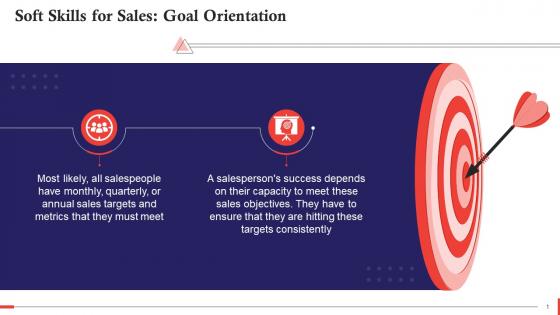
This slide discusses the importance of goal orientation as a soft skill for sales. All salespeople have monthly, quarterly, or annual sales targets and metrics they must meet. A salespersons success depends on their capacity to meet these sales objectives.
People who downloaded this PowerPoint presentation also viewed the following :
Goal Orientation As A Soft Skill Required For Sales Training Ppt with all 16 slides:
Use our Goal Orientation As A Soft Skill Required For Sales Training Ppt to effectively help you save your valuable time. They are readymade to fit into any presentation structure.











FAQs for Goal Orientation As A Soft Skill Required For
Goal-oriented and task-oriented mindsets differ in focus, encompassing long-term vision, strategic prioritization, and outcome-driven approaches versus immediate steps, procedural execution, and activity completion. While task-oriented individuals excel at efficient execution, goal-oriented professionals enhance strategic combination by aligning efforts with overarching objectives, ultimately delivering increased innovation and competitive advantage. With many organizations finding that a blend of both fosters operational efficiency and sustained growth, these approaches present both challenges and opportunities.
SMART goals—Specific, Measurable, Achievable, Relevant, and Time-bound—enhance team productivity by providing clarity, focus, and a structured approach to task completion. While demanding initial planning, these goals streamline workflows by enabling better resource allocation, progress tracking, and accountability across departments like marketing and finance. Ultimately delivering increased efficiency and improved outcomes, with many organizations finding that focused objectives minimize wasted effort and accelerate project timelines.
Intrinsic motivation, encompassing enjoyment, satisfaction, and personal values, plays a crucial role in achieving personal goals by fueling sustained effort, enhancing creativity, and fostering resilience. While external rewards can be helpful, intrinsic drive enables individuals to persevere through challenges, with many finding that passion-driven pursuits deliver greater fulfillment and ultimately, more significant long-term success across industries like education and entrepreneurship.
Visualization techniques improve goal attainment in presentations by fostering confidence, refining delivery, and anticipating audience reactions. These methods enable presenters to mentally rehearse scenarios, streamlining responses to challenging questions and enhancing overall stage presence, with many finding that proactive mental preparation ultimately delivers impactful messaging and stronger audience connections.
Goal-setting procrastination can be overcome through task decomposition, timeboxing, and accountability partnerships, while simultaneously leveraging positive reinforcement and minimizing distractions. These strategies enhance focus by breaking down large objectives, scheduling dedicated work periods, and fostering commitment, with many professionals finding that consistent small wins ultimately deliver momentum and increased productivity.
Organizations can foster a culture of goal orientation by implementing clear objectives, providing regular feedback, and linking performance to rewards. These strategies enhance employee engagement, streamline workflows, and accelerate progress towards key results, while also presenting both challenges and opportunities for adaptation. With many institutions finding that transparent goal setting improves operational efficiency and ultimately delivers increased productivity and a competitive advantage.
Aggressive goal-setting, while motivating, presents both challenges and opportunities, potentially leading to burnout, unethical behavior, and decreased collaboration. While increased productivity can result, it also risks fostering a hyper-competitive environment, particularly in sectors like finance and sales. These approaches can streamline short-term gains, but ultimately delivering diminished employee well-being and hindering long-term innovation with many organizations finding that sustainable success requires balanced objectives.
Personal values significantly impact goal setting by shaping priorities, influencing motivation, and dictating acceptable strategies, with individuals naturally gravitating towards objectives aligned with their core beliefs. While ambition drives many, deeply held values—like integrity or community—ensure goals are pursued ethically and sustainably, ultimately delivering greater fulfillment and long-term success, with many organizations finding that value-driven employees exhibit increased commitment.
Technology assists in tracking and managing progress towards goals through project management software, data analytics dashboards, and automated reporting systems. These tools streamline workflows by enabling real-time monitoring, identifying bottlenecks, and facilitating data-driven decision-making, with many financial services and healthcare institutions finding that enhanced transparency ultimately delivers improved operational efficiency and faster achievement of key performance indicators.
Leaders can effectively communicate goals to inspire teams by clearly articulating vision, outlining specific objectives, and fostering open dialogue, ultimately driving alignment. While detailed plans are crucial, it also requires connecting those goals to individual roles and recognizing contributions, with many organizations finding that transparent communication enhances employee engagement and delivers increased productivity and innovation.
Key metrics for gauging goal success include Key Performance Indicators (KPIs), Return on Investment (ROI), Customer Acquisition Cost (CAC), and Net Promoter Score (NPS). These measurements streamline performance tracking by quantifying progress, identifying bottlenecks, and enabling data-driven decisions, with many financial services institutions finding that consistent monitoring delivers enhanced operational efficiency and competitive advantage.
Goal orientation significantly influences company performance by shaping strategic alignment, resource allocation, and employee motivation. While learning orientation fosters innovation and adaptation, performance orientation drives efficiency and results, with many institutions finding that a strategic combination delivers sustained competitive advantage. Ultimately, this enables enhanced operational efficiency and improved customer experiences in an increasingly dynamic landscape.
Effective goal setting faces barriers like unclear definitions, lack of commitment, and insufficient resource allocation, alongside unrealistic expectations and fear of failure. These challenges can be overcome by employing the SMART criteria—Specific, Measurable, Achievable, Relevant, and Time-bound—while organizations increasingly find that fostering a culture of accountability enhances commitment, ultimately delivering improved performance and strategic advantage.
Feedback loops improve goal orientation processes in teams by enabling continuous monitoring, course correction, and enhanced accountability through regular check-ins, performance reviews, and 360-degree assessments. While implementing these systems requires initial investment, organizations—like hospitals and financial services—find that transparent feedback streamlines workflows, ultimately delivering increased efficiency and better customer experiences.
Growth mindset significantly impacts goal orientation in learning environments by fostering resilience, embracing challenges, and valuing effort over innate ability. While fixed mindsets prioritize performance goals—seeking validation—growth mindsets encourage learning goals, ultimately delivering deeper understanding and sustained motivation. With many institutions finding that cultivating this approach enhances student engagement, it streamlines personalized learning paths and accelerates skill development.
-
The designs by SlideTeam are honestly the best I have seen so far. Will be definitely coming back for more.
-
Nothing beats the well-formatted and professionally designed templates offered. Kudos to SlideTeam for their amazing collection of PPT slides.