


Google Quantum Computer Unleashing The Power Of Advanced Computing AI CD




Try Before you Buy Download Free Sample Product
 Impress Your
 Audience
 100%
100% Editable
 Save Hours
 of Time


Check out our professionally designed Google Quantum Computer Unleashing the power of an advanced computing template that leverages the ability of quantum mechanics to conduct fast calculations and solve complex problems. This Quantum supremacy deck initially showcases a quantum computing overview, which includes key features, benefits, brief history, and key statistics. Moreover, Quantum software PowerPoint also highlights Googles quantum computing overview, which provides for past journeys, computing partnerships, key features, benefits, and ethical and responsible principles. Furthermore, Artificial Intelligence PPT also shows key players operating in the quantum computing market. Also, the Sycamore processor presentation highlights various Google quantum computing hardware and software systems. Lastly, this Quantum theory module also shows the team involved in the Google quantum computing project and future trends and potential that will shape the industry. Get access to our powerful artificial intelligence ppt now.
People who downloaded this PowerPoint presentation also viewed the following :
Content of this Powerpoint Presentation
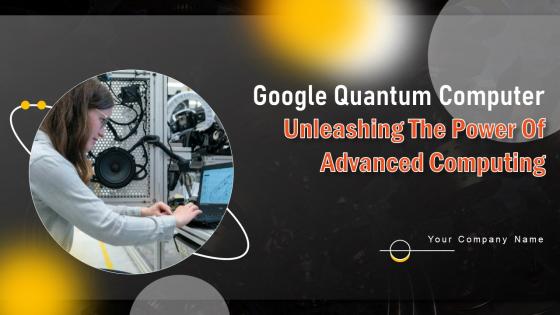
Slide 1: The slide introduces Google Quantum Computer Unleashing The Power Of Advanced Computing.
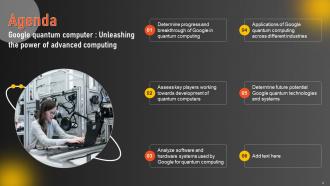
Slide 2: This is an Agenda slide. State your agendas here.
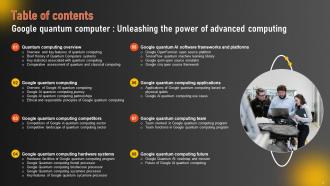
Slide 3: The slide displays Table of contents for presentation.
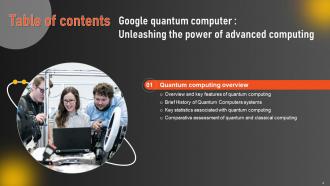
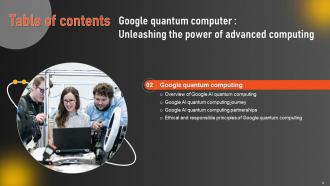
Slide 4: The slide again depicts Table of contents.
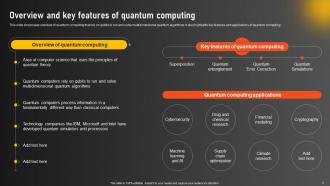
Slide 5: This slide showcases overview of quantum computing that rely on qubits to run and solve multidimensional quantum algorithms.
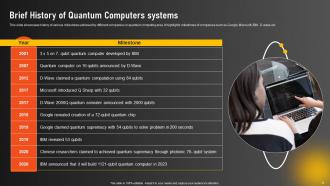
Slide 6: This slide exhibits history of various milestones achieved by different companies in quantum computing area.
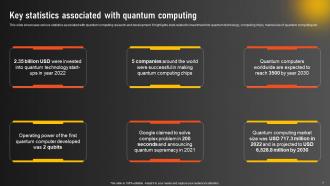
Slide 7: This slide represents various statistics associated with quantum computing research and development.
Slide 8: This slide shows comparative assessment of classical and quantum computing system.
Slide 9: The slide highlights title of contents further.
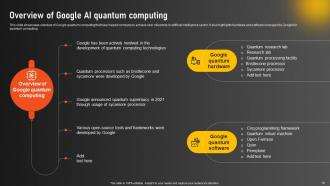
Slide 10: This slide gives overview of Google quantum computing that have helped company to achieve new milestone in artificial intelligence sector.
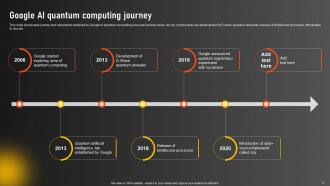
Slide 11: This slide represents journey and milestones achieved by Google in quantum computing area over last few years.
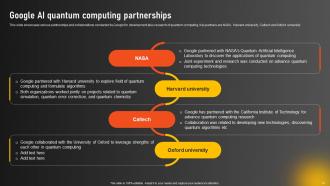
Slide 12: This slide displays various partnerships and collaborations conducted by Google for development plus research of quantum computing.
Slide 13: This slide shows various ethical and responsible principles followed by Google for quantum computing development plus deployment.
Slide 14: The slide contains another title of contents.
Slide 15: This slide highlights various competitors working towards development and deployment of quantum computing technologies.
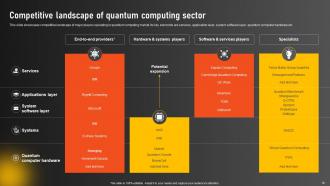
Slide 16: This slide shows competitive landscape of major players operating in quantum computing market.
Slide 17: The slide again displays title of contents.
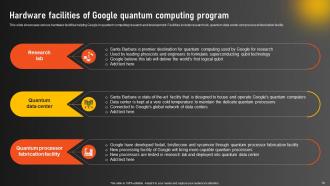
Slide 18: This slide presents various hardware facilities helping Google in quantum computing research and development.
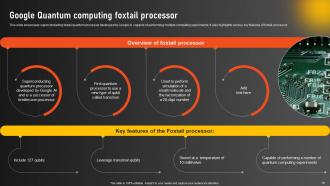
Slide 19: This slide shows superconducting foxtail quantum processor developed by Google AI.
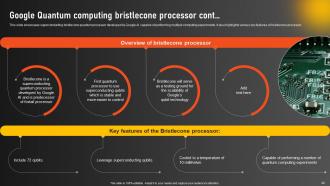
Slide 20: This slide continues superconducting bristlecone quantum processor developed by Google AI.
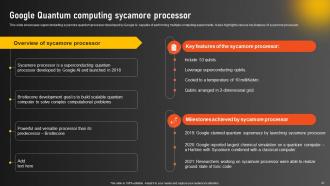
Slide 21: This slide again renders superconducting sycamore quantum processor developed by Google AI.
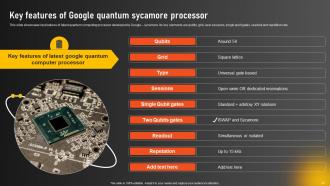
Slide 22: This slide showcases key features of latest quantum computing processor developed by Google – sycamore.
Slide 23: The slide describes title of contents further.
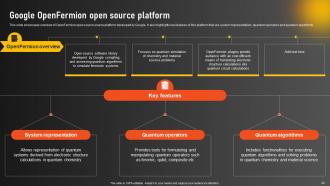
Slide 24: This slide highlights overview of OpenFermion open source source platform developed by Google.
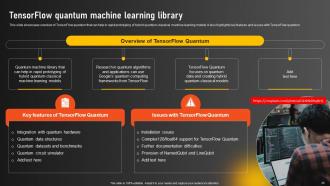
Slide 25: This slide shows overview of TensorFlow quantum that can help in rapid prototyping of hybrid quantum-classical machine learning models.
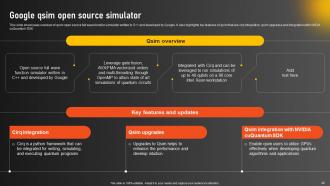
Slide 26: This slide illustrates overview of qsim open source full wave function simulator written in C++ and developed by Google.
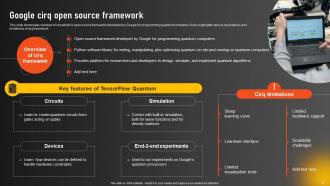
Slide 27: This slide gives overview of cirq which is open source framework developed by Google for programming quantum computers.
Slide 28: The slide exhibits title of contents further.
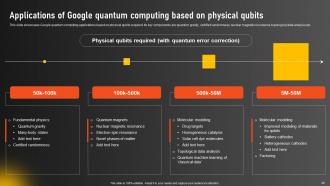
Slide 29: This slide shows Google quantum computing applications based on physical qubits required.
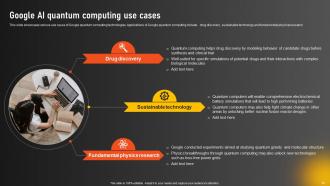
Slide 30: This slide highlights various use cases of Google quantum computing technologies.
Slide 31: The slide displays Title of contents further.
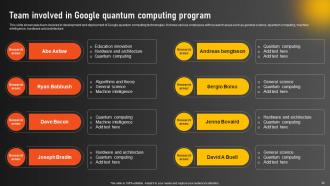
Slide 32: This slide showcases team involved in development and deployment of Google quantum computing technologies.
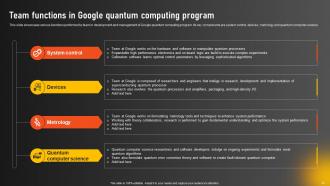
Slide 33: This slide renders various functions performed by team in development and management of Google quantum computing program.
Slide 34: The slide displays title of contents which is to be discussed further.
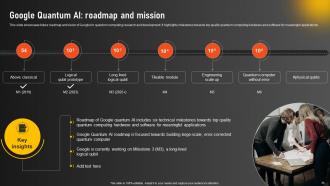
Slide 35: This slide displays future roadmap and vision of Google for quantum computing research and development.
Slide 36: This slide illustrates future plans and potential of Google AI quantum computing technologies.
Slide 37: This slide shows all the icons included in the presentation.
Slide 38: This slide is titled as Additional Slides for moving forward.
Slide 39: This slide presents Roadmap with additional textboxes.
Slide 40: This slide provides 30 60 90 Days Plan with text boxes.
Slide 41: This slide shows Post It Notes. Post your important notes here.
Slide 42: This is a Timeline slide. Show data related to time intervals here.
Slide 43: This is Our Target slide. State your targets here.
Slide 44: This slide contains Puzzle with related icons and text.
Slide 45: This is a Thank You slide with address, contact numbers and email address.
Google Quantum Computer Unleashing The Power Of Advanced Computing AI CD with all 50 slides:
Use our Google Quantum Computer Unleashing The Power Of Advanced Computing AI CD to effectively help you save your valuable time. They are readymade to fit into any presentation structure.















FAQs for Google Quantum Computer Unleashing The Power Of Advanced
Google's quantum computing technology relies on quantum superposition, quantum entanglement, error correction algorithms, quantum gate operations, and specialized qubit architectures using superconducting circuits. These principles work together by enabling parallel processing of multiple states simultaneously, maintaining quantum coherence through advanced error mitigation, and executing complex calculations exponentially faster than classical computers, with applications in cryptography, optimization, and machine learning ultimately delivering significant computational advantages for research institutions and enterprises.
Google's quantum computer Sycamore demonstrates quantum supremacy by performing specific calculations exponentially faster than classical computers, completing tasks in minutes that would take traditional supercomputers thousands of years. While currently limited to specialized problems, this computational advantage enables breakthroughs in cryptography, drug discovery, and financial modeling, with organizations increasingly exploring quantum applications for competitive advantage.
Google's quantum processors have demonstrated Shor's algorithm for factoring, Grover's search algorithm, variational quantum eigensolvers (VQE), quantum approximate optimization algorithms (QAOA), and quantum machine learning protocols. These algorithms enable breakthrough capabilities in cryptography, database searches, molecular simulation, and optimization problems, with financial services, pharmaceutical research, and logistics companies increasingly exploring quantum advantages for complex computational challenges.
Quantum entanglement enables Google's quantum processors to create interconnected qubit states that process information exponentially faster than classical systems, with their Sycamore chip leveraging entangled particles for complex calculations. This quantum phenomenon allows Google to tackle optimization problems, cryptography, and machine learning applications that would take traditional computers millennia, ultimately delivering breakthrough computational advantages across research and commercial sectors.
Google faces significant challenges including quantum error rates, maintaining qubit stability at scale, developing error correction algorithms, and creating practical software interfaces for developers. These technical hurdles require substantial investment in specialized infrastructure and talent, with quantum systems needing near-absolute zero temperatures and isolation, ultimately presenting both engineering complexity and commercial viability questions for widespread adoption.
Quantum computing can revolutionize cryptography by breaking current encryption methods while enabling quantum-resistant security protocols, and transform machine learning through exponentially faster pattern recognition, optimization algorithms, and data processing capabilities. Financial institutions and healthcare organizations are exploring quantum applications for fraud detection, drug discovery, and risk modeling, ultimately delivering unprecedented computational advantages that could reshape competitive landscapes across industries.
Google's 2019 quantum supremacy demonstration proved quantum computers could solve specific problems exponentially faster than classical supercomputers, completing a calculation in 200 seconds that would take traditional computers thousands of years. This breakthrough validates quantum computing's potential for revolutionizing cryptography, drug discovery, and financial modeling, with industries increasingly recognizing quantum technology's strategic advantage for complex optimization challenges.
Google's quantum research teams address error rates through quantum error correction codes, surface code implementation, advanced calibration techniques, and real-time error monitoring systems. These approaches significantly reduce computational errors by isolating logical qubits from environmental interference, continuously adjusting system parameters, and implementing sophisticated correction algorithms, with many researchers finding that these combined strategies enhance quantum system reliability and scalability.
Google's Quantum AI lab drives quantum computing advancement through breakthrough hardware development, algorithm research, quantum error correction, and strategic partnerships with academic institutions and industry leaders. The lab's work on quantum supremacy demonstrations, practical applications in optimization and machine learning, and open-source quantum software platforms enables organizations across sectors to explore quantum solutions, ultimately accelerating commercial viability and competitive advantage.
Industries outside tech can leverage Google's quantum computing through enhanced optimization, accelerated research, and improved security capabilities across their operations. Financial services can revolutionize risk modeling and fraud detection, healthcare can accelerate drug discovery and personalized medicine, while manufacturing and logistics can optimize supply chains and resource allocation, ultimately delivering competitive advantages and operational efficiencies.
Google collaborates with academic institutions like MIT and Stanford, industry partners including NASA and Volkswagen, and quantum computing companies such as IonQ and Rigetti through its Google Quantum AI division. These strategic partnerships enhance research capabilities, accelerate practical applications in optimization and simulation, and expand quantum algorithm development, with many organizations finding that collaborative approaches deliver faster breakthroughs and competitive advantages.
Google focuses on superconducting qubits and achieving quantum supremacy through specialized processors like Sycamore, while IBM emphasizes cloud-accessible quantum systems and Microsoft develops topological qubits with integrated software platforms. These distinct approaches enable different applications, with Google targeting computational breakthroughs, IBM focusing on enterprise accessibility, and Microsoft pursuing fault-tolerant systems, ultimately delivering varied pathways for quantum advancement.
Google's quantum computing advancements present ethical implications including data privacy vulnerabilities, cybersecurity disruption, potential job displacement through automation, and widening technological inequality between organizations. While these concerns require careful consideration, companies increasingly find that proactive ethical frameworks, responsible development practices, and strategic workforce retraining ultimately deliver competitive advantage while minimizing societal risks.
Google addresses quantum accessibility through Cirq for programming quantum circuits, Quantum AI collaborations with universities, cloud-based quantum processors, and comprehensive educational resources including documentation and tutorials. These initiatives enable researchers across institutions to experiment with quantum algorithms, develop applications, and advance their skills, while partnerships with academic centers accelerate research breakthroughs, ultimately democratizing quantum computing development and fostering innovation across multiple sectors.
Researchers envision Google Quantum Computing revolutionizing everyday technologies through enhanced drug discovery, personalized medicine recommendations, advanced weather forecasting, and ultra-secure financial transactions. These applications could streamline healthcare diagnostics, optimize traffic management systems, and accelerate artificial intelligence capabilities, with many industries finding that quantum-enhanced algorithms ultimately deliver faster processing speeds and more precise predictive modeling.
-
Exclusive and extensive collection of templates. Really helped me create a professional presentation in just no time.
-
“I always have a wonderful experience with SlideTeam. It's my ""go to"" when I need a template.”