

Grab Business Investments Grab Investor Funding Pitch Deck Ppt Inspiration Format





Try Before you Buy Download Free Sample Product
 Impress Your
Audience
 100%
Editable
 Save Hours
of Time


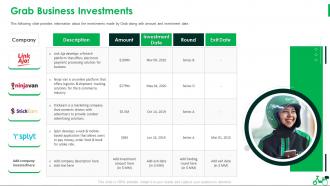
This following slide provides information about the investments made by Grab along with amount and investment date.
People who downloaded this PowerPoint presentation also viewed the following :
Grab Business Investments Grab Investor Funding Pitch Deck Ppt Inspiration Format with all 6 slides:
Use our Grab Business Investments Grab Investor Funding Pitch Deck Ppt Inspiration Format to effectively help you save your valuable time. They are readymade to fit into any presentation structure.





FAQs for Grab Business Investments Grab Investor Funding Pitch Deck
Every investor pitch deck must include problem identification, solution presentation, market opportunity analysis, business model explanation, competitive landscape assessment, financial projections, team credentials, and funding requirements. These elements work together by demonstrating market need, showcasing strategic positioning, and building investor confidence, with successful startups finding that comprehensive decks significantly enhance their ability to secure funding and establish credibility.
Storytelling transforms investor pitch decks by weaving customer pain points, solution narratives, and market opportunities into compelling problem-solution arcs that resonate emotionally with investors. Through structured narrative frameworks, startups can illustrate traction milestones, showcase user testimonials, and demonstrate market validation, while connecting financial projections to relatable scenarios, ultimately delivering memorable presentations that inspire confidence and investment commitment.
Effective pitch deck visuals include clean charts showing market growth trajectories, compelling infographics that simplify complex business models, professional product screenshots, customer testimonials with photos, and clear financial projections with trend lines. These visual elements enhance storytelling by making data digestible, building credibility through social proof, and demonstrating market opportunity, with many successful startups finding that investors respond most positively to visuals that combine emotional appeal with concrete evidence of traction and scalability potential.
Pitch decks should emphasize different elements for each investor type, with angel investor presentations focusing on founder credentials, market opportunity, and early traction, while venture capitalist decks prioritize scalability metrics, competitive analysis, and detailed financial projections. Angel investors often value personal connections and founding team expertise, whereas VCs require comprehensive market sizing, unit economics, and clear exit strategies, ultimately enabling founders to address each group's specific investment criteria and risk preferences.
Common startup pitch deck mistakes include unclear value propositions, unrealistic financial projections, overcomplicated slides, weak market analysis, and failing to address competition directly. These errors undermine credibility with investors, with many venture capitalists finding that startups who streamline their messaging, validate assumptions with data, and clearly articulate scalable business models ultimately secure funding more effectively.
Financial projections resonate with investors when presented through clear visualizations, realistic assumptions, multiple scenarios, and key milestone tracking that demonstrates deep market understanding. These projections should include detailed revenue models, cost structures, and growth trajectories supported by market data, with many successful startups finding that transparent methodology and conservative estimates build credibility while showcasing scalable business potential.
A problem-solution framework serves as the foundational narrative structure for investor pitch decks, clearly defining market pain points, quantifying their impact, and positioning your solution as the strategic response. This approach enables investors to quickly grasp market opportunity size, understand customer urgency, and evaluate competitive differentiation, with many venture capitalists finding that startups using this framework communicate value propositions more effectively, ultimately securing higher engagement rates and funding success.
The team section should receive significant emphasis in investor pitch decks, as investors often prioritize the founding team's experience, expertise, and track record over the initial idea itself. This section demonstrates credibility through relevant industry background, previous successes, and complementary skill sets, while highlighting why this specific team can execute the vision and scale the business effectively in competitive markets.
Effective ways include comprehensive market sizing with TAM/SAM/SOM analysis, competitive positioning matrices, customer validation data, growth trend documentation, and differentiation frameworks. These approaches streamline investor understanding by demonstrating market scale, competitive advantages, and strategic positioning, with many startups finding that visual data storytelling and clear value propositions ultimately deliver stronger funding outcomes and investor confidence.
Startups should address risks through a dedicated slide that acknowledges key challenges like market competition, regulatory hurdles, and scaling obstacles, while demonstrating proactive mitigation strategies. This transparency builds investor confidence by showing realistic planning and strategic thinking, with many successful startups finding that honest risk assessment actually strengthens their credibility and differentiates them from overly optimistic presentations.
The ideal investor pitch deck contains 10-15 slides, typically presented in 10-20 minutes, because this length maintains investor attention while covering essential business fundamentals like problem, solution, market size, and financial projections. This strategic format enables entrepreneurs to deliver compelling narratives without overwhelming busy investors, with many successful startups finding that concise presentations generate more meaningful discussions and follow-up meetings.
Founders can demonstrate traction through clear, focused metrics like revenue growth, user acquisition rates, customer testimonials, and strategic partnerships, presenting 3-5 key indicators rather than exhaustive data. This targeted approach enables investors to quickly assess market validation and business momentum, with many successful startups finding that quality metrics paired with brief customer success stories ultimately deliver compelling evidence of scalability without creating information overload.
Supplementary materials should include detailed financial models, market research data, competitive analysis reports, customer testimonials, product demos, and legal documentation like patents or contracts. These materials enable deeper dives into specific areas investors question, while supporting your pitch narrative with concrete evidence, ultimately building credibility and demonstrating thorough market understanding and strategic planning.
Design and layout significantly influence investor perceptions by establishing credibility, ensuring information clarity, and demonstrating professionalism throughout the presentation. A well-structured pitch deck with consistent visual elements, clear data visualization, and logical flow enables investors to quickly grasp key concepts, ultimately enhancing founder credibility and investment appeal.
**INPUT**: What are some successful pitch deck examples, and what makes them stand out? **OUTPUT**: Successful pitch deck examples include Airbnb's problem-solution narrative, Uber's market size demonstration, Buffer's transparent metrics approach, WeWork's vision-focused storytelling, and Mint's competitive analysis clarity. These decks stand out by combining compelling storytelling with concrete data, clear market positioning, and strategic financial projections, ultimately delivering investor confidence through authentic problem-solving narratives and scalable business models.
-
Their professional templates are very impressive, even my manager was curious about the source. I am very grateful.
-
What a stunning collection of customizable templates! Really a time-saver..