

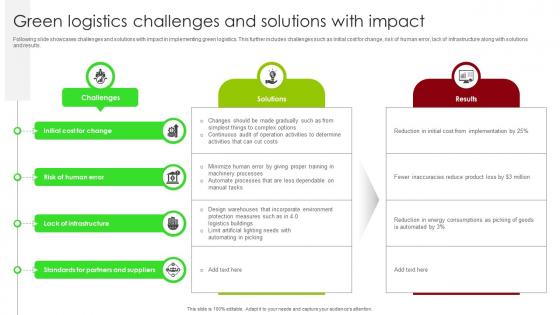
Green Logistics Challenges And Solutions With Impact




Try Before you Buy Download Free Sample Product
 Impress Your
Audience
 100%
Editable
 Save Hours
of Time


Following slide showcases challenges and solutions with impact in implementing green logistics. This further includes challenges such as initial cost for change, risk of human error, lack of infrastructure along with solutions and results.
People who downloaded this PowerPoint presentation also viewed the following :
Green Logistics Challenges And Solutions With Impact with all 9 slides:
Use our Green Logistics Challenges And Solutions With Impact to effectively help you save your valuable time. They are readymade to fit into any presentation structure.








FAQs for Green Logistics Challenges And
Green logistics principles include energy-efficient transportation, waste reduction, sustainable packaging, carbon footprint minimization, and resource optimization throughout supply chain operations. These approaches streamline environmental impact by reducing emissions, lowering operational costs, and enhancing brand reputation, with many manufacturing and retail organizations finding that sustainable practices ultimately deliver competitive advantage while meeting increasingly stringent regulatory requirements.
Companies can assess their environmental impact through carbon footprint analysis, energy consumption tracking, waste generation measurement, transportation efficiency audits, and supply chain emissions monitoring. These assessments enable organizations to identify reduction opportunities, optimize route planning, and implement sustainable practices, with many logistics providers finding that comprehensive environmental tracking ultimately delivers cost savings and competitive advantages in an increasingly sustainability-focused market.
Technology enhances green logistics through route optimization software, IoT sensors for fuel monitoring, electric vehicle fleets, automated warehouses, and AI-powered demand forecasting. These innovations streamline operations by reducing fuel consumption, minimizing waste, and optimizing resource allocation, with many transportation companies finding that strategic technology adoption delivers significant cost savings while meeting sustainability goals.
Effective strategies include optimizing delivery routes through AI algorithms, transitioning to electric and hybrid vehicle fleets, implementing intermodal transportation combining rail and road, adopting fuel-efficient driving practices, and consolidating shipments to maximize load capacity. These approaches enable logistics companies to reduce fuel consumption, lower operational costs, and meet sustainability targets, with many retailers and manufacturers finding that strategic route optimization alone delivers 15-20% emission reductions while enhancing customer satisfaction.
Businesses can implement eco-friendly packaging by adopting biodegradable materials, right-sizing packaging dimensions, utilizing reusable containers, incorporating recycled content, and partnering with sustainable suppliers. Companies like Amazon and Unilever streamline operations through automated packaging systems that minimize waste while reducing material costs, ultimately delivering enhanced brand reputation and operational efficiency in an increasingly environmentally-conscious marketplace.
Key metrics for green logistics effectiveness include carbon footprint reduction, fuel efficiency improvements, waste minimization rates, energy consumption per shipment, and sustainable packaging adoption percentages. These measurements enable organizations to track environmental impact while optimizing operational costs, with many logistics companies finding that comprehensive sustainability metrics ultimately deliver both regulatory compliance and competitive advantage in increasingly eco-conscious markets.
Reverse logistics supports sustainability goals by enabling product returns, recycling, remanufacturing, and waste reduction throughout supply chains. Through strategic recovery programs, companies minimize landfill waste, reduce raw material consumption, and create circular economy models, with many retailers and manufacturers finding that reverse logistics delivers cost savings while enhancing environmental responsibility and brand reputation.
Companies transitioning to greener logistics face challenges including higher upfront infrastructure costs, limited availability of sustainable transportation options, complex supply chain redesign requirements, and resistance to operational changes. While these obstacles can slow initial implementation, many organizations find that strategic planning, phased rollouts, and partnerships with green technology providers ultimately deliver cost savings and competitive advantage.
Collaboration among stakeholders enhances green logistics effectiveness by sharing resources, standardizing sustainable practices, and coordinating supply chain optimization across multiple partners. Through strategic partnerships, companies streamline transportation routes, reduce duplicate shipments, and implement shared warehousing solutions, with many logistics networks finding that collaborative approaches deliver cost savings while significantly reducing environmental impact.
Successful green logistics implementations include Walmart's transportation efficiency initiatives, UPS's alternative fuel vehicle fleet, DHL's carbon-neutral delivery programs, IKEA's renewable energy integration, and Amazon's electric delivery vans. These organizations streamline operations through route optimization, sustainable packaging, and clean energy adoption, ultimately delivering reduced operational costs, enhanced brand reputation, and competitive advantage in an increasingly environmentally-conscious marketplace.
Regulations and standards significantly accelerate green logistics adoption by establishing mandatory emission limits, sustainability reporting requirements, and incentive frameworks that encourage cleaner transportation methods. European Union's stringent carbon regulations and California's emission standards have prompted logistics companies to invest in electric fleets, optimize routes, and implement sustainable packaging, ultimately delivering competitive advantages while ensuring regulatory compliance in an increasingly environmentally-conscious marketplace.
Employee training and awareness are crucial for green logistics success because they ensure consistent implementation of sustainable practices, help identify improvement opportunities, and foster environmental responsibility throughout operations. Well-trained teams streamline waste reduction, optimize fuel efficiency, and enhance supply chain sustainability, with many logistics companies finding that educated employees drive innovation and deliver measurable cost savings while strengthening competitive advantage.
Companies can leverage alternative fuels like electric batteries, hydrogen fuel cells, biodiesel, compressed natural gas, and renewable diesel to power their vehicle fleets and reduce carbon emissions significantly. These sustainable energy sources enable logistics operations to achieve lower operational costs, meet regulatory requirements, and enhance brand reputation, with many transportation companies finding that alternative fuels deliver competitive advantages while supporting environmental goals.
Logistics innovations driving sustainability include electric delivery vehicles, AI-powered route optimization, drone deliveries, smart warehousing systems, and renewable energy integration. These technologies streamline operations by reducing fuel consumption, minimizing carbon emissions, and enhancing operational efficiency, with many retail and manufacturing companies finding that strategic combinations ultimately deliver significant cost savings while meeting increasingly demanding environmental standards.
Customer expectations significantly drive green logistics initiatives by demanding sustainable packaging, carbon-neutral shipping options, and transparent environmental reporting throughout supply chains. Companies increasingly find that meeting these expectations through eco-friendly delivery methods, reduced packaging waste, and clear sustainability metrics not only enhances brand loyalty but also delivers competitive advantage, with many organizations discovering that green practices ultimately reduce costs while improving customer satisfaction.
-
You can rely on SlideTeam whenever you run out of designs for your presentation. Thank you so much SlideTeam!
-
Their professional templates are very impressive, even my manager was curious about the source. I am very grateful.