


Greencore Business Model Industry Report Of Commercially Prepared Food Part 2




Try Before you Buy Download Free Sample Product
 Impress Your
 Audience
 100%
100% Editable
 Save Hours
 of Time


Our Greencore Business Model Industry Report Of Commercially Prepared Food Part 2 are topically designed to provide an attractive backdrop to any subject. Use them to look like a presentation pro.
People who downloaded this PowerPoint presentation also viewed the following :
Greencore Business Model Industry Report Of Commercially Prepared Food Part 2 with all 6 slides:
Use our Greencore Business Model Industry Report Of Commercially Prepared Food Part 2 to effectively help you save your valuable time. They are readymade to fit into any presentation structure.





FAQs for Greencore Business Model Industry Report Of Commercially Prepared
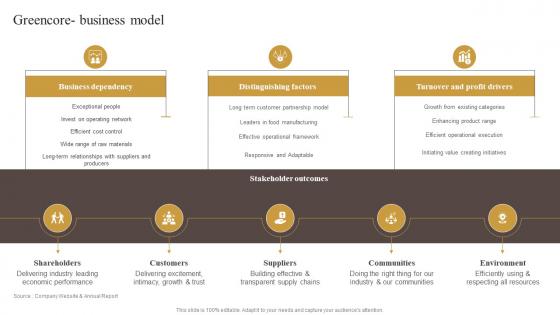
Greencore's business model centers on convenience food manufacturing, supply chain integration, customer partnerships, operational efficiency, and market diversification across multiple food categories. The company streamlines production through centralized facilities, strategic retailer relationships, and scalable manufacturing processes, with many food service partners finding that this integrated approach delivers consistent quality, reduced costs, and enhanced market responsiveness.
Greencore differentiates itself through specialized convenience food manufacturing, strategic retail partnerships, operational efficiency, and geographic focus on key markets like the UK and US. The company leverages automated production facilities, innovative product development, and supply chain optimization to deliver consistent quality, competitive pricing, and rapid market responsiveness, ultimately securing long-term contracts with major retailers.
Sustainability serves as a core strategic pillar for Greencore, encompassing sustainable sourcing, waste reduction, energy efficiency, and circular economy principles throughout their food manufacturing operations. This commitment enables enhanced operational efficiency, reduced environmental impact, and stronger stakeholder relationships, with many food manufacturers finding that integrated sustainability practices deliver cost savings, regulatory compliance, and competitive advantage in an increasingly environmentally-conscious market.
Greencore leverages partnerships through strategic supplier relationships, retail collaborations, and technology alliances to streamline operations, enhance product innovation, and expand market reach. These partnerships enable cost optimization, improved supply chain efficiency, and accelerated product development cycles, with many food manufacturers finding that collaborative approaches ultimately deliver competitive advantages and stronger customer relationships in increasingly dynamic markets.
Greencore's primary revenue streams include manufacturing convenience foods, providing food-to-go products, producing sandwiches and salads, supplying ready meals, and offering ingredient solutions to retailers and foodservice providers. Through strategic partnerships with major UK supermarket chains, restaurants, and convenience stores, Greencore delivers scalable food production services, ultimately enabling consistent supply chain efficiency and competitive market positioning in the convenience food sector.
Greencore manages supply chain efficiency through integrated production facilities, strategic supplier partnerships, automated quality control systems, and real-time inventory management. These operational approaches streamline food production while maintaining consistent quality standards, with many food manufacturers finding that combining centralized processing with distributed delivery networks ultimately delivers faster turnaround times and enhanced product freshness.
Greencore incorporates innovation through advanced food technology, sustainable packaging solutions, plant-based product development, automated manufacturing processes, and data-driven consumer insights. These approaches enable the company to streamline production efficiency, enhance nutritional profiles, and deliver environmentally conscious convenience foods, with many retail partners finding that innovative offerings drive competitive advantage in increasingly health-focused markets.
Greencore approaches consumer trends through continuous market research, product innovation, strategic partnerships with retailers, and agile manufacturing processes that enable rapid adaptation. The company leverages consumer insights to develop healthier, convenient food solutions across multiple categories, while maintaining flexible supply chains that respond to shifting preferences like plant-based options, ultimately delivering enhanced customer satisfaction and competitive market positioning.
Greencore faces challenges including rising ingredient costs, labor shortages in food production, increasing consumer demand for sustainable packaging, and intense competition from both traditional food manufacturers and emerging meal kit services. These pressures require strategic investments in automation, supply chain optimization, and product innovation, with many food companies finding that operational efficiency and sustainability initiatives ultimately deliver competitive advantage in an increasingly complex marketplace.
Greencore leverages advanced technology through automated production lines, predictive analytics for demand forecasting, IoT sensors for quality monitoring, and supply chain optimization software. These technologies streamline manufacturing processes by reducing waste, minimizing downtime, and enhancing food safety standards, with many food manufacturers finding that integrated systems ultimately deliver faster production cycles and improved operational efficiency.
Brexit has significantly impacted Greencore's operations by requiring supply chain restructuring, regulatory compliance adjustments, and strategic market repositioning across their UK and Irish facilities. The company has responded by diversifying supplier networks, investing in automation to offset labor challenges, and strengthening relationships with major retail partners, ultimately enhancing operational resilience while maintaining their market-leading position in convenience food manufacturing.
Greencore adapts to plant-based demand by expanding its product portfolio, investing in specialized manufacturing capabilities, and partnering with retailers to develop innovative meat alternatives and dairy-free options. Through strategic R&D investments and flexible production lines, major supermarket chains increasingly stock Greencore's plant-based ready meals, sandwiches, and prepared foods, ultimately delivering enhanced market reach and competitive positioning in the rapidly growing alternative protein sector.
Greencore measures success through operational efficiency metrics like production volumes and cost per unit, financial indicators including revenue growth and margin optimization, and customer satisfaction scores across retail partnerships. These metrics enable the food manufacturer to streamline supply chain operations, enhance product quality consistency, and deliver competitive pricing, with many convenience food companies finding that integrated measurement systems ultimately drive market share expansion and sustained profitability.
Greencore addresses food safety and regulatory compliance through rigorous quality management systems, comprehensive supplier auditing, advanced traceability technologies, strict hygiene protocols, and continuous staff training across all facilities. These integrated approaches enable the company to meet stringent regulatory standards while minimizing contamination risks, ultimately delivering consistent product quality and maintaining consumer trust in an increasingly regulated food manufacturing environment.
Greencore enhances employee engagement through comprehensive training programs, career development pathways, flexible working arrangements, recognition schemes, and wellness initiatives focused on work-life balance. These strategic approaches streamline talent retention by creating inclusive workplace cultures, accelerating skill development, and delivering competitive benefits packages, with many food manufacturing organizations finding that engaged workforces ultimately drive operational efficiency and customer satisfaction.
-
Easy to edit slides with easy to understand instructions.
-
Thanks to SlideTeam, we have an ideal template to present all the info we need to cover. Their slides give our numbers and projections a more clear and enchanting look.