


Grid Computing Architecture Powerpoint Presentation Slides




Try Before you Buy Download Free Sample Product
 Impress Your
 Audience
 100%
100% Editable
 Save Hours
 of Time


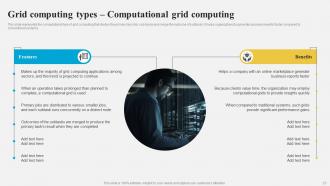
Organizations use grid computing to perform large tasks or solve complex problems challenging on a single computer. Grab our effectively designed Grid Computing Architecture template. It gives a brief idea about grid computing by covering its overview, characteristics, benefits, types of machines, and resources. Our Grid Computing Services deck incorporates the critical components of grid computing, like user interface, security, scheduler, data management, and workload and resource management. It also includes grid computing architecture by covering standards and methods for grid computing environments, security models, and its working. Additionally, our Grid Computing Architecture PPT contains various types of grid computing, including computational, data, collaborative, manuscript, and modular. Further, it exhibits the grid user roles from an administrative and user perspective and reveals the applications of grid computing in various fields like life science, engineering-oriented applications, data-oriented applications, scientific research collaboration, etc. Furthermore, our Grid Computing Components template caters to the difference between cloud computing, cluster computing, utility computing, and grid computing. Moreover, it comprises requirements to develop grid computing systems, a timeline to create a grid environment, and a roadmap for a grid computing network. Get access now.
People who downloaded this PowerPoint presentation also viewed the following :
Content of this Powerpoint Presentation
Slide 1: This slide introduces Grid Computing Architecture. Commence by stating Your Company Name.
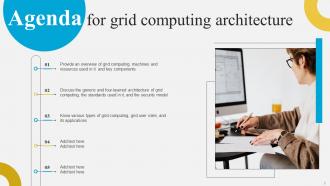
Slide 2: This slide depicts the Agenda of the presentation.
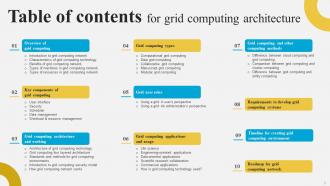
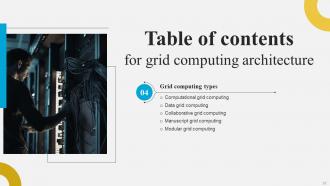
Slide 3: This slide incorporates the Table of contents.
Slide 4: This slide highlights the Title for the Topics to be discussed next.
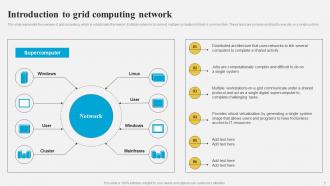
Slide 5: This slide represents the overview of grid computing, which is a distributed framework.
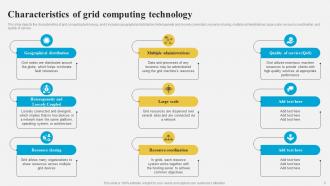
Slide 6: This slide depicts the characteristics of grid computing technology.
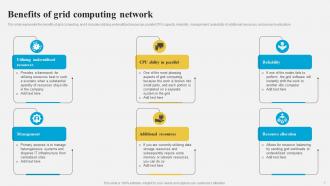
Slide 7: This slide exhibits the Benefits of grid computing network.
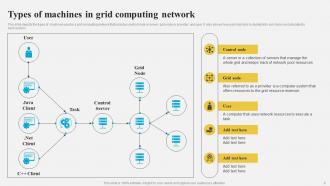
Slide 8: This slide displays the types of machines used in a grid computing network.
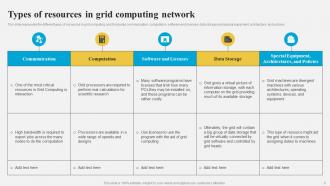
Slide 9: This slide states the Types of resources in grid computing network.
Slide 10: This slide portrays the Heading for the Components to be covered in the following template.
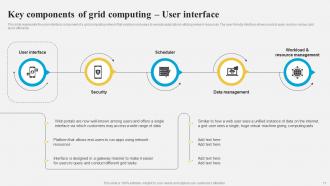
Slide 11: This slide represents the user interface component of a grid computing network that enables end-users to execute applications utilizing network resources.
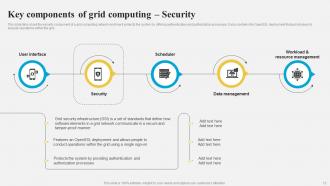
Slide 12: This slide talks about the security component of a grid computing network.
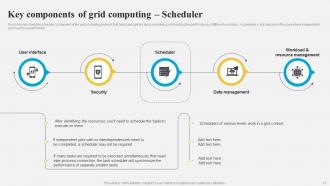
Slide 13: This slide describes the scheduler component of the grid computing network that helps execute the tasks.
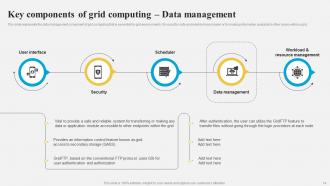
Slide 14: This slide highlights the Key components of grid computing data management.
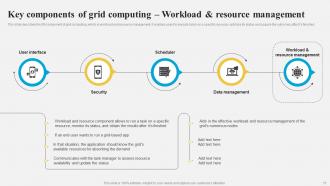
Slide 15: This slide describes the 5th component of grid computing, which is workload and resource management.
Slide 16: This slide incorporates the Title for the Ideas to be discussed further.
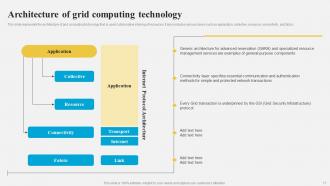
Slide 17: This slide represents the architecture of grid computing technology,used collaborative sharing of resources.
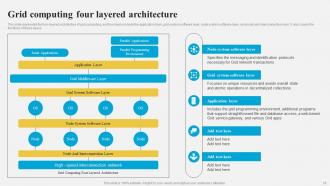
Slide 18: This slide illustrates the Grid computing four-layered architecture.
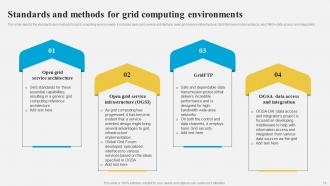
Slide 19: This slide depicts the standards and methods for grid computing environments.
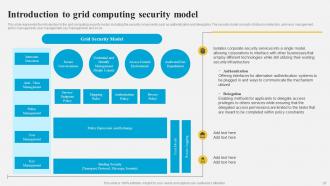
Slide 20: This slide reveals the Introduction to grid computing security model.
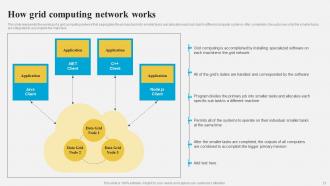
Slide 21: This slide presents the working of a grid computing network.
Slide 22: This slide elucidates the Heading for the Ideas to be covered in the forth-coming template.
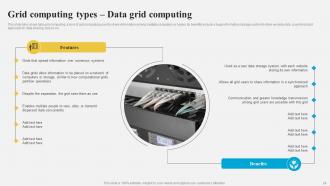
Slide 23: This slide talks about data grid computing, used to share information among multiple computers or nodes.
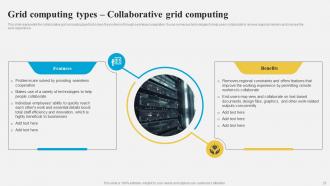
Slide 24: This slide shows the collaborative grid computing type that solves the problems through seamless cooperation.
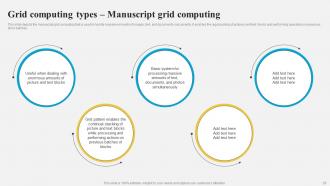
Slide 25: This slide depicts the manuscript grid computing.
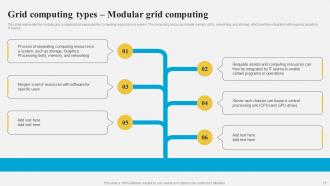
Slide 26: This slide reveals the modular grid computing that separates the computing resources in a system.
Slide 27: This slide exhibits the Title for the Components to be discussed next.
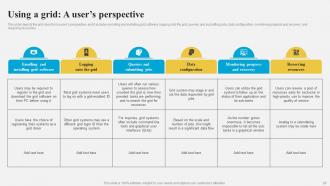
Slide 28: This slide displays the grid roles from a user’s perspective.
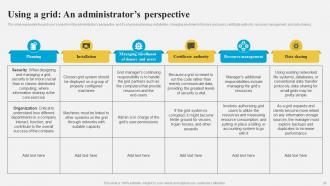
Slide 29: This slide represents the grid user’s roles from the administrator’s perspective.
Slide 30: This slide includes the Heading for the Topics to be covered further.
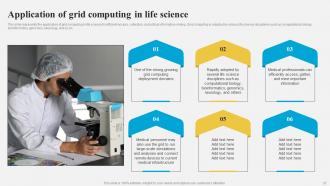
Slide 31: This slide talks about the Application of grid computing in life science.
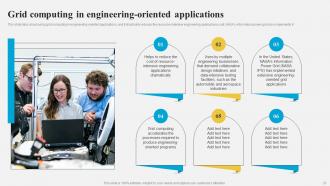
Slide 32: This slide deals with the Grid computing in engineering-oriented applications.
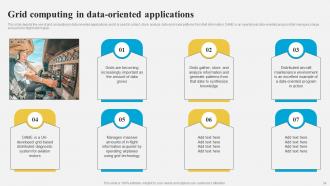
Slide 33: This slide depicts the use of grid computing in data-oriented applications.
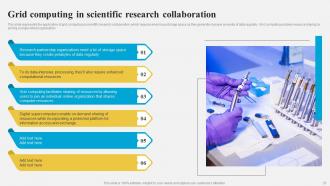
Slide 34: This slide presents the application of grid computing in scientific research collaboration.
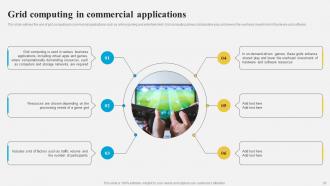
Slide 35: This slide outlines the use of grid computing in commercial applications.
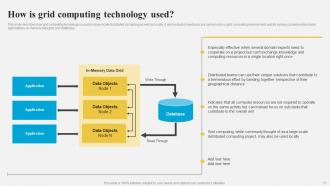
Slide 36: This slide describes how grid computing technology is used in large-scale distributed computing as well as locally.
Slide 37: This slide mentions the Title for the Topics to be covered next.
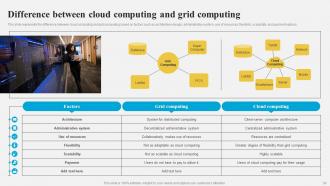
Slide 38: This slide elucidates the Difference between cloud computing and grid computing.
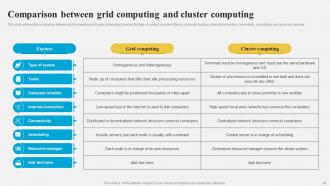
Slide 39: This slide outlines the comparison between grid computing and cluster computing.
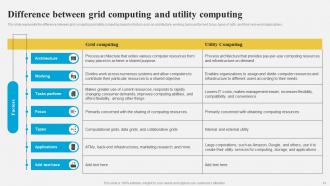
Slide 40: This slide represents the difference between grid computing and utility computing.
Slide 41: This slide includes the Heading for the Contents to be discussed in the following template.
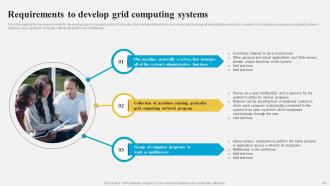
Slide 42: This slide depicts the key requirements for developing a grid computing system.
Slide 43: This slide mentions the Title for the Ideas to be covered further.
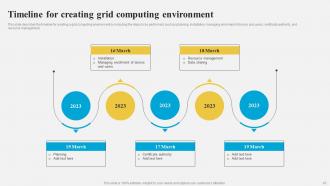
Slide 44: This slide describes the timeline for creating a grid computing environment.
Slide 45: This slide portrays the Heading for the Ideas to be discussed next.
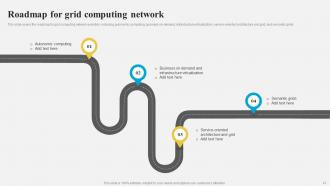
Slide 46: This slide covers the roadmap for grid computing network evolution.
Slide 47: This is the Icons slide containing all the Icons used in the plan.
Slide 48: This slide is used for showcasing some Additional information.
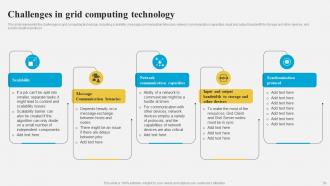
Slide 49: This slide exhibits the Challenges in grid computing technology.
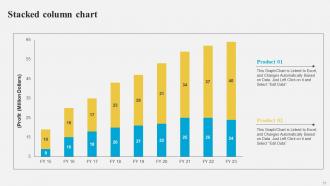
Slide 50: This slide shows the Stacked column chart.
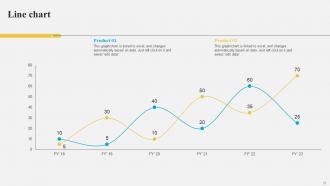
Slide 51: This slide presents the Line chart.
Slide 52: This is the Puzzle slide with related imagery.
Slide 53: This is Our team slide. State your team-related information here.
Slide 54: This slide contains the Post it notes for reminders and deadlines.
Slide 55: This is the About us slide. State your company-related information here.
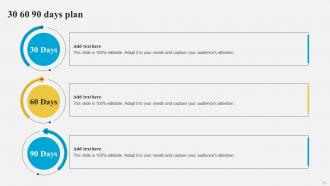
Slide 56: This is the 30 60 90 days plan slide for efficient planning.
Slide 57: This slide reveals the Circular process.
Slide 58: This is the Thank You slide for acknowledgement.
Grid Computing Architecture Powerpoint Presentation Slides with all 66 slides:
Use our Grid Computing Architecture Powerpoint Presentation Slides to effectively help you save your valuable time. They are readymade to fit into any presentation structure.










FAQs for Grid Computing Architecture
Grid computing utilizes distributed architecture connecting heterogeneous computing resources across multiple organizations through standardized protocols, middleware, and resource management systems. Unlike cloud computing's centralized infrastructure offering on-demand services, grid computing enables collaborative resource sharing among institutions like research universities and scientific organizations, ultimately delivering specialized computational power for complex, data-intensive projects requiring distributed collaboration.
Resource management and job scheduling in grid computing work through middleware platforms that monitor available resources, queue incoming tasks, and optimize workload distribution across heterogeneous systems. These systems use sophisticated algorithms to match computational requirements with available capacity, while load balancers ensure efficient resource utilization, ultimately enabling organizations to maximize performance and minimize processing times across distributed computing environments.
Grid computing's primary applications include climate modeling, drug discovery, financial risk analysis, particle physics simulations, and genomic research. These distributed systems enable researchers and industries to process massive datasets, accelerate complex calculations, and reduce computational costs, with pharmaceutical companies and research institutions finding that grid networks deliver faster breakthrough discoveries and enhanced competitive advantage.
Grid computing enhances data-intensive applications by distributing computational workloads across multiple interconnected systems, enabling parallel processing, reducing execution times, and maximizing resource utilization. Through this distributed approach, organizations in sectors like genomics, financial modeling, and climate research can process massive datasets more efficiently, ultimately delivering faster insights and competitive advantages in increasingly data-driven markets.
Grid computing faces significant challenges including authentication across distributed systems, data encryption during transmission, unauthorized access prevention, resource allocation conflicts, and maintaining consistent data integrity across multiple nodes. These security vulnerabilities can compromise sensitive information, especially in sectors like healthcare and financial services, while data synchronization issues ultimately impact system reliability and organizational trust in distributed computing environments.
Grid computing enhances high-performance computing by distributing complex computational tasks across multiple interconnected systems, enabling parallel processing, resource sharing, and dynamic load balancing. This distributed approach allows organizations in research, financial modeling, and scientific simulation to tackle massive datasets and complex calculations more efficiently, ultimately delivering faster processing speeds, reduced computational costs, and enhanced scalability for demanding HPC applications.
Middleware and software frameworks serve as the essential foundation for grid computing by providing resource management, task scheduling, security protocols, communication interfaces, and data integration services. These technologies enable seamless coordination across distributed systems, allowing organizations in sectors like financial services and research institutions to leverage computational resources efficiently, ultimately delivering enhanced performance and cost-effective scalability.
Organizations collaborate in grid computing through shared resource pools, standardized protocols, and federated identity management systems that enable seamless access across institutional boundaries. Research consortiums like pharmaceutical companies share computational power for drug discovery, while academic institutions pool resources for climate modeling, ultimately delivering faster research outcomes and reduced infrastructure costs through strategic resource allocation.
Best practices for implementing grid computing solutions include conducting thorough infrastructure assessments, establishing robust security protocols, ensuring network bandwidth adequacy, implementing standardized middleware platforms, and developing comprehensive resource management policies. These approaches streamline deployment by minimizing compatibility issues, optimizing resource allocation, and maintaining system reliability, with many enterprises finding that phased implementation across departments delivers scalable performance improvements and operational efficiency.
Grid computing facilitates heterogeneous resource sharing through standardized middleware protocols, virtualization layers, and resource abstraction services that mask underlying system differences. These technologies enable seamless integration of diverse hardware, operating systems, and applications across distributed networks, with organizations in research, finance, and manufacturing finding that unified resource pools significantly reduce costs while enhancing computational capabilities.
Grid computing significantly reduces energy consumption through optimized resource utilization, dynamic workload distribution, and elimination of redundant infrastructure across participating organizations. By consolidating computing power and enabling shared resources, organizations minimize idle server time, reduce cooling requirements, and achieve better hardware efficiency, with many enterprises finding that grid implementations deliver substantial cost savings while supporting their sustainability goals.
Grid computing has evolved to become a critical infrastructure for AI and machine learning by providing distributed processing power, enhanced data analytics capabilities, and scalable computational resources that enable complex algorithm training. Through cloud-grid integration, organizations across sectors like healthcare, finance, and research can process massive datasets, accelerate model development, and deploy AI solutions more efficiently, ultimately delivering faster insights and competitive advantages in an increasingly data-driven landscape.
Public grids offer shared computing resources across organizations with cost-effective scalability, private grids provide dedicated infrastructure within single organizations ensuring security and control, while hybrid grids combine both approaches strategically. These architectures enable organizations to balance resource accessibility, data protection, and operational costs, with many financial institutions and research organizations finding that hybrid models deliver optimal flexibility while maintaining critical security requirements.
Latency and bandwidth issues significantly impact grid computing performance by creating communication delays between distributed nodes, limiting data transfer speeds, and causing synchronization bottlenecks across the network. These challenges particularly affect data-intensive applications in research institutions and financial services, where organizations increasingly implement optimization strategies, caching mechanisms, and intelligent workload distribution to minimize network overhead and enhance overall system efficiency.
Compliance and regulatory considerations in grid computing are significant because distributed data processing across multiple jurisdictions creates complex legal obligations, security requirements, and data governance challenges. Organizations in healthcare, finance, and government must navigate varying privacy laws, audit trails, and security standards while ensuring seamless grid operations, ultimately requiring strategic compliance frameworks that balance regulatory adherence with operational efficiency.
-
Excellent template with unique design.
-
Fantastic and innovative graphics with useful content. The templates are the best and latest in the industry.