

Growth strategies for achieving competitive advantage in the renewable energy sector case competition complete deck





Try Before you Buy Download Free Sample Product
 Impress Your
Audience
 100%
Editable
 Save Hours
of Time


Our Growth Strategies For Achieving Competitive Advantage In The Renewable Energy Sector Case Competition Complete Deck are topically designed to provide an attractive backdrop to any subject. Use them to look like a presentation pro.
People who downloaded this PowerPoint presentation also viewed the following :
Content of this Powerpoint Presentation
Slide 1: This is the cover slide of Application of Latest Renewable Energy Trends to Improve Market Share (Case Competition).
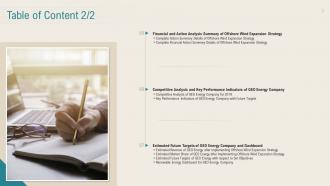
Slide 2: This is the Table of Contents slide that lists out all the essential elements covered in the deck.
Slide 3: This is the Table of Contents slide that lists out all the essential elements covered in the deck.
Slide 4: This slide talks about GEO Energy Company Business overview, objectives and challenges.
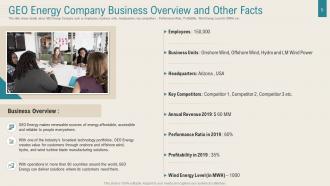
Slide 5: This slide shows details about GEO Energy Company such as employees, business units, headquarters, key competitors , Performance Ratio, Profitability, Wind Energy Level (in MWH) etc.
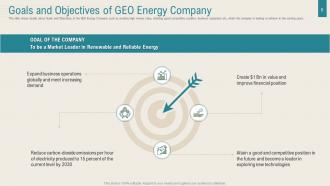
Slide 6: This slide shows details about Goals and Objectives of the GEO Energy Company such as creating high money value, attaining good competitive position, business expansion etc. which the company is looking to achieve in the coming years.
Slide 7: This slide shows some key challenges that are faced by GEO energy Company such as huge investment cost required, reduce fossil fuel consumption, unavailability of high power, power quality issues etc.
Slide 8: This slide shows the criteria for evaluation of growth opportunities in GEO energy company based on Competitive Advantage, Strategic Fit, Financial benefits and Growth Potential.
Slide 9: This slide shows growth opportunities and options available with the GEO energy Company that can be compared with evaluation criteria's such as Competitive Advantage, Financial Benefits, Strategic Fit and Growth Potential. Growth Option available are Offshore Wind Expansion, increasing power capacity, repowering wind turbines, reorganizing Grid Solutions etc.
Slide 10: This slide presents Stages Involved in Offshore Wind Expansion Strategy and Stage 1 Benefits and Method Details.
Slide 11: This slide shows various stages that GEO Energy company must undergo in order to implement Offshore Wind Expansion Strategy. These stages include Feel the Breeze (Local Business Expansion Strategy), Catch the Wind (Acquisition and Development Strategy) and Take Off (Global Expansion Plan).
Slide 12: This slide shows some benefits of Feel the Breeze Strategy to GEO Energy Company such as increased profit margin, improved market share, reduced costs etc.
Slide 13: This slide shows method details for implementation of feel the breeze (local expansion) strategy such as purpose of the strategy, how it is to be implemented and where it is do be done.
Slide 14: This slide shows the major competitive edge which the GEO Energy company have to implement Offshore Wind Expansion Strategy. Key competitive advantage includes leading innovator in offshore development, market share of 22%, high global wind capacity etc.
Slide 15: This slide shows the problem and solution of catch the wind strategy (Acquisition and Development) for the GEO Energy Company. Some of the problems are perishability of resources, intense competition level, unreliable energy source etc.
Slide 17: This slide shows method details for implementing Catch the Wind (Acquisition and Development) along with strategic goal to be achieved.
Slide 18: This slide shows the financial investment details for the acquisition and development of Zithium Balance A/S by GEO Energy Company through internal financing, external loans, retained earnings etc.
Slide 19: This slide shows the timeline of activities for Complete Storage Technology Launch by GEO Energy Company such along with the time in quarters. Some of the activities are storage site selection, R&D activities, acquiring Zithium Balance A/S, Large-Scale Technology Launch etc.
Slide 20: This slide shows some strategic benefits of Acquiring and Developing Zithium Balance A/S to GEO Energy Company such as increase in sales, synergy advantages, enhanced product development, improve quality, costs reduction etc.
Slide 21: This slide shows completive analysis of Zithium Balance A/S with similar companies based on Cycle Life (in MaH) . Some of the competitors are LME Authorities, VLA Systems, Flow batteries etc.
Slide 22: This slide presents Method Details, Benefits and Supported Operations of Stage 3 of Wind Expansion Strategy.
Slide 23: This slide shows Global Expansion Opportunities available with GEO Energy Company along with strategic goal, operations that will be supported at international level and the countries that will provide Early Mover Advantage to GEO Energy Company.
Slide 24: This slide shows company related and operations related benefits of Takeoff Strategy to GEO Energy Company such as diversified demand, economies of scale, reliable growth, improved storage competency levels etc.
Slide 25: This slide shows method details for implementing Takeoff Strategy in GEO Energy Company such as establish storage capability on local level, evaluate market position, enter the Russian market, expansion of business operations to Canada and Australia, evaluation of expansion opportunities on regular basis etc.
Slide 26: This slide presents Financial and Action analyis summary of Offshore wind expansion strategy.
Slide 27: This slide shows the complete action summary of various stages involved in Offshore Wind Expansion Strategy such as feel the breeze, catch the wind and take off along with strategic goal at each stage.
Slide 28: This slide shows the Complete Financial Action Summary Details of Offshore Wind Expansion Strategy with multiple activities involved, investment required at each level and time required to complete each activity.
Slide 29: This slide presents Key Performance Indicators of GEO Energy Company with Future Targets.
Slide 30: This slide shows the competitive analysis of GEO Energy Company with other similar line competitors on the bases of certain parameters such as Revenue , Return on Investment, Performance Ratio , Wind Energy Level , Plant Availability, Market Share etc.
Slide 31: The slide shows the key Performance Indicator (KPI)’s which will help the company to track the success rate of implemented strategies. Some of the KPI’s are Revenue , Return on Investment, Performance Ratio , Wind Energy Levels , Plant Availability, Profitability etc.
Slide 32: This slide presents estimated future targets of GEO energy company and dashboard.
Slide 33: This slide shows the estimated Revenue of GEO Energy after implementing Offshore Wind Expansion Strategy. The revenue will increase and is estimated to reach $ 87 MM in 2023. Some reasons for increase in revenue are also mentioned.
Slide 34: This slide shows the estimated Market Share of GEO Energy after implementing Offshore Wind Expansion Strategy. The market share will rise and is expected to reach $ 87 MM in 2023. Some reasons for increase in market share are also mentioned.
Slide 35: This slide shows the estimated future targets of GEO Energy in consideration with Set Objectives. The future targets are based on creating value, improving core business competency, expanding business operations etc.
Slide 36: This slide shows a Renewable Energy dashboard for GEO Energy Company with details on total consumption, total sales, energy sources, production costs, sales by sector etc.
Slide 37: This is an Icon Slide. Use it as per your needs.
Slide 38: This slide is titled Additional Slides to move forward. Change/ alter content as per need.
Slide 39: This is an About Us slide. State company/team specifications etc. here.
Slide 40: This is Our Team slide with name and designation to fill.
Slide 41: This is a Venn Diagram slide that can be used to compare three different elements.
Slide 42: This is Our Mission Our Vision slide to state your mission, vision etc.
Slide 43: This is a Bar Chart slide that can be used to compare different elements.
Slide 44: This is a Post it Notes slide that can be used to keep important information at one place.
Slide 45: This is Our Location/Global Presence slide on a world map image.
Slide 46: This is a Thank You slide for acknowledgement.
Growth strategies for achieving competitive advantage in the renewable energy sector case competition complete deck with all 46 slides:
Use our Growth Strategies For Achieving Competitive Advantage In The Renewable Energy Sector Case Competition Complete Deck to effectively help you save your valuable time. They are readymade to fit into any presentation structure.





FAQs for Growth strategies for achieving competitive advantage in the renewable energy sector case
Key components include market analysis, customer acquisition strategies, product development roadmaps, funding mechanisms, and scalability frameworks. These elements work together by identifying target demographics, optimizing conversion funnels, and establishing operational systems, with many startups finding that strategic combinations of digital marketing, partnership development, and data-driven decision making ultimately deliver sustainable revenue growth and competitive market positioning.
Established companies can leverage market research through customer segmentation analysis, competitive intelligence, trend forecasting, and unmet needs identification to uncover expansion opportunities. By analyzing consumer behavior patterns, market gaps, and emerging demands across different sectors, organizations streamline their strategic planning while minimizing investment risks, ultimately delivering targeted growth initiatives that enhance competitive positioning.
Digital marketing enables businesses to scale by reaching broader audiences, targeting specific demographics, automating customer acquisition, and measuring campaign effectiveness in real-time. Through social media advertising, search engine optimization, and email marketing, companies streamline their growth processes, reduce customer acquisition costs, and accelerate market penetration, with many organizations finding that strategic digital campaigns deliver measurable revenue growth.
Businesses effectively integrate customer feedback by implementing systematic collection methods, analyzing sentiment patterns, prioritizing feature requests, establishing feedback loops, and aligning insights with strategic planning. Through surveys, social listening, and direct engagement, organizations enhance product development, refine service delivery, and accelerate market expansion, with many companies finding that customer-driven strategies ultimately deliver higher retention rates and sustainable competitive advantage.
Companies can foster innovation through strategic R&D investments, cross-functional collaboration, employee innovation programs, partnerships with startups, and creating dedicated innovation labs or incubators. These approaches streamline idea generation, accelerate product development, and enhance market responsiveness, with many organizations finding that combining internal creativity with external partnerships ultimately delivers sustained competitive advantage and scalable growth opportunities.
Exploring new geographic markets contributes to business growth by diversifying revenue streams, reducing dependence on single markets, and accessing untapped customer bases with different needs and purchasing power. Companies in retail, technology, and financial services find that geographic expansion enables increased market share, enhanced brand recognition, and improved resilience against regional economic downturns, ultimately delivering sustainable competitive advantage.
Businesses should track revenue growth rate, customer acquisition cost, customer lifetime value, market share expansion, and retention rates to measure growth strategy success. These metrics enable organizations to assess profitability, operational efficiency, and competitive positioning across different channels, with many companies finding that balanced scorecards combining financial and customer metrics deliver clearer strategic insights.
Strategic partnerships accelerate business growth by expanding market reach, sharing resources and expertise, and reducing operational costs through collaborative efficiencies. Through strategic alliances, companies access new customer bases, leverage complementary technologies, and enter markets faster than solo expansion, with many organizations finding that partnerships deliver competitive advantages while minimizing risks.
Aggressive growth strategies present risks including cash flow strain, operational complexity, quality control challenges, market overextension, and resource dilution across multiple initiatives. While these challenges require careful management, organizations can mitigate risks through phased scaling approaches, robust financial planning, and strategic partnerships, with many companies finding that measured expansion ultimately delivers sustainable competitive advantage and market positioning.
Employee engagement is crucial for growth strategy execution, as engaged employees drive innovation, deliver superior customer experiences, and adapt more readily to strategic changes. Companies with highly engaged workforces see 23% higher profitability and 18% higher productivity, with organizations like Google and Microsoft finding that engaged teams accelerate market expansion, enhance operational efficiency, and ultimately deliver sustainable competitive advantages in increasingly dynamic business environments.
Technology serves as a strategic enabler for sustainable business growth by automating operations, optimizing resource allocation, enhancing customer experiences, and providing data-driven insights for decision-making. Through cloud computing, AI analytics, and digital platforms, organizations streamline processes, reduce operational costs, and scale efficiently, with many companies finding that these technologies ultimately deliver competitive advantage and long-term market positioning.
During economic downturns, businesses can pivot growth strategies by diversifying revenue streams, focusing on cost-effective digital channels, strengthening customer retention programs, and exploring strategic partnerships or acquisitions. These approaches enable organizations to maintain momentum while competitors retreat, with many companies finding that downturns present opportunities to capture market share, streamline operations, and emerge stronger when economic conditions improve.
**INPUT**: What are the best practices for scaling operations and infrastructure to support growth? **OUTPUT**: Best practices for scaling operations include investing in automation technologies, implementing cloud-based infrastructure, standardizing processes across departments, developing scalable team structures, and establishing robust data analytics capabilities. These strategic approaches enable organizations to streamline workflows, enhance operational efficiency, and maintain service quality during expansion, with many growing companies finding that early infrastructure investments ultimately deliver competitive advantages and sustainable growth trajectories. [Word count: 60 words]
Content marketing supports long-term growth by building brand authority, generating qualified leads, improving search rankings, and nurturing customer relationships throughout the buyer's journey. Through consistent, valuable content across multiple channels, organizations enhance customer engagement, reduce acquisition costs, and establish competitive differentiation, with many companies finding that strategic content efforts ultimately drive sustainable revenue growth and market expansion.
Diversification drives business expansion by reducing market dependency, attracting new customer segments, increasing revenue streams, and leveraging existing capabilities across multiple offerings. Through strategic diversification, companies like Amazon expanding from books to cloud services, or Apple moving from computers to mobile devices, create competitive advantages, minimize risks from economic downturns, and ultimately achieve sustainable growth while maximizing resource utilization.
-
Visually stunning presentation, love the content.
-
The Designed Graphic are very professional and classic.
-
Unique design & color.
-
Great quality slides in rapid time.
-
Editable templates with innovative design and color combination.
-
Best Representation of topics, really appreciable.
-
Content of slide is easy to understand and edit.
-
Excellent products for quick understanding.
-
Visually stunning presentation, love the content.
-
Great designs, really helpful.