


Guide For Establishing Franchise Business Model Powerpoint Presentation Slides




Try Before you Buy Download Free Sample Product
 Impress Your
 Audience
 100%
100% Editable
 Save Hours
 of Time


We are introducing a comprehensive presentation deck, Guide for Establishing Franchise Business Model, a strategic roadmap for navigating the intricate landscape of franchising. This deck meticulously covers every facet of establishing a successful franchise, providing invaluable insights for both new entrants and seasoned entrepreneurs. Additionally, our Franchise PPT delves into the intricate dynamics of the Franchisor-Franchisee relationship, exploring the nuances that foster a collaborative and thriving partnership. It also uncovers the diversity within franchise types, from the ubiquitous Business Format and Product Distribution models to the strategic nuances of Investment franchises. Furthermore, our Investment Presentation explores various franchise ownership models, gaining a deep understanding of the evolving landscape. It also helps understand the intricacies of establishing and financing a franchise, ensuring a solid foundation for sustainable growth. Lastly, the Franchise Marketing Deck culminates with insightful case studies on Subway and Marriott International, showcasing real-world successes and distilling critical takeaways for your franchising journey. Elevate your understanding, make informed decisions, and chart a course for franchise success with our comprehensive guide.
People who downloaded this PowerPoint presentation also viewed the following :
Content of this Powerpoint Presentation
Slide 1: This slide introduces Guide for Establishing Franchise Business Model. State Your Company Name and begin.
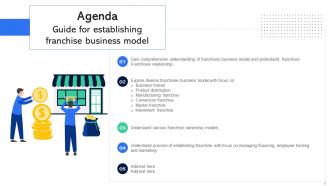
Slide 2: This slide is an Agenda slide. State your agendas here.
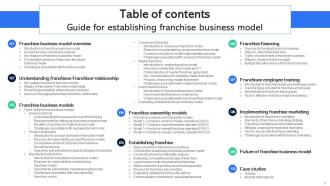
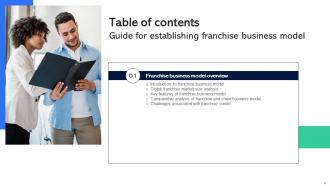
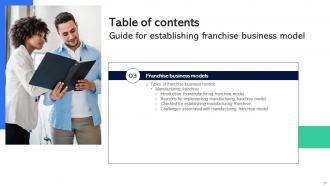
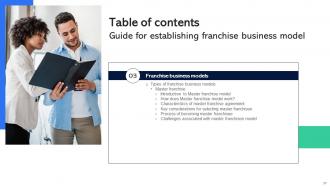
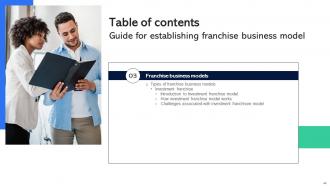
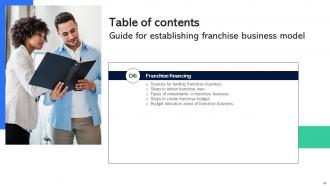
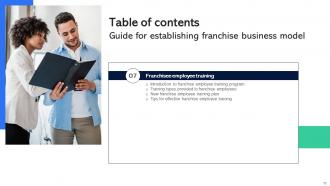
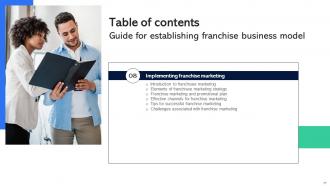
Slide 3: This slide shows a Table of Contents for the presentation.
Slide 4: This slide is an introductory slide.
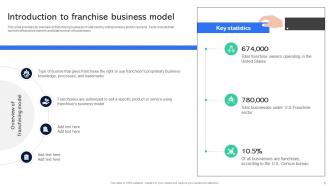
Slide 5: This slide provides an overview of franchising business model used by entrepreneurs and its key facts.
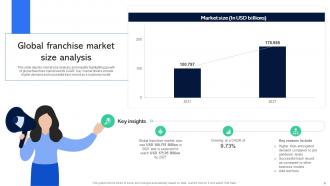
Slide 6: This slide depicts market size analysis and insights highlighting growth of global franchise market and its CAGR.
Slide 7: This slide mentions the features associated with franchise business model used by entrepreneurs.
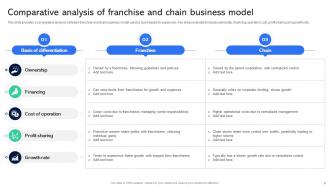
Slide 8: This slide puts a comparative analysis between franchise and chain business model used by businesses for expansion.
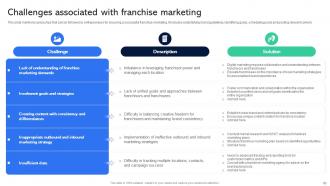
Slide 9: This slide highlights key issues faced by entrepreneurs while implementing franchise business model.
Slide 10: This slide is an introductory slide.
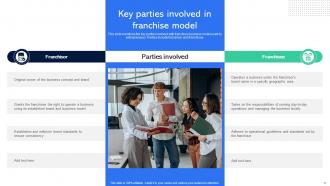
Slide 11: This slide entails the key parties involved with franchise business model used by entrepreneurs.
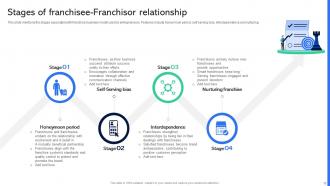
Slide 12: This slide includes the stages associated with franchise business model used by entrepreneurs.
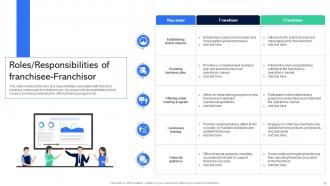
Slide 13: This slide involves the roles and responsibilities associated with franchise business model used by entrepreneurs.
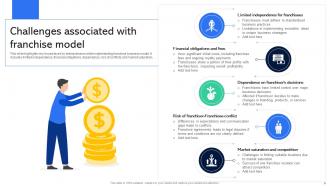
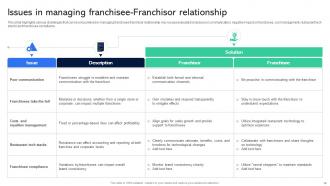
Slide 14: This slide proclaims various challenges that can be encountered in managing franchisee franchisor relationship.
Slide 15: This slide is an introductory slide.
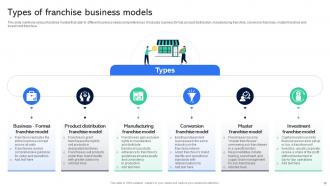
Slide 16: This slide mentions various franchise models that cater to different business needs and preferences.
Slide 17: This slide is an introductory slide.
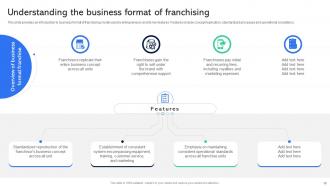
Slide 18: This slide provides an introduction to business format of franchising model used by entrepreneurs and its key features.
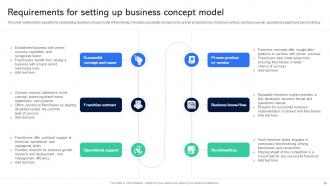
Slide 19: This slide puts the requisites for establishing business concept model of franchising.
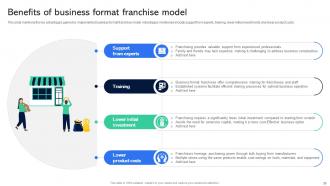
Slide 20: This slide includes the key advantages gained by implemented business format franchise model.
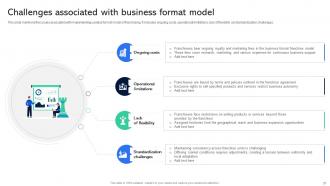
Slide 21: This slide elaborates the issues associated with implementing useless format model of franchising.
Slide 22: This slide is an introductory slide.
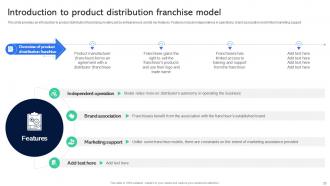
Slide 23: This slide portrays an introduction to product distribution franchising model used by entrepreneurs and its key features.
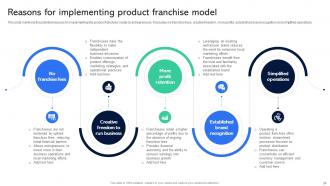
Slide 24: This slide mentions the potential reasons for implementing the product franchise model by entrepreneurs.
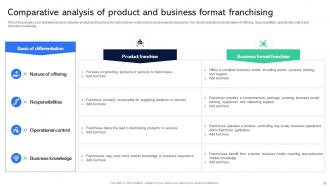
Slide 25: This slide provides a comparative analysis between product and business format franchise model used by businesses for expansion.
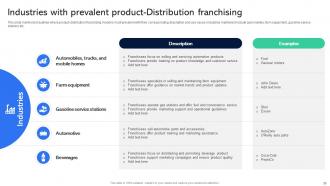
Slide 26: This slide showcases industries where product-distribution franchising model is most prevalent with their corresponding description and use cases.
Slide 27: This slide is an introductory slide.
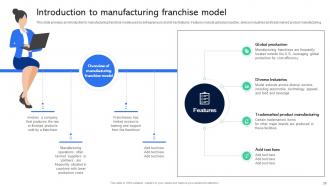
Slide 28: This slide shows an introduction to manufacturing franchise model used by entrepreneurs and its key features.
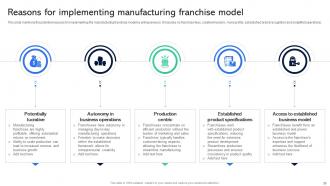
Slide 29: This slide puts the potential reasons for implementing the manufacturing franchise model by entrepreneurs.
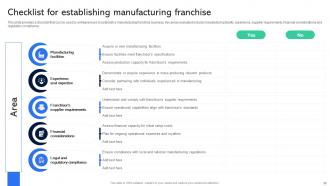
Slide 30: This slide involves a checklist that can be used by entrepreneurs to establish a manufacturing franchise business.
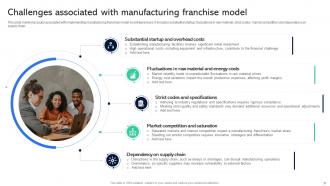
Slide 31: This slide includes issues associated with implementing manufacturing franchise model by entrepreneurs.
Slide 32: This slide is an introductory slide.
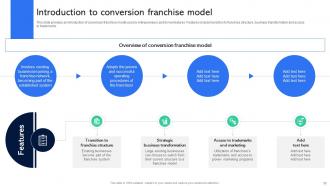
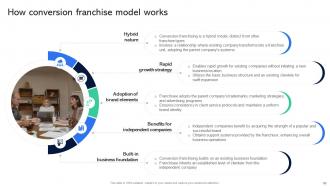
Slide 33: This slide caters to an introduction of conversion franchise model used by entrepreneurs and its key features.
Slide 34: This slide contains the potential reasons for implementing the conversion franchise model by entrepreneurs.
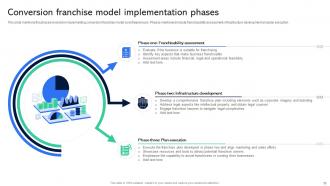
Slide 35: This slide denotes the phases involved in implementing conversion franchise model by entrepreneurs.
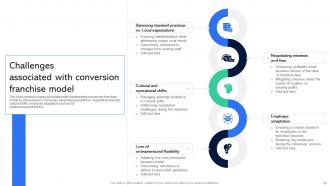
Slide 36: This slide puts issues associated with implementing conversion franchise model by entrepreneurs.
Slide 37: This slide is an introductory slide.
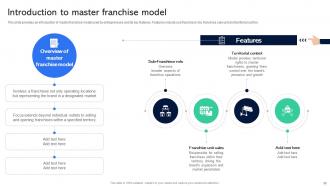
Slide 38: This slide provides an introduction of master franchise model used by entrepreneurs and its key features.
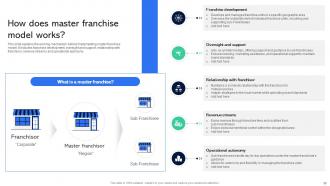
Slide 39: This slide explains the working mechanism behind implementing master franchise model.
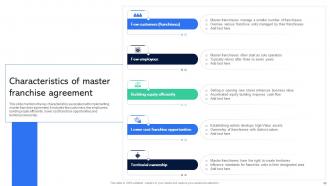
Slide 40: This slide covers the key characteristics associated with implementing master franchise agreement.
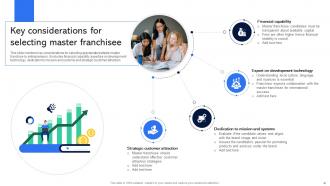
Slide 41: This slide mentions key considerations for selecting appropriate/suitable master franchise by entrepreneurs.
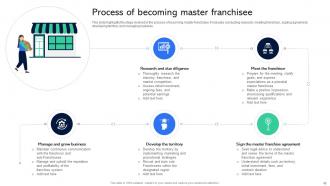
Slide 42: This slide highlights the steps involved in the process of becoming master franchisee.
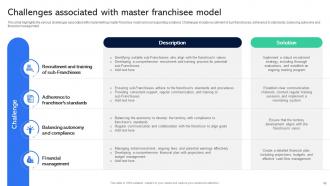
Slide 43: This slide portrays the various challenges associated with implementing master franchise model and corresponding solutions.
Slide 44: This slide is an introductory slide.
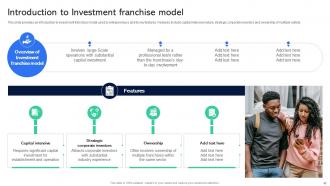
Slide 45: This slide provides an introduction to investment franchise model used by entrepreneurs and its key features.
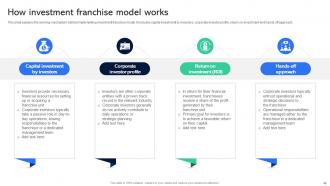
Slide 46: This slide explains the working mechanism behind implementing investment franchise model.
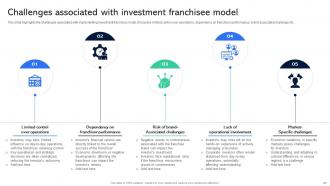
Slide 47: This slide highlights the challenges associated with implementing investment franchise model.
Slide 48: This slide is an introductory slide.
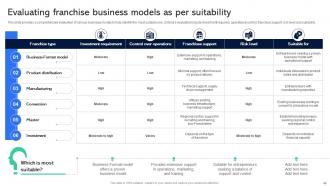
Slide 49: This slide provides a comprehensive evaluation of various business models to help identify the most suitable one.
Slide 50: This slide is an introductory slide.
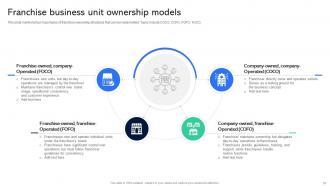
Slide 51: This slide mentions four major types of franchise ownership structures that can be implemented.
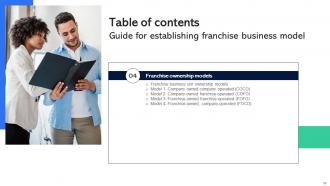
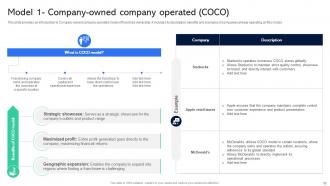
Slide 52: This slide caters to an introduction to Company owned company operated model of franchise ownership.
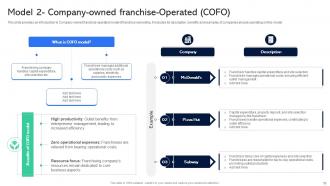
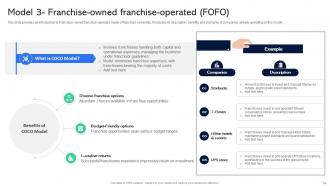
Slide 53: This slide covers an introduction to Company-owned franchise-operated model of franchise ownership.
Slide 54: This slide contains an introduction to Franchise-owned franchise-operated model of franchise ownership.
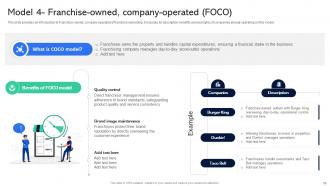
Slide 55: This slide provides an introduction to Franchise-owned, company-operated of franchise ownership.
Slide 56: This slide is an introductory slide.
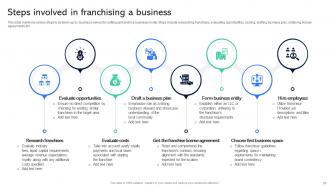
Slide 57: This slide mentions various steps to be taken up by business owners for setting up franchise business model.
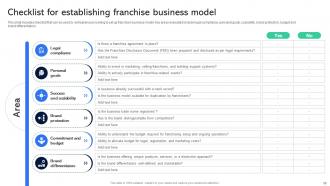
Slide 58: This slide includes checklist that can be used by entrepreneurs looking to set up franchise business model.
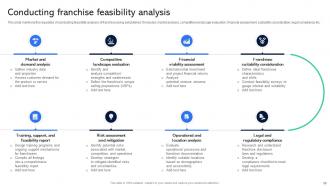
Slide 59: This slide puts the requisites of conducting feasibility analysis of franchise being established.
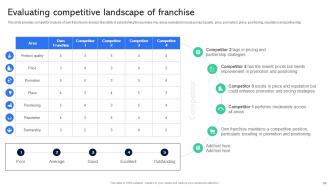
Slide 60: This slide points to the competitor analysis of own franchise to analyze feasibility of establishing the business.
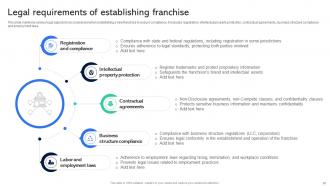
Slide 61: This slide mentions various legal aspects to be considered when establishing a new franchise to ensure compliance.
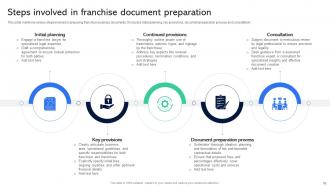
Slide 62: This slide includes various steps involved in preparing franchise business documents.
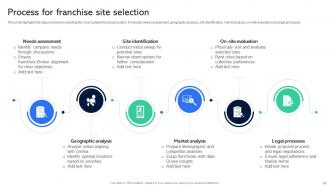
Slide 63: This slide highlights the steps involved in selecting the most suitable franchise location.
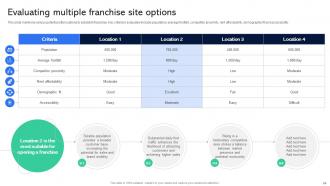
Slide 64: This slide mentions various potential site locations to establish franchise.
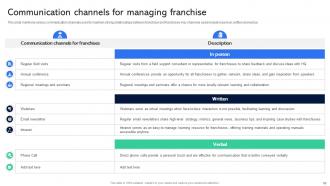
Slide 65: This slide contains various communication channels used to maintain strong relationships between franchisor and franchisee.
Slide 66: This slide is an introductory slide.
Slide 67: This slide describes various ways to finance the purchase of a franchise and achieve necessary capital.
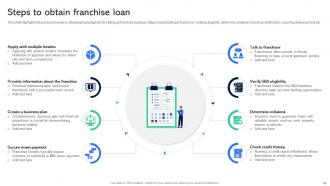
Slide 68: This slide denotes the process involved in obtaining financing/loan for setting up franchise business.
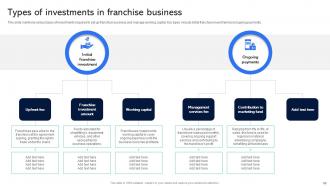
Slide 69: This slide mentions various types of investments required to set up franchise business and manage working capital.
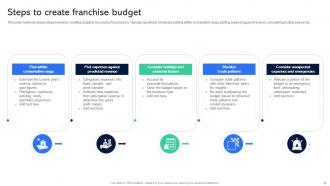
Slide 70: This slide puts various steps involved in creating budget to be used by franchises to manage operations.
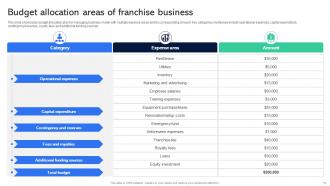
Slide 71: This slide entails budget allocation plan for managing business model with multiple expense areas and its corresponding amount.
Slide 72: This slide is an introductory slide.
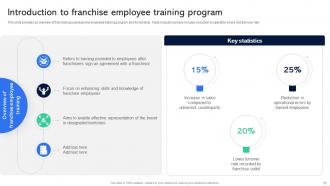
Slide 73: This slide provides an overview of franchising business new employee training program and its key facts.
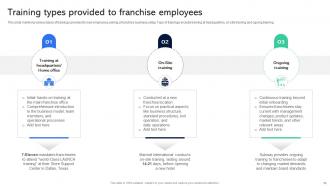
Slide 74: This slide exhibits various types of trainings provided to new employees joining a franchise business setup.
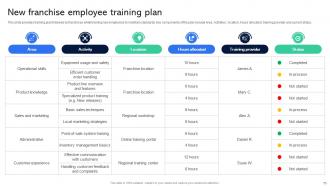
Slide 75: This slide provides training plan followed by franchises while training new employees to maintain standards.
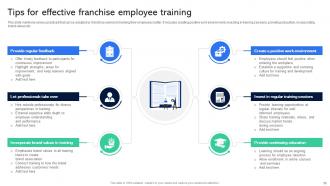
Slide 76: This slide mentions various practices that can be adopted by franchise owners to training their employees better.
Slide 77: This slide is an introductory slide.
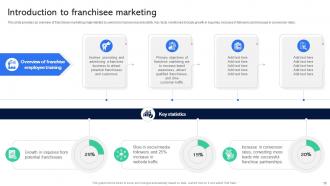
Slide 78: This slide outlines an overview of franchisee marketing implemented by owners to improve brand visibility.
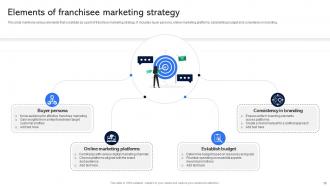
Slide 79: This slide marks various elements that constitute as a part of franchise marketing strategy.
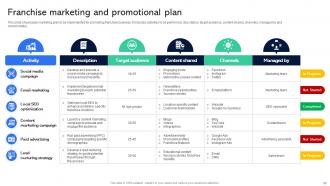
Slide 80: This slide showcases marketing plan to be implemented for promoting franchise business.
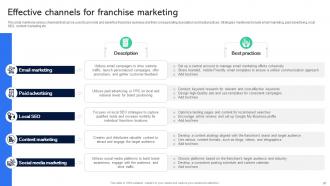
Slide 81: This slide shows various channels that can be used to promote and advertise franchise business and their corresponding description and best practices.
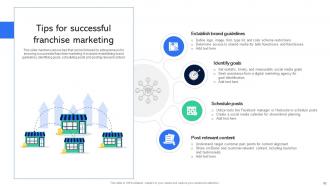
Slide 82: This slide mentions various tips that can be followed by entrepreneurs for ensuring a successful franchise marketing.
Slide 83: This slide entails various tips that can be followed by entrepreneurs for ensuring a successful franchise marketing.
Slide 84: This slide is an introductory slide.
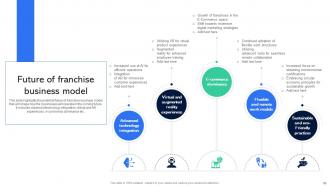
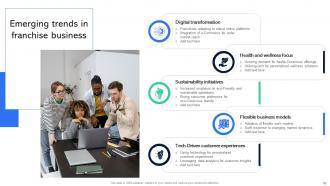
Slide 85: This slide highlights the potential future of franchise business model that will shape how the businesses will operate in the coming future.
Slide 86: This slide is an introductory slide.
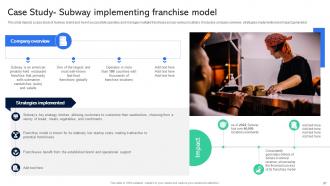
Slide 87: This slide depicts a case study of Subway brand and how it successfully operates and manages multiple franchises across various locations.
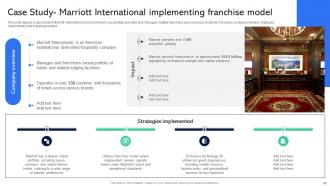
Slide 88: This slide marks a case study of Marriott International brand and how it successfully operates and manages multiple franchises across various locations.
Slide 89: This slide shows all the icons included in the presentation.
Slide 90: This slide is titled Additional Slides for moving forward.
Slide 91: This slide is 100% editable.
Slide 92: This slide is an additional slide.
Slide 93: This slide is an additional slide.
Slide 94: This slide is an additional slide.
Slide 95: This slide is an additional slide.
Slide 96: This slide is a thank-you slide with address, contact numbers, and email address.
Guide For Establishing Franchise Business Model Powerpoint Presentation Slides with all 104 slides:
Use our Guide For Establishing Franchise Business Model Powerpoint Presentation Slides to effectively help you save your valuable time. They are readymade to fit into any presentation structure.













FAQs for Guide For Establishing Franchise Business Model
Honestly, the biggest win is getting a business model that already works - operations, marketing, all that stuff is figured out for you. Brand recognition helps a ton too. You'll get training (super helpful if you're new to the industry), ongoing support, and access to their supplier deals which can save serious money. Downside? Less freedom to do your own thing, plus you're paying fees forever. But the lower risk usually makes up for it, at least in my opinion. Oh, and definitely talk to other franchisees first - they'll give you the real scoop on what it's actually like.
Dude, franchisor support can literally make or break you. Their training and guidance helps you skip the beginner mistakes that cost serious money. Plus when stuff hits the fan (and trust me, it will), you'll want someone knowledgeable to call. Good franchisors do regular check-ins and actually respond when you need help. The crappy ones? You're basically on your own. Before signing anything, talk to current franchisees about response times - that conversation will tell you everything. Don't just take the sales pitch at face value.
Honestly, franchising can be pretty limiting - you're stuck paying royalty fees forever and can't really make the business your own. Plus you're totally dependent on whether the brand has a good reputation or not. The operational rules are super strict too, which gets old fast. Before jumping in, definitely talk to current franchisees about what it's really like day-to-day. Research the company hard and try negotiating contract terms if you can. Having solid cash reserves helps since unexpected costs always pop up. Oh, and connecting with other franchise owners is clutch - they'll give you the real scoop and support when things get tough.
Hey! So franchise deals are all over the place depending on what you're getting into. Food places are crazy strict - they'll control everything from your recipes to where you buy napkins, I swear. Service franchises like cleaning businesses? Way more chill about how you operate day-to-day. Retail sits in between - they'll dictate your products and store look but won't micromanage you as much. It really depends on how much they need every location to feel identical. Definitely check out 2-3 agreements before you commit though, you'll start seeing the patterns.
Brand recognition is massive for franchises. People already trust the name, so you don't have to convince them from scratch. McDonald's vs some random burger joint - no contest, right? Marketing becomes way cheaper since the brand basically sells itself. You get their systems and supplier deals too, which is pretty sweet. Just make sure whatever franchise you pick is actually known in your area. National fame doesn't always mean locals care. I'd honestly rather have strong regional recognition than weak national stuff.
Dude, first thing - get that franchise disclosure document (FDD). Yeah it's boring as hell but has all the real numbers and fees. Talk to franchisees who've been running for 2-3 years, not the new ones still drinking the kool-aid. Ask about actual revenue vs what they were promised. Make sure you've got enough cash for startup costs PLUS like 6-12 months of expenses because things always take longer to get profitable. Check if the brand actually works in your area too. Oh and definitely get a franchise lawyer to look everything over - I know it's another expense but trust me on this one.
So franchise costs are all over the place, but here's the breakdown. You'll pay an initial fee ($10k-$100k), then startup costs for equipment and buildout ($50k-$500k+). Don't forget ongoing royalties either - usually 4-8% of what you make. McDonald's type places? We're talking $1-2M+. But service stuff like cleaning companies might only need $50-100k to start. Restaurant franchises kill your budget because of the physical space requirements. My advice? Get franchise disclosure docs from 3-4 brands you're considering. That'll give you the real numbers instead of just rough estimates.
Definitely research all the local licensing stuff and zoning laws first - don't sign anything until you know what you're getting into. Your franchisor might help but honestly they miss local details sometimes. Get a business lawyer who knows franchising, trust me it's worth it upfront. I'd also join the chamber of commerce since they actually send updates when regulations change. Oh and this is key - make friends with local officials and inspectors early. Way better than dealing with compliance nightmares once you're already open. My cousin learned that the hard way with his pizza place.
Honestly, most franchise owners mess up by just following the manual and calling it a day. You've gotta actually connect with your customers - like, remember their names and stuff. Get involved in local events, sponsor little league teams, whatever fits your area. Social media is huge too (my neighbor literally picks restaurants based on Google reviews, it's crazy). Train your team to go beyond what corporate expects. Oh, and if the franchise lets you add small local touches, definitely do that. The successful owners I know treat it like their own business, not just another corporate location.
Look, established franchises have their training down to a science - thick manuals, actual training centers, the whole deal. Years of refining their system means you get solid structure plus a network of other franchisees to learn from. With newer franchises, honestly? You're kinda winging it together. Their training's pretty basic since they're still figuring stuff out too. But here's the thing - you get way more face time with the actual founders and can help shape how things work. If you're eyeing a newer franchise, definitely talk to their first few franchisees about what the training was actually like.
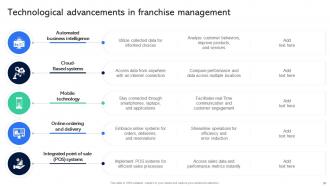
Dude, franchising tech has changed everything. You can run multiple locations from one dashboard now. Training apps keep everyone on the same page, and the data helps you figure out what's actually working. Cloud POS systems are huge - no more spreadsheet hell trying to reconcile everything manually. Franchisors can help you remotely and track if you're following their rules. You get better marketing tools too. Honestly, when you're checking out franchises, ask about their tech setup first. It'll tell you if they're actually keeping up or just stuck in 2005.
Honestly, social media's your best bet for growing those franchise locations. Each spot needs its own vibe that actually connects with the neighborhood - like, people want to feel they're supporting something local, not just another corporate chain. Behind-the-scenes stuff works great. Show off your team, share what customers are saying, jump into local events. You'll need to stick to brand rules obviously, but don't be robotic about it. Pick whatever platform your customers actually use first - no point posting on Instagram if they're all on Facebook, you know? Once you nail that down, expanding gets way easier.
Track your sales revenue and profit margins first - those are non-negotiable. Cash flow timing will kill you faster than low sales, trust me on that one. Labor costs should stay under 30% of revenue if possible. Customer acquisition costs matter too, especially retention rates. Compare yourself to other franchise locations in your network - that's free benchmarking right there. Don't sleep on inventory turnover and average transaction size either. Start monthly tracking with these basics, then get fancy later once you've got the rhythm down.
Honestly, most of it comes down to having solid operations manuals - like, stupidly detailed ones covering everything from recipes to how staff should greet customers. Training is huge too. You can't just hand someone a manual and hope for the best. The part that trips up a lot of franchisors though? Actually checking that people follow the rules. I'd do regular inspections, mystery shoppers, monthly reporting - the whole nine yards. Some places use digital checklists now where franchisees send photos as proof they're doing things right, which is pretty smart. Create clear standards, train properly, then follow up relentlessly.
Honestly, tech integration is huge right now - digital ordering, AI customer service, all that stuff. Franchises are also ditching expensive traditional spots for micro-locations like food trucks and mall kiosks. Health and wellness is blowing up too, which makes sense given everything that's happened. What's really smart is how successful franchises are offering more flexible agreements now. They let franchisees adapt locally while keeping the brand consistent. Oh, and home-based franchises are having a moment since real estate costs are insane. Look for brands in your industry that are actually adapting to these changes instead of fighting them.
-
“Immediate response, professional support, and effective solutions that were customized and immediately provided. Well done- Thank you!”
-
This PowerPoint layout is very helpful from a business point of view, and it's visually stunning too! I'm so happy with this product because it has helped me understand and deliver great presentations.