

Guide On Defining Roles Of Stablecoins Different Types Of Central Bank Digital Currencies BCT SS





Try Before you Buy Download Free Sample Product
 Impress Your
Audience
 100%
Editable
 Save Hours
of Time


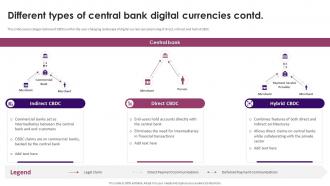
This slide covers classifications of CBDCs within the evolving landscape of digital currencies comprising of wholesale and retail CBDC further consisting of direct, indirect and hybrid CBDC.
People who downloaded this PowerPoint presentation also viewed the following :
Guide On Defining Roles Of Stablecoins Different Types Of Central Bank Digital Currencies BCT SS with all 10 slides:
Use our Guide On Defining Roles Of Stablecoins Different Types Of Central Bank Digital Currencies BCT SS to effectively help you save your valuable time. They are readymade to fit into any presentation structure.









FAQs for Guide On Defining Roles Of Stablecoins Different Types Of Central Bank Digital
Stablecoins are privately-issued digital currencies pegged to stable assets like the US dollar, while CBDCs are government-issued digital versions of national currencies with direct central bank backing. Stablecoins operate through private blockchain networks enabling faster cross-border payments and DeFi applications, whereas CBDCs provide sovereign monetary control and regulatory oversight, with many central banks finding that CBDCs deliver enhanced financial inclusion while maintaining traditional monetary policy tools.
Stablecoins maintain their value through collateral backing, algorithmic mechanisms, and reserve management systems that peg them to stable assets like fiat currencies, commodities, or baskets of securities. These stability mechanisms work by providing transparent reserves, automated supply adjustments, and regular audits, with many financial institutions finding that well-backed stablecoins deliver reliable value preservation and enhanced transaction efficiency.
Stablecoins serve as essential liquidity bridges, price stability anchors, trading pairs, and fiat currency alternatives within the cryptocurrency ecosystem, enabling seamless transactions without traditional banking intermediaries. These digital assets streamline cross-border payments, facilitate decentralized finance operations, and provide reliable value storage, with many financial institutions and payment processors finding that stablecoins deliver faster settlement times and reduced transaction costs.
CBDCs could significantly transform traditional banking by enabling direct central bank transactions, reducing intermediary roles, and streamlining cross-border payments through programmable digital infrastructure. While this presents challenges for commercial banks' deposit-based models, it also creates opportunities for enhanced payment efficiency, reduced settlement times, and improved financial inclusion, with many institutions finding that strategic adaptation delivers competitive advantages.
Widespread stablecoin adoption presents risks including regulatory uncertainty, potential market manipulation, cybersecurity vulnerabilities, liquidity concerns during market stress, and challenges to traditional monetary policy control. While these digital assets streamline cross-border payments and enhance financial inclusion, banks and financial institutions increasingly recognize that proper regulatory frameworks, robust auditing mechanisms, and technological safeguards are essential for maintaining stability and consumer protection in an evolving digital financial landscape.
Regulatory frameworks for stablecoins focus on consumer protection, reserve backing requirements, and anti-money laundering compliance, while CBDCs operate under central bank monetary policy authority and existing financial regulations. Stablecoins face varying oversight across jurisdictions with emphasis on transparency and stability, whereas CBDCs benefit from government backing, with many central banks finding that direct regulatory control enables streamlined implementation and enhanced monetary policy effectiveness.
CBDCs enhance financial inclusion by providing direct access to digital payments without traditional banking infrastructure, enabling instant government transfers, reducing transaction costs, and offering basic financial services through mobile devices. These digital currencies allow unbanked populations in rural areas to participate in formal economies, receive social benefits seamlessly, and access credit services, ultimately delivering greater economic participation and financial empowerment across underserved communities.
Stablecoins present both challenges and opportunities for monetary policy by creating parallel payment systems, potentially reducing central bank control over money supply, influencing exchange rates, and affecting traditional banking intermediation. While they can enhance cross-border efficiency and financial inclusion, many central banks find that widespread stablecoin adoption requires careful regulatory frameworks to maintain currency stability and preserve monetary sovereignty. **Word count: 58 words**
Decentralized stablecoins present both enhanced security through cryptographic protocols and distributed consensus mechanisms, while fiat-backed stablecoins rely on traditional banking security and regulatory oversight for asset protection. While decentralized options minimize counterparty risk and single points of failure, fiat-backed alternatives offer institutional safeguards and compliance frameworks, with many financial institutions finding that hybrid approaches ultimately deliver optimal security balance.
CBDC implementation could revolutionize cross-border transactions by enabling faster settlement, reducing intermediary costs, enhancing regulatory compliance, and improving transaction transparency across international corridors. These digital currencies streamline currency exchange processes, minimize correspondent banking delays, and deliver real-time settlement capabilities, with many central banks finding that CBDCs ultimately enhance financial inclusion while maintaining monetary sovereignty.
Governments can ensure CBDC security through multi-layered cybersecurity frameworks, advanced encryption protocols, blockchain-based immutable ledgers, real-time threat monitoring systems, and rigorous regulatory compliance standards. These comprehensive security measures enable central banks to detect fraudulent transactions, prevent unauthorized access, and maintain system resilience, while financial institutions increasingly find that robust cybersecurity infrastructure ultimately delivers enhanced public trust and operational stability.
CBDCs present both enhanced transparency and privacy challenges compared to stablecoins, with central banks maintaining complete transaction visibility while stablecoins offer varying degrees of pseudonymity. While CBDCs enable governments to monitor financial flows for regulatory compliance and fraud prevention, many institutions find that stablecoins provide greater user privacy through blockchain architecture, ultimately delivering different balances between oversight and confidentiality.
CBDCs present both challenges and opportunities for stablecoins, potentially reducing demand for payment-focused stablecoins while creating new niches for specialized applications. While government-backed digital currencies offer regulatory certainty and widespread acceptance, stablecoins can differentiate through programmability, cross-border efficiency, and integration with decentralized finance, with many finding that both will coexist in an increasingly diverse digital currency ecosystem.
Stablecoins themselves don't require mining, but those collateralized by cryptocurrencies like Bitcoin face indirect environmental concerns through energy-intensive proof-of-work consensus mechanisms. However, many stablecoins operate on more energy-efficient blockchains like Ethereum's proof-of-stake system, while CBDCs increasingly prioritize sustainable infrastructure, with financial institutions finding that newer blockchain technologies significantly reduce carbon footprints.
Consumer perceptions reveal that CBDCs benefit from government backing and regulatory clarity, enhancing trust among traditional banking customers, while stablecoins face skepticism about transparency and reserve backing. However, tech-savvy users often prefer stablecoins for privacy and decentralization, with financial institutions finding that trust ultimately depends on clear regulatory frameworks and proven stability mechanisms.
-
My search for complete decks ended with SlideTeam. Such a surplus collection of HD PowerPoints. Moreover, their standard and widescreen formats have helped me in delivering bullseye presentations.
-
The PPTs are extremely simple to modify. Thank you for providing the slides that are ready to be used. They assist me in saving a lot of time.