

Guide To Creating Global Value Proposition Canvas To Understand Customer Needs Strategy SS




Try Before you Buy Download Free Sample Product
 Impress Your
 Audience
 100%
100% Editable
 Save Hours
 of Time


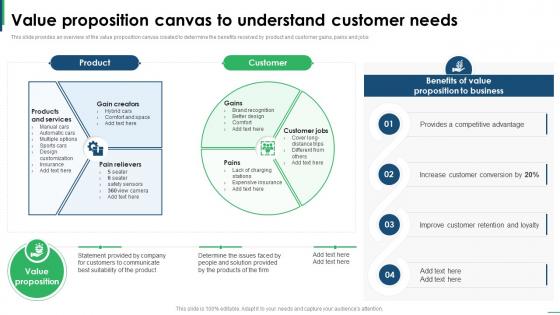
This slide provides an overview of the value proposition canvas created to determine the benefits received by product and customer gains, pains and jobs.
People who downloaded this PowerPoint presentation also viewed the following :
Guide To Creating Global Value Proposition Canvas To Understand Customer Needs Strategy SS with all 9 slides:
Use our Guide To Creating Global Value Proposition Canvas To Understand Customer Needs Strategy SS to effectively help you save your valuable time. They are readymade to fit into any presentation structure.








FAQs for Guide To Creating Global Value Proposition Canvas To Understand Customer
The Global Value Proposition Canvas includes customer segments, value propositions, customer jobs, pains, pain relievers, gains, and gain creators, alongside cultural considerations, regulatory requirements, and market-specific adaptations. These components work together by identifying local customer needs, addressing regional challenges, and delivering culturally relevant solutions, with many multinational organizations finding that this comprehensive approach ultimately enhances global market penetration and competitive positioning.
The Global Value Proposition Canvas differs from traditional frameworks by incorporating cross-cultural considerations, regional market dynamics, currency variations, and regulatory differences across multiple geographies. While traditional approaches focus on single markets, this global framework enables organizations to identify universal value drivers alongside location-specific customizations, ultimately delivering scalable propositions that resonate across diverse international markets.
Businesses can adapt the Global Value Proposition Canvas through cultural research, localized customer personas, region-specific pain point analysis, culturally relevant value messaging, and collaborative workshops with local teams. This strategic combination enables organizations to maintain core value propositions while tailoring customer segments, jobs-to-be-done, and gain creators for diverse markets, with many multinational companies finding that cultural customization significantly enhances market penetration and customer resonance.
Companies can effectively gather customer insights through customer interviews, surveys, focus groups, behavioral analytics, and social media monitoring to populate the canvas comprehensively. These research methods enable organizations to understand pain points, desired gains, and job requirements across different market segments, with many businesses finding that combining qualitative interviews with quantitative data analysis delivers the most accurate customer profiles for strategic decision-making.
Customer segments fundamentally shape global value propositions by defining distinct regional needs, cultural preferences, purchasing behaviors, and market expectations that require tailored approaches. Through demographic analysis, cultural research, and local market insights, organizations strategically adapt their core offerings, messaging, and delivery methods across different markets, ultimately delivering region-specific value while maintaining brand consistency and competitive advantage globally.
The Global Value Proposition Canvas enhances cross-border marketing by mapping cultural preferences, regional pain points, and local customer behaviors across different markets, enabling businesses to tailor messaging, product positioning, and value delivery for each geographic segment. This strategic approach helps companies identify universal value drivers while customizing market-specific elements, ultimately delivering more resonant campaigns and competitive advantage in international expansion efforts.
Organizations can measure global value proposition efficacy through customer acquisition costs, retention rates, market penetration metrics, brand awareness scores, and revenue growth across regions. These metrics enable businesses to assess regional performance variations, identify optimization opportunities, and refine their propositions accordingly, with many multinational companies finding that localized measurement approaches deliver more actionable insights and sustainable competitive advantage.
Competitive analysis informs Global Value Proposition Canvas development by identifying market gaps, differentiation opportunities, and customer pain points competitors aren't addressing effectively. This intelligence enables organizations to position their value propositions strategically, refine customer segments, and enhance job-to-be-done mapping, ultimately delivering superior customer experiences and sustainable competitive advantage in global markets.
Common pitfalls include oversimplifying cultural differences, applying uniform value propositions across diverse markets, neglecting local competitive landscapes, and failing to validate assumptions through regional customer research. These mistakes often result in misaligned messaging and poor market penetration, with many global organizations finding that successful canvas implementation requires dedicated local market analysis, cultural adaptation strategies, and iterative testing to ensure value propositions resonate authentically across different regions.
Technology facilitates Global Value Proposition Canvas implementation through cloud-based collaboration platforms, real-time data analytics, automated customer feedback collection, and integrated project management systems. These digital tools enable multinational teams to collaborate seamlessly across time zones, analyze market data efficiently, and track proposition performance continuously, ultimately delivering faster market insights and more responsive value proposition development for competitive advantage.
**INPUT**: What are some real-world examples of successful global value propositions? **OUTPUT**: Successful global value propositions include McDonald's standardized convenience with local menu adaptation, Airbnb's universal travel affordability, Amazon's consistent fast delivery worldwide, and Uber's seamless transportation access. These companies deliver value by combining core benefits like reliability, accessibility, and cost-effectiveness with regional customization, ultimately enabling scalable growth while meeting diverse market needs across different cultural and economic environments. [Word count: 60 words]
Businesses ensure consistency by establishing core value pillars that remain constant globally while allowing local adaptation of messaging, delivery methods, and cultural relevance. Through centralized brand guidelines, regular cross-market collaboration, and standardized customer feedback systems, companies like McDonald's and Coca-Cola maintain unified value promises while adapting execution locally, ultimately delivering coherent brand experiences across diverse markets.
Regional market trends significantly influence the Global Value Proposition Canvas by requiring localized customer segments, culturally adapted pain points, and region-specific gain creators that reflect local preferences, regulatory environments, and economic conditions. These variations enable organizations to maintain strategic coherence while delivering customized value propositions, with many multinational companies finding that regional adaptation ultimately enhances global competitive advantage and market penetration.
Visual design is critically important in presenting a Global Value Proposition Canvas, as it transforms complex value propositions into clear, accessible formats that stakeholders across different regions can quickly understand and act upon. Through strategic color coding, intuitive layouts, and culturally-sensitive visual elements, organizations enhance comprehension, facilitate cross-cultural collaboration, and accelerate decision-making processes, ultimately delivering stronger market penetration and competitive advantage.
Businesses can access various tools including online canvas generators, collaborative platforms like Miro and Figma, specialized software such as Strategyzer, market research databases, and customer analytics tools. These resources streamline global value proposition development by enabling cross-cultural customer insights, facilitating remote team collaboration, and providing data-driven market analysis, ultimately delivering strategic clarity and competitive advantage across international markets.
-
SlideTeam is my one-stop destination for templates. Highly recommended!
-
They guys always go the extra mile to meet the expectations of their customers. Almost a year has been associated with them.