


Guide To Dealer Development Strategy For Automobile Industry Strategy CD




Try Before you Buy Download Free Sample Product
 Impress Your
 Audience
 100%
100% Editable
 Save Hours
 of Time


Comprehensive guide to enhancing dealer development strategies within the automotive industry. It offers insights into refining dealership networks, strengthening brand presence, and maximizing sales opportunities. The PPT slides provide steps for creating a robust dealer development strategy tailored to specific business objectives. Auto Dealership Growth Blueprint covers techniques for optimizing existing dealer networks and evaluating the effectiveness of implemented strategies, ensuring alignment with business goals. The Automotive Retailer Expansion PowerPoint presentation covers various dealership enhancement initiatives, including expansion plans, training programs, and marketing campaigns. Customize this 100 percent editable template with our highly skilled research or design team. Get access now.
People who downloaded this PowerPoint presentation also viewed the following :
Content of this Powerpoint Presentation
Slide 1: This slide showcase title Guide to Dealer Development Strategy for Automobile Industry. State Your Company Name.
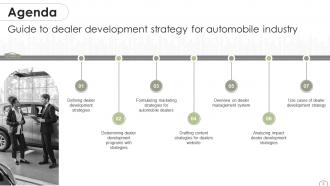
Slide 2: This slide showcase Agenda.
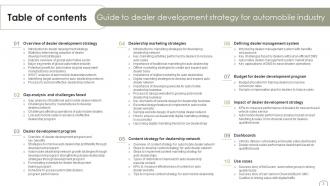
Slide 3: This slide exhibit Table of Content.
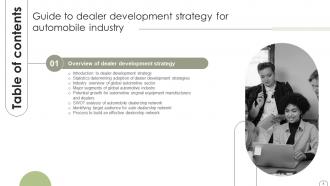
Slide 4: This slide exhibit Table of Content: Overview of dealer development strategy.
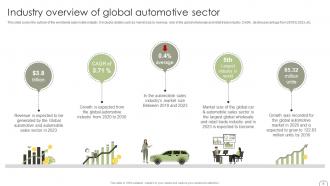
Slide 5: This slide covers the outlook of the worldwide automobile industry.
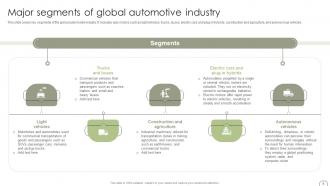
Slide 6: This slide covers key segments of the global automobile industry.
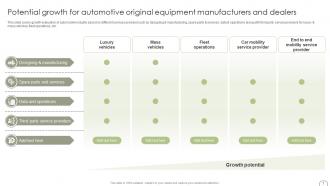
Slide 7: This slide covers growth evaluation of automobile industry based on different services provided.
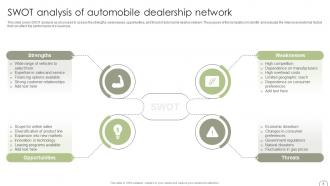
Slide 8: This slide covers SWOT analysis as a tool used to assess the strengths, weaknesses, opportunities, and threat of automobile dealers network.
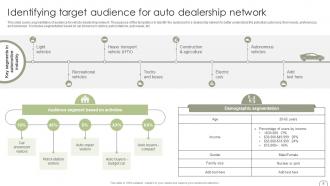
Slide 9: This slide covers segmentation of audience for vehicle dealership network.
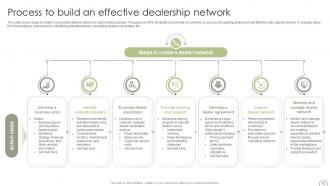
Slide 10: This slide covers steps to create a successful dealers network for automobile business.
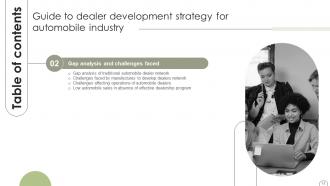
Slide 11: This slide exhibit Table of Content: Gap analysis and challenges faced.
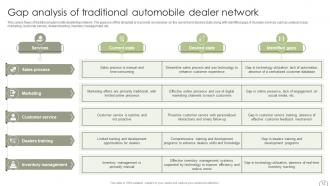
Slide 12: This covers flaws of traditional automobile dealership network.
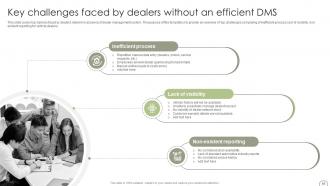
Slide 13: This slide covers pain points faced by auto manufacturers in developing dealership network.
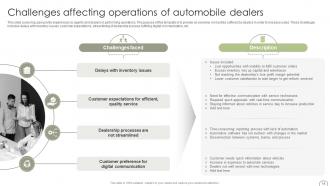
Slide 14: This slide covers top pain points experiences by agents and dealers in performing operations.
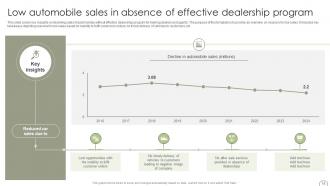
Slide 15: This slide covers key insights on declining sales of automobiles without effective dealership program for training dealers and agents.
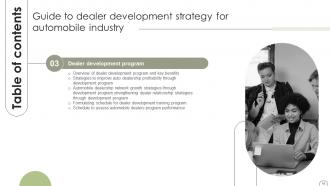
Slide 16: This slide exhibit Table of Content: Dealer development program.
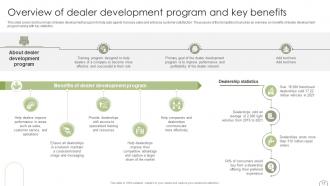
Slide 17: This slide covers brief summary of dealer development program to help auto agents increase sales and enhance customer satisfaction.
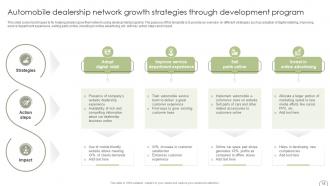
Slide 18: This slide covers techniques to for helping dealers grow their network using development programs.
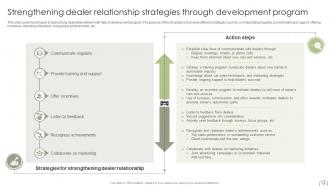
Slide 19: This slide covers techniques to build strong dealership network with help of development program.
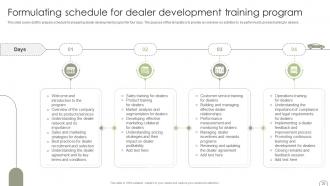
Slide 20: This slide covers draft to prepare schedule for preparing dealer development program for four days.
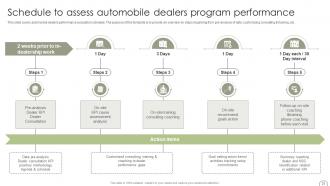
Slide 21: This slide covers automobile dealers performance evaluation schedule.
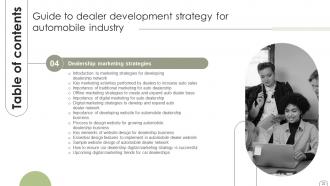
Slide 22: This slide exhibit Table of Content: Dealership marketing strategies.
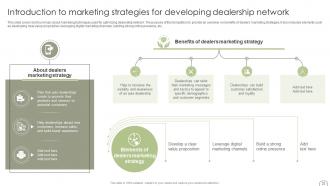
Slide 23: This slide covers brief summary about marketing techniques used for optimizing dealership network.
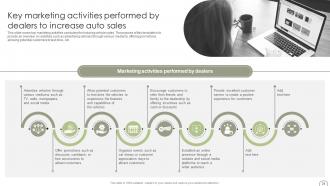
Slide 24: This slide covers top marketing activities conducted for inducing vehicle sales.
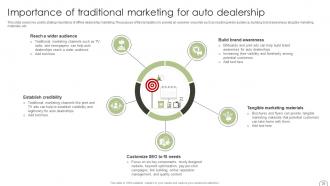
Slide 25: This slide covers key points stating importance of offline dealership marketing.
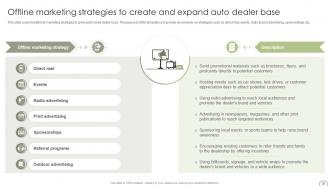
Slide 26: This slide covers traditional marketing strategies to grow automobile dealer base.
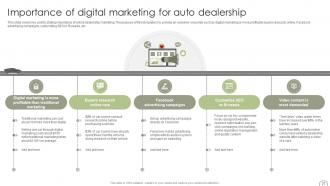
Slide 27: This slide covers key points stating importance of online dealership marketing.
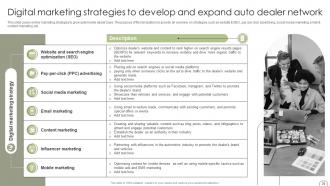
Slide 28: This slide covers online marketing strategies to grow automobile dealer base.
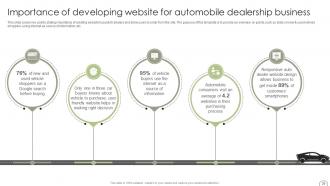
Slide 29: This slide covers key points stating importance of creating website to publish dealers and allow users to order from the site.
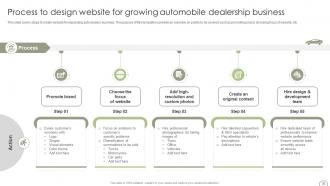
Slide 30: This slide covers steps to create website for expanding auto dealers business.
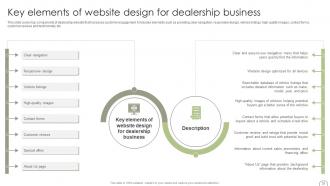
Slide 31: This slide covers top components of dealership website that increases customer engagement.
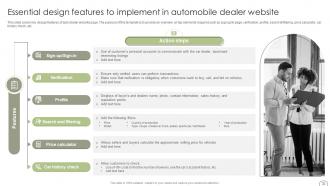
Slide 32: This slide covers key design features of auto dealer website page.
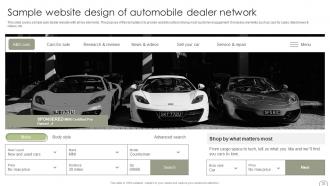
Slide 33: This slide covers sample auto dealer website with all key elements.
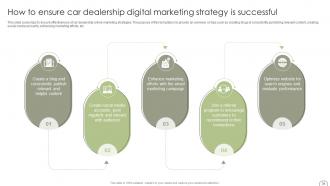
Slide 34: This slide covers tips to ensure effectiveness of car dealership online marketing strategies.
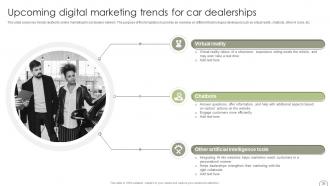
Slide 35: This slide covers key trends related to online marketing for car dealers network.
Slide 36: This slide exhibit Table of Content: Content strategy for dealership network.
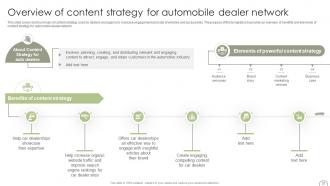
Slide 37: This slide covers brief summary of content strategy used by dealers and agency to increase engagement and sale of vehicles and accessories.
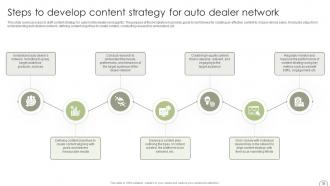
Slide 38: This slide covers process to draft content strategy for automobile dealers and agents.
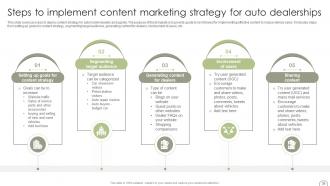
Slide 39: This slide covers process to deploy content strategy for automobile dealers and agents.
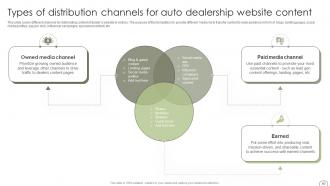
Slide 40: This slide covers different channels for distributing content of dealer’s website to visitors.
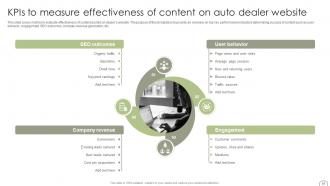
Slide 41: This slide covers metrics to evaluate effectiveness of content posted on dealer’s website.
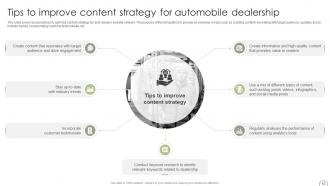
Slide 42: This slide covers best practices to optimize content strategy for auto dealers website network.
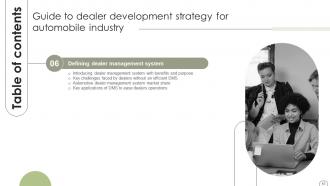
Slide 43: This slide exhibit Table of Content: Defining dealer management system.
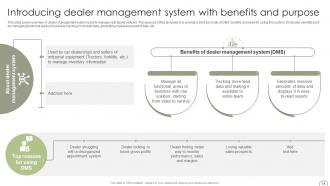
Slide 44: This slide covers overview of dealer management system used to manage vast dealer network.
Slide 45: This slide covers top barriers faced by dealers network in absence of dealer management system.
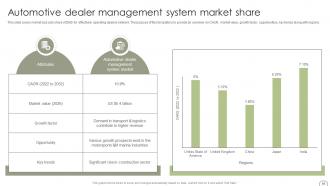
Slide 46: This slide covers market size and share of DMS for effectively operating dealers network.
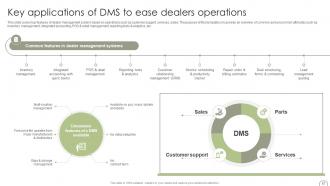
Slide 47: This slide covers top features of dealer management system based on operations such as customer support, services, sales.
Slide 48: This slide exhibit Table of Content: Budget for dealer development program
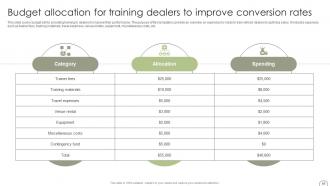
Slide 49: This slide covers budget set for providing training to dealers to improve their performance.
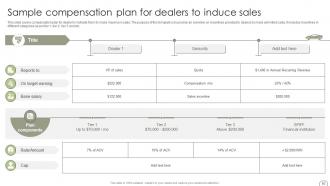
Slide 50: This slide covers compensation plan for dealer to motivate them to make maximum sales.
Slide 51: This slide exhibit Table of Content: Impact of dealer development strategy.
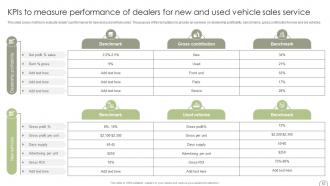
Slide 52: This slide covers metrics to evaluate dealer’s performance for new and used vehicle sales.
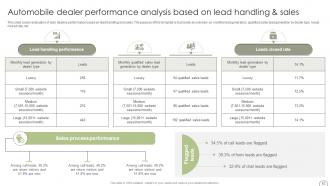
Slide 53: This slide covers evaluation of auto dealers performance based on lead handling and sales.
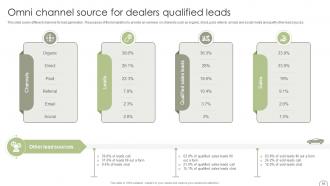
Slide 54: This slide covers different channels for lead generation.
Slide 55: This slide exhibit Table of Content: Dashboards.
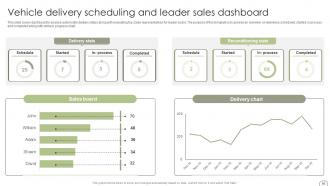
Slide 56: This slide covers dashboard to analyse automobile delivery status along with evaluating top sales representatives for leader board.
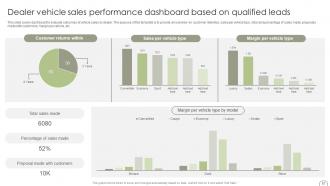
Slide 57: This slide covers dashboard to evaluate outcomes of vehicle sales by dealer.
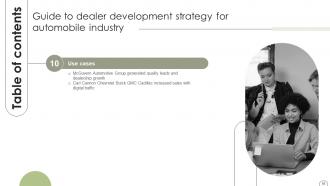
Slide 58: This slide exhibit Table of Content: Use cases.
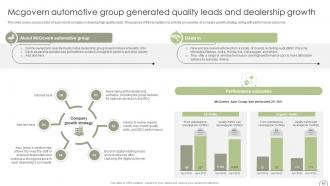
Slide 59: This slide covers success story of automobile company in drawing high quality leads.
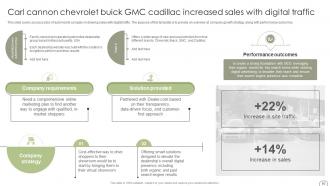
Slide 60: This slide covers success story of automobile company in drawing sales with digital traffic.
Slide 61: This slide shows all the icons included in the presentation.
Slide 62: This slide is titled as Additional Slides for moving forward.
Slide 63: This is Our Team slide with names and designation.
Slide 64: This is Our Vision, Mission & Goal slide. Post your Visions, Missions, and Goals here.
Slide 65: This slide provides 30 60 90 Days Plan with text boxes.
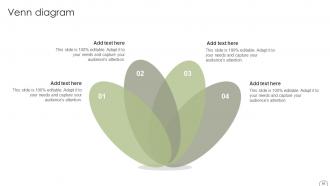
Slide 66: This slide depicts Venn diagram with text boxes.
Slide 67: This slide shows Post It Notes for reminders and deadlines. Post your important notes here.
Slide 68: This is a Thank You slide with address, contact numbers and email address.
Guide To Dealer Development Strategy For Automobile Industry Strategy CD with all 76 slides:
Use our Guide To Dealer Development Strategy For Automobile Industry Strategy CD to effectively help you save your valuable time. They are readymade to fit into any presentation structure.











FAQs for Guide To Dealer Development Strategy For Automobile
Effective dealer development strategies include comprehensive training programs, performance monitoring systems, incentive structures, territory optimization, and ongoing support mechanisms. These components work together by enhancing dealer capabilities, streamlining operations, and aligning partner goals with business objectives, with many organizations finding that strategic dealer development ultimately delivers expanded market reach and sustained revenue growth.
Market research informs dealer selection by analyzing local demographics, competitive landscapes, market penetration rates, customer preferences, and regional growth trends. Through comprehensive data analysis, businesses can identify high-potential territories, assess dealer capabilities against market demands, and develop targeted growth strategies, with many organizations finding that research-driven selection significantly enhances dealer performance and market expansion success.
Dealer training enhances product knowledge through comprehensive curricula covering features, benefits, competitive positioning, and technical specifications, while developing customer service skills like consultative selling, objection handling, and relationship management. Well-trained dealers deliver more informed recommendations, faster problem resolution, and personalized experiences, with many organizations finding that strategic training programs ultimately drive higher conversion rates and customer satisfaction.
CRM systems enhance dealer management by centralizing partner data, automating communication workflows, tracking performance metrics, and streamlining order processing across multiple channels. These technologies enable manufacturers to deliver faster support responses, monitor dealer inventory levels, and provide real-time sales analytics, with many automotive and electronics companies finding that integrated CRM platforms ultimately boost dealer satisfaction and revenue growth.
Companies establish meaningful dealer relationships through transparent communication, comprehensive training programs, competitive incentive structures, and consistent support systems that address operational challenges. Through regular business reviews, joint marketing initiatives, and technology integration platforms, organizations enhance dealer performance while building trust, ultimately delivering improved market penetration and sustained partnership growth across distribution networks.
Businesses should track sales volume, market penetration rates, customer satisfaction scores, inventory turnover, and revenue growth to measure dealer performance effectively. These metrics enable organizations to identify top-performing partners, optimize resource allocation, and enhance channel profitability, with many companies finding that comprehensive dealer scorecards ultimately drive stronger partnerships and competitive market positioning.
Incentive programs can be structured through tiered commission rates, performance bonuses, volume discounts, marketing co-op funds, and exclusive territory rights. These strategic combinations enhance dealer engagement by rewarding top performers, supporting growth investments, and providing competitive advantages, with many organizations finding that multi-layered incentive structures ultimately deliver stronger sales results and long-term dealer loyalty.
Tiered dealer development programs deliver structured growth pathways, personalized support levels, performance-based incentives, clear advancement criteria, and enhanced partner retention. These strategic frameworks enable organizations to optimize resource allocation while providing targeted training and support, with many companies finding that tiered approaches increase dealer satisfaction, accelerate partner development, and ultimately drive stronger sales performance across diverse market segments.
Businesses can identify emerging dealers through performance analytics, market feedback, sales velocity tracking, and territory analysis to spot high-potential partners. Through targeted training programs, enhanced support resources, and strategic incentives, companies can nurture these relationships while providing marketing assistance and operational guidance, ultimately delivering stronger market penetration and sustainable revenue growth across expanding dealer networks.
Effective dealer retention strategies include enhanced support programs, competitive incentive structures, comprehensive training initiatives, streamlined communication channels, and performance-based rewards systems. These approaches strengthen partnerships by providing dealers with better tools, resources, and profitability opportunities, while many automotive and consumer goods companies find that consistent engagement and mutual value creation significantly reduce turnover in competitive environments.
Multi-channel distribution significantly enhances dealer development strategies by expanding market reach, diversifying revenue streams, and enabling targeted customer engagement across digital and traditional platforms. This approach allows dealers to optimize inventory management, reduce dependency on single channels, and leverage data analytics for better customer insights, while many organizations finding that integrated multi-channel strategies deliver improved operational efficiency and competitive advantage.
Common dealer development challenges include inadequate training programs, inconsistent brand representation, poor communication channels, limited marketing support, and insufficient performance tracking systems. These obstacles can be addressed by implementing comprehensive onboarding processes, establishing clear communication protocols, and providing ongoing educational resources, with many organizations finding that regular performance reviews and collaborative planning sessions ultimately deliver stronger dealer relationships and enhanced market penetration.
Companies can leverage dealer feedback to improve products and services by implementing systematic feedback collection processes, conducting regular surveys and focus groups, analyzing sales data patterns, and maintaining open communication channels with dealer networks. This strategic approach enables businesses to identify product gaps, enhance service offerings, and streamline operational processes, with many organizations finding that dealer insights drive innovation and ultimately deliver improved customer satisfaction and competitive market positioning.
Brand consistency across diverse dealer networks can be maintained through comprehensive brand guidelines, standardized training programs, regular audits, digital asset management systems, and consistent communication protocols. These approaches streamline brand implementation by ensuring uniform messaging, visual identity, and customer experiences, with many automotive and retail organizations finding that centralized brand management ultimately delivers stronger market presence and competitive advantage.
Local market understanding is crucial for successful dealer partnerships, as it enables targeted customer engagement, culturally relevant marketing approaches, and competitive pricing strategies tailored to regional preferences. Through deep market insights, dealers can navigate local regulations, build stronger customer relationships, and adapt product offerings effectively, while manufacturers benefit from enhanced market penetration and sustainable revenue growth across diverse geographical territories.
-
Excellent Designs.
-
The templates are handy and I can personalize them as per my needs. Glad to be your subscriber!