

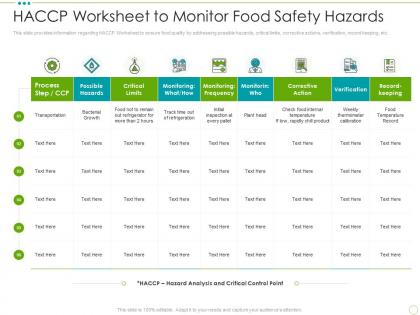
Haccp worksheet to monitor food safety hazards food safety excellence




Try Before you Buy Download Free Sample Product
 Impress Your
 Audience
 100%
100% Editable
 Save Hours
 of Time


This slide provides information regarding HACCP Worksheet to ensure food quality by addressing possible hazards, critical limits, corrective actions, verification, record keeping, etc.
People who downloaded this PowerPoint presentation also viewed the following :
Haccp worksheet to monitor food safety hazards food safety excellence with all 2 slides:
Use our HACCP Worksheet To Monitor Food Safety Hazards Food Safety Excellence to effectively help you save your valuable time. They are readymade to fit into any presentation structure.

FAQs for Haccp worksheet to monitor food safety hazards
So HACCP basically has seven steps you gotta follow - analyze hazards, find your critical control points, set limits for those points, monitor everything, plan what to do when stuff goes wrong, verify it's all working, and keep records. It's honestly like setting up checkpoints throughout your kitchen process. Temperature limits are huge - that's where most people mess up. When something breaks down, you'll already know your game plan instead of panicking. I'd start by just walking through your whole process and figuring out where things could go sideways.
Honestly, just take what you're already doing and see how it fits into HACCP's seven principles - you'll probably find you're closer than you think. Most places already do temperature checks and cleaning, they just haven't made them official control points yet. But here's the thing - do your own hazard analysis first instead of copying someone else's plan (I've seen that backfire). Pick your real risks, set up monitoring around those, and document it all properly. Oh and train your team on the actual procedures they'll be doing. If it feels like too much, maybe start with just one product line? You can always expand later once you've got the hang of it.
Look, hazard analysis is basically the whole foundation of HACCP - you're playing detective and figuring out what could mess up your food at each step. Biological, chemical, physical hazards, all of it. Without this step, you can't even identify your critical control points later (kind of defeats the whole purpose, right?). Map out your process flow first, then go through each step with your team. Honestly, don't try doing this solo - you'll miss stuff. Ask "what goes wrong here?" at every single stage. It sounds tedious but it's literally what makes or breaks your whole system.
Look, once a year minimum but that's barely cutting it. Switch suppliers or ingredients? Update it right then. New equipment too. I've watched places get absolutely roasted in audits because they forgot to update after changing vendors - honestly such an avoidable mess. Customer complaints or safety incidents mean you should probably take another look at your plan. Something's not working right if issues keep popping up. Set a yearly reminder and make sure your team knows to tell you about any changes that could mess with food safety.
Honestly, getting people on board is the worst part - everyone thinks it's just more BS paperwork. Your team will definitely cut corners when things get crazy busy, and good luck getting them to actually check those control points every single time. Training sucks too since HACCP makes zero sense to most people at first. Oh, and the record-keeping? Way more time-consuming than you'd think. I'd probably start with just one product line though - get that dialed in before you mess with everything else. Makes the whole thing less of a nightmare.
Look, your HACCP is only as good as your people actually understanding what they're doing. You can't just have them check boxes - they need to get *why* each step matters. Once they understand the science behind it all, they'll catch problems before they blow up. I've watched too many places fail because nobody explained the bigger picture to staff. Training has to be hands-on too, not just some boring PowerPoint. Different shifts need to stay consistent, and honestly? Regular refreshers are huge because people forget stuff. When your team really gets it, they become your best defense against screwing up food safety.
Okay so you'll definitely need your HACCP plan docs, monitoring records, corrective action logs - all that stuff. Temperature logs and pH readings are huge because auditors eat that up. Calibration records for equipment too, plus supplier verification docs. Training records are super important - honestly your team knowing the plan matters more than having perfect paperwork sometimes. Oh and don't forget verification records. I'd just start with a basic filing system, digital works fine. Make sure someone actually owns keeping it updated though, otherwise it'll be a mess when inspection time comes.
Honestly, digital temp monitoring is a game changer - it logs everything automatically and alerts you when temps go wonky. No more running around with clipboards! Food safety software handles your CCPs and corrective actions too, plus spits out audit reports. IoT sensors are getting pretty popular now, though I still think they're kind of overkill for smaller places. Pick something that actually matches your operation size. Don't go for the fanciest system just because it looks cool. Start small with one thing and add more later.
HACCP works best for the big players - meat processing plants, dairy operations, seafood companies. Restaurants get huge benefits too since they're touching food constantly. Beverage companies use it, pet food manufacturers... honestly, if contamination could kill your customers, you need this system. Oh, and those ready-to-eat meal places are all over it. My advice? Start by mapping out your critical control points first - that's where you'll actually reduce risk and see real safety improvements. It's kinda boring work but totally worth it.
So basically, HACCP is way more proactive than old-school inspection methods. Traditional stuff just catches problems after they happen - like finding contamination or bad temps. But HACCP? You're identifying hazards at every single step and stopping them before they become issues. It's honestly a smarter approach. Map out your critical control points first and you'll see how systematic everything becomes. Think seatbelt vs. hoping the ambulance shows up fast, you know? Instead of just testing your final product, you're building safety right into the whole process from start to finish.
First thing - get people on your HACCP team who actually understand how stuff works in your facility. Don't just pull random employees! Walk through every single step and hunt for biological, chemical, and physical hazards. Write it all down as you go. Then figure out how likely each hazard is and how bad it could be if it happened. Honestly, this part takes forever but you can't skip it. Think about what hazards might pop up, get worse, or could be stopped at each point. This whole list becomes the base for finding your critical control points later.
Just keep it basic at first - no need for expensive software or hiring consultants yet. Figure out your main food safety risks and write down those critical control points. Temperature logs, simple checklists, that kind of stuff. Too many small places get stuck overthinking the whole thing, honestly. Your health department probably does free HACCP workshops which are actually pretty useful for learning the basics. Don't reinvent the wheel either - grab templates online for your hazard analysis. The real trick is getting your team into routines they'll actually follow with the monitoring and paperwork. Consistency beats perfection every time.
Dude, you really don't want to mess with HACCP violations. The fines alone can be brutal - we're talking thousands for minor stuff, way more for serious issues. If someone actually gets sick from your food? That's when things get scary with potential criminal charges. The FDA will shut you down without blinking, plus you'll probably get hit with lawsuits from customers. I've watched businesses completely fold after foodborne illness outbreaks - like, never reopened again. Product recalls are insanely expensive too. Make sure your team knows what they're doing and keep those records clean. Trust me, it's not worth the risk.
Look, HACCP is basically about finding the spots where your food is most likely to get contaminated and putting controls there. Way smarter than just crossing your fingers, right? Map out your whole process first - that's key. Then figure out where things could go sideways, like temps not hitting right or your cooler crapping out. Monitor those critical points constantly so you catch problems before anyone gets sick. My cousin's restaurant swears by it. Much better than the old method of just testing everything at the end when it's too late to fix anything.
So CCPs are basically your safety checkpoints - the spots where you can actually stop food hazards before they become a real problem. You're looking at things like cooking temps, pH levels, that kind of stuff. Don't go crazy with these though - you only want a few since you'll be monitoring them constantly. Each one needs solid science behind it, not just "this seems like good practice." Honestly, I learned this the hard way during my first HACCP audit. If a CCP fails, you've got a legit food safety issue. Set clear limits for each one and make sure your monitoring procedures are actually doable day-to-day.
-
Awesome presentation, really professional and easy to edit.
-
Appreciate the research and its presentable format.