


Hacking it dashboard snapshot for threat tracking ppt slides demonstration




Try Before you Buy Download Free Sample Product
 Impress Your
Audience
 100%
Editable
 Save Hours
of Time


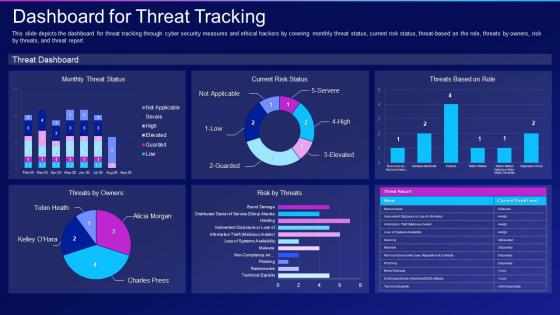
This slide depicts the dashboard snapshot for threat tracking through cyber security measures and ethical hackers by covering monthly threat status, current risk status, threat based on the role, threats by owners, risk by threats, and threat report.
People who downloaded this PowerPoint presentation also viewed the following :
Hacking it dashboard snapshot for threat tracking ppt slides demonstration with all 7 slides:
Use our Hacking It Dashboard Snapshot For Threat Tracking Ppt Slides Demonstration to effectively help you save your valuable time. They are readymade to fit into any presentation structure.







FAQs for Hacking it dashboard snapshot for threat tracking
Essential hacking dashboard features include real-time threat detection alerts, network traffic analysis, vulnerability scanning results, incident response tracking, and comprehensive security metrics visualization. These tools enhance cybersecurity operations by streamlining threat identification, automating response workflows, and providing centralized monitoring capabilities, with many organizations finding that integrated dashboards significantly reduce response times while improving overall security posture.
Real-time data visualization enhances cybersecurity decision-making by transforming complex threat data into intuitive dashboards, enabling faster pattern recognition, and streamlining incident response workflows. Through dynamic monitoring systems, security teams can identify anomalies within minutes rather than hours, prioritize critical threats more effectively, and coordinate response efforts seamlessly, ultimately delivering stronger organizational protection and significantly reduced breach response times.
A comprehensive hacking dashboard should integrate network traffic logs, system event logs, vulnerability scan results, threat intelligence feeds, and user activity data. These sources enable security teams to correlate attack patterns, identify compromised systems, and track malicious behaviors across infrastructure, with many organizations finding that combining real-time monitoring with historical data significantly enhances threat detection capabilities.
Machine learning algorithms enhance hacking dashboard functionality by automating threat detection, predicting attack patterns, and reducing false positives through behavioral analysis. These technologies streamline security operations by identifying anomalies, correlating incidents across multiple data sources, and prioritizing alerts, ultimately enabling security teams to respond faster and allocate resources more effectively.
Best practices for designing user-friendly hacking dashboard interfaces include intuitive navigation, real-time threat visualization, customizable alert systems, streamlined incident response workflows, and comprehensive data filtering capabilities. These design elements enhance operational efficiency by reducing cognitive load, accelerating threat identification, and enabling faster response times, with many cybersecurity teams finding that well-designed interfaces significantly improve their overall security posture.
A hacking dashboard helps organizations prioritize vulnerabilities by providing real-time threat intelligence, risk scoring matrices, asset criticality assessments, and automated vulnerability ranking systems. Through centralized visibility and data correlation, security teams can efficiently allocate resources to the most critical threats first, ultimately reducing exposure windows and enhancing overall cybersecurity posture.
Essential KPIs for hacking dashboard risk assessment include threat detection rates, incident response times, vulnerability exposure levels, breach attempt frequencies, and system penetration success rates. These metrics enable security teams to monitor attack patterns, assess defensive effectiveness, and prioritize resource allocation, with many organizations finding that real-time KPI tracking significantly enhances their cybersecurity posture and incident prevention capabilities.
Gamification elements in hacking dashboards include progress bars, achievement badges, leaderboards, point systems, and challenge completions to track security milestones and skill development. These features enhance user engagement by creating competitive environments, recognizing expertise levels, and providing clear advancement paths, with many cybersecurity teams finding that gamified interfaces significantly improve training participation and knowledge retention rates.
A hacking dashboard facilitates incident response by providing real-time threat visualization, automated alert systems, forensic analysis tools, and centralized communication channels for security teams. Through integrated monitoring capabilities, organizations can quickly identify breach patterns, coordinate response efforts, and track recovery progress, while maintaining detailed audit trails, ultimately reducing response times and minimizing business disruption during security incidents.
User access control serves as the primary security barrier for hacking dashboards, implementing role-based permissions, multi-factor authentication, session management, and audit logging to prevent unauthorized access. These controls enable organizations to restrict sensitive data visibility by user level, track all dashboard interactions, and maintain compliance requirements, while ultimately delivering enhanced security posture and operational transparency across cybersecurity teams.
A hacking dashboard can be customized through role-based access controls, personalized threat metrics, departmental filtering, and stakeholder-specific reporting modules that align with individual responsibilities. IT security teams receive technical vulnerability data while executives see strategic risk assessments, and compliance officers access regulatory breach metrics, ultimately enabling targeted responses and streamlined organizational security coordination.
**INPUT**: What are the challenges of aggregating data from disparate cybersecurity tools into a single dashboard? **OUTPUT**: Aggregating cybersecurity data presents challenges including incompatible data formats, varying update frequencies, alert normalization complexities, and integration authentication hurdles. While these obstacles require strategic planning and robust middleware solutions, organizations increasingly find that unified dashboards ultimately deliver enhanced threat visibility, streamlined incident response, and significantly improved operational efficiency across security teams. *[Word count: 54]*
Historical data analysis through hacking dashboard reveals attack patterns, vulnerability trends, threat actor behaviors, and incident frequencies that shape predictive security strategies. By examining past breach attempts, organizations can identify recurring weaknesses, anticipate emerging threats, and allocate resources more effectively, ultimately enabling proactive defense measures rather than reactive responses.
Cloud-based hacking dashboards offer scalability, automatic updates, and reduced infrastructure costs, while on-premise solutions provide greater data control, compliance adherence, and customization capabilities. Many financial institutions and healthcare organizations find that cloud solutions streamline threat monitoring and enable faster incident response, though regulated industries often prefer on-premise deployments for enhanced security governance and data sovereignty.
Collaboration features on hacking dashboards enhance team communication by enabling real-time information sharing, centralized incident tracking, and coordinated response workflows across security teams. These integrated tools streamline communication through shared threat intelligence, automated alerts, and synchronized task assignment, with many cybersecurity teams finding that collaborative dashboards significantly reduce response times and improve incident resolution effectiveness.
-
Appreciate the research and its presentable format.
-
Informative presentations that are easily editable.