


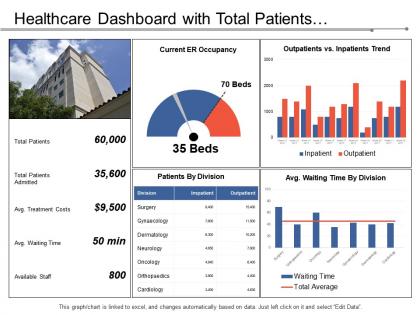
Healthcare dashboard with total patients admitted and average treatment cost




Try Before you Buy Download Free Sample Product
 Impress Your
 Audience
 100%
100% Editable
 Save Hours
 of Time


Folks feel assured of a happy ending due to our Healthcare Dashboard With Total Patients Admitted And Average Treatment Cost. Your intelligence generates joy.
People who downloaded this PowerPoint presentation also viewed the following :
Healthcare dashboard with total patients admitted and average treatment cost with all 6 slides:
Function freely with our Healthcare Dashboard With Total Patients Admitted And Average Treatment Cost. They will always be at your disposal.
FAQs for Healthcare dashboard with total patients admitted and
Healthcare dashboards typically display patient flow metrics, clinical quality indicators, financial performance data, operational efficiency measures, and staff productivity statistics. These metrics enable healthcare administrators to streamline resource allocation, enhance patient care delivery, and optimize operational workflows, with many hospitals finding that real-time visibility into bed occupancy, readmission rates, and cost per patient ultimately delivers improved outcomes and competitive advantage.
Healthcare dashboards improve patient outcomes by providing real-time visibility into patient vitals, treatment progress, medication adherence, and care coordination across departments. Through centralized data visualization, hospitals and clinics streamline clinical workflows, reduce response times, and enable proactive interventions, with many healthcare systems finding that integrated dashboards ultimately deliver faster diagnoses and enhanced care quality.
Real-time data analytics enhance healthcare dashboards by enabling instant patient monitoring, immediate alert systems, and dynamic resource allocation tracking. Through continuous data streams, hospitals can identify critical patient changes, optimize staff deployment, and streamline emergency responses, while healthcare administrators gain immediate insights into operational efficiency, ultimately delivering faster patient care and improved clinical outcomes.
Healthcare dashboards commonly utilize cloud platforms like AWS and Azure, data visualization tools such as Tableau and Power BI, real-time analytics engines, API integrations, and robust security frameworks. These technologies work together by streamlining data aggregation from multiple sources, enabling real-time patient monitoring, and delivering secure access to critical metrics, with many hospitals finding that this combination significantly enhances clinical decision-making and operational efficiency.
Healthcare dashboards can be customized through modular design elements, role-based access controls, specialty-specific metrics integration, personalized alert systems, and flexible reporting frameworks. These customization capabilities enable hospitals to focus on patient flow optimization, clinics to track appointment efficiency, and specialist practices to monitor treatment outcomes, ultimately delivering streamlined workflows and enhanced patient care experiences across diverse healthcare environments.
Best practices for visualizing complex healthcare data include using clear hierarchical layouts, color-coding by priority levels, real-time updating capabilities, role-based access controls, and intuitive drill-down functionalities. These approaches streamline clinical decision-making by presenting patient metrics, operational workflows, and performance indicators in digestible formats, with many hospitals finding that strategic dashboard design ultimately enhances care delivery and reduces response times.
Healthcare dashboards facilitate regulatory compliance by providing real-time monitoring of key metrics, automated reporting capabilities, audit trail documentation, and standardized data collection processes. These systems enable hospitals and clinics to track patient safety indicators, medication adherence, and quality measures continuously, while generating comprehensive reports for regulatory bodies, ultimately reducing compliance risks and streamlining audit preparations.
Patient engagement tools enhance healthcare dashboard success by enabling direct communication, appointment scheduling, medication reminders, health tracking, and personalized care plans. These features streamline patient-provider interactions while improving treatment adherence and health outcomes, with many healthcare organizations finding that engaged patients demonstrate better compliance, reduced readmission rates, and ultimately deliver improved satisfaction scores and operational efficiency.
Predictive analytics integrates into healthcare dashboards through machine learning algorithms, real-time data processing, risk stratification models, and automated alert systems that analyze patient patterns and trends. These capabilities enable hospitals and clinics to anticipate patient deterioration, optimize resource allocation, and reduce readmission rates, ultimately delivering proactive care and improved outcomes.
Healthcare dashboard implementation challenges include data integration complexity, user adoption resistance, privacy compliance requirements, technical infrastructure limitations, and stakeholder alignment difficulties. While organizations must navigate interoperability issues between legacy systems and ensure HIPAA compliance, many healthcare institutions find that strategic planning and phased deployment ultimately deliver enhanced operational efficiency, improved patient outcomes, and streamlined decision-making capabilities across departments.
Mobile-compatible dashboards revolutionize healthcare delivery by enabling real-time patient monitoring, instant access to medical records, streamlined communication between care teams, and faster clinical decision-making from any location. Healthcare providers can respond to critical alerts immediately, coordinate care seamlessly across departments, and deliver more responsive patient services, ultimately enhancing care quality while reducing response times in hospitals and clinics.
A well-designed healthcare dashboard reduces operational costs by streamlining administrative processes, minimizing manual data entry, and optimizing resource allocation across departments. Through real-time analytics and automated reporting, hospitals and clinics achieve significant cost savings in staffing, reduce billing errors, and enhance inventory management, ultimately delivering improved financial efficiency while maintaining quality patient care.
Interoperability enables healthcare dashboards to aggregate data from electronic health records, laboratory systems, imaging platforms, and pharmacy databases, creating comprehensive patient views. This seamless integration streamlines clinical workflows, reduces data silos, and enhances decision-making accuracy, with many hospitals finding that unified dashboards ultimately deliver faster diagnoses and improved patient outcomes.
Healthcare dashboards support public health crisis management by providing real-time disease tracking, resource allocation monitoring, hospital capacity oversight, and population health analytics. These systems enable health authorities to identify outbreak patterns, coordinate emergency responses, and optimize resource distribution across regions, with many public health agencies finding that centralized data visualization accelerates decision-making and enhances crisis coordination efforts.
User experience and interface design significantly influence healthcare dashboard adoption by determining accessibility, workflow integration, and clinical utility for busy medical professionals. Intuitive interfaces that seamlessly integrate with existing hospital systems, provide customizable views, and deliver actionable insights at a glance enable clinicians to make faster decisions, ultimately improving patient care efficiency and encouraging widespread adoption across healthcare organizations.
-
Top Quality presentations that are easily editable.
-
Enough space for editing and adding your own content.