


High medium low shown by three coloured metric board





Try Before you Buy Download Free Sample Product
 Impress Your
Audience
 100%
Editable
 Save Hours
of Time


End idle jabber with our High Medium Low Shown By Three Coloured Metric Board. Get folks to indulge in beneficial discussions.
People who downloaded this PowerPoint presentation also viewed the following :
Content of this Powerpoint Presentation
Description:
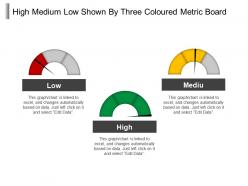
The image displays a PowerPoint slide with the title "High Medium Low Shown By Three Coloured Metric Board." It features three semi-circular gauges representing different levels of a metric: one for low (red), medium (yellow), and high (green). Each gauge has a description box below it stating that the graph/chart is linked to Excel, and changes automatically based on data, with instructions to edit the data by left-clicking and selecting "Edit Data."
The gauges are a visual aid for presenting quantitative data, and the colors are typically used to indicate performance or status levels, with red often signaling a warning or low level, yellow indicating a middle or cautionary level, and green signifying a high or optimal level.
Use Cases:
This slide can be effectively used in a variety of industries to visualize and communicate performance metrics or status levels:
1. Manufacturing:
Use: Monitoring production quality levels.
Presenter: Quality Assurance Manager.
Audience: Production team, management.
2. Finance:
Use: Displaying financial health or risk assessments.
Presenter: Financial Analyst.
Audience: Investors, corporate executives.
3. Sales:
Use: Tracking sales performance against targets.
Presenter: Sales Manager.
Audience: Sales team, stakeholders.
4. IT Services:
Use: Reporting system uptime or service level agreements (SLAs).
Presenter: IT Service Manager.
Audience: Clients, technical staff.
5. Energy:
Use: Showing energy consumption or efficiency ratings.
Presenter: Energy Manager.
Audience: Sustainability teams, regulatory bodies.
6. Education:
Use: Representing school or student performance metrics.
Presenter: School Administrator.
Audience: Educators, parents.
7. Transportation:
Use: Indicating fleet operational status or maintenance needs.
Presenter: Fleet Manager.
Audience: Logistics personnel, maintenance teams.
High medium low shown by three coloured metric board with all 5 slides:
Get exactly as you demand with our High Medium Low Shown By Three Coloured Metric Board. Say goodbye to any compromises.


FAQs for High medium low shown by three
Key performance metrics for effective project management include schedule variance, budget variance, resource utilization, quality indicators, and stakeholder satisfaction scores. These metrics enable project managers to identify potential issues early, optimize resource allocation, and maintain project momentum, with many organizations finding that consistent tracking ultimately delivers improved project outcomes and enhanced client relationships.
Businesses can align performance metrics with strategic goals by establishing clear key performance indicators that directly measure strategic objectives, cascading these metrics across all organizational levels, and regularly reviewing alignment through balanced scorecards. This approach ensures operational activities support broader vision, with companies like Amazon and Toyota finding that integrated metric systems drive focused execution, enhance accountability, and ultimately deliver measurable progress toward long-term competitive advantage.
Customer satisfaction serves as a critical performance metric in service industries, directly impacting retention rates, revenue growth, referral generation, and brand reputation. Through satisfaction surveys, Net Promoter Scores, and feedback analytics, companies in hospitality, healthcare, and financial services can identify service gaps, optimize resource allocation, and enhance operational efficiency, ultimately delivering competitive advantage and sustainable profitability.
Quantitative performance metrics measure success through numerical data like revenue, conversion rates, and productivity scores, while qualitative metrics assess subjective factors such as customer satisfaction, employee engagement, and brand perception. Organizations increasingly combine both approaches to gain comprehensive insights, with financial services using quantitative data for operational efficiency and qualitative feedback for service excellence, ultimately delivering balanced performance evaluation and strategic competitive advantage.
Best practices for setting realistic performance metrics include using historical data as baselines, aligning metrics with strategic objectives, ensuring measurability and time-bound targets, involving stakeholders in the process, and regularly reviewing relevance. These approaches streamline goal-setting by establishing clear expectations, enhancing accountability, and enabling data-driven adjustments, with many organizations finding that collaborative metric development ultimately delivers improved performance visibility and sustained business outcomes.
Technology improves performance metric accuracy by automating data collection, eliminating manual entry errors, and providing real-time monitoring capabilities across multiple systems and touchpoints. Through advanced analytics platforms and integrated dashboards, organizations streamline reporting processes, enhance data validation, and deliver more precise insights, with many companies finding that automated tracking reduces discrepancies by significant margins.
Key e-commerce performance metrics include conversion rate, average order value, customer acquisition cost, customer lifetime value, cart abandonment rate, and return on ad spend. These metrics enable businesses to optimize marketing campaigns, enhance user experience, and improve inventory management, with many retailers finding that tracking these KPIs simultaneously delivers better customer insights and significantly higher profitability.
Organizations utilize performance metrics for employee evaluations by establishing clear KPIs, tracking goal achievement, measuring productivity levels, assessing quality standards, and monitoring behavioral indicators. These metrics enable managers to provide objective feedback, identify skill gaps, recognize top performers, and create targeted development plans, ultimately delivering fairer assessments and enhanced employee growth opportunities.
Common pitfalls in interpreting performance metrics include focusing on vanity metrics without business impact, lacking proper context or benchmarks, cherry-picking favorable data points, and misunderstanding correlation versus causation. These interpretation errors can mislead strategic decisions across organizations, with many companies finding that establishing clear measurement frameworks, regular metric audits, and cross-functional review processes ultimately delivers more accurate insights and better resource allocation.
Businesses balance leading and lagging metrics by creating integrated dashboards that track predictive indicators alongside historical outcomes, ensuring both short-term responsiveness and long-term strategic alignment. Through strategic combinations like monitoring customer satisfaction scores with revenue growth, or employee engagement with productivity rates, organizations enhance decision-making capabilities while maintaining operational efficiency and competitive advantage.
Essential marketing campaign metrics include conversion rates, return on investment (ROI), customer acquisition cost, click-through rates, and engagement metrics like time spent and social shares. These measurements enable organizations to optimize resource allocation, identify high-performing channels, and refine targeting strategies, with many businesses finding that comprehensive tracking across multiple touchpoints delivers significantly improved campaign effectiveness and competitive advantage.
Performance metrics inform decision-making by providing quantifiable data on operational efficiency, resource allocation, and strategic outcomes, enabling leaders to identify trends, bottlenecks, and opportunities. Through comprehensive analytics dashboards, organizations in healthcare, finance, and manufacturing can streamline processes, optimize investments, and enhance customer experiences, ultimately delivering competitive advantage and measurable growth.
Key performance metrics for financial reporting include revenue growth, profit margins, cash flow, return on investment, and debt-to-equity ratios. These metrics enable organizations to streamline decision-making, enhance investor confidence, and optimize resource allocation, with many financial institutions and corporations finding that prioritizing these indicators ultimately delivers greater operational transparency and competitive advantage.
Companies ensure agile performance metrics by regularly reviewing and updating measurement frameworks, incorporating real-time data analytics, and aligning metrics with evolving strategic objectives and market conditions. Through flexible dashboards and continuous feedback loops, organizations can quickly pivot their measurement approach, enabling faster decision-making and maintaining competitive advantage in increasingly dynamic business environments.
Ethical considerations include fairness in metric selection, transparency in evaluation criteria, privacy protection of employee data, bias prevention in algorithmic assessments, and ensuring metrics don't promote unhealthy competition. These frameworks enhance workplace trust by establishing clear standards, protecting individual rights, and promoting equitable treatment, with many organizations finding that ethical metric implementation ultimately delivers better employee engagement and sustainable performance outcomes.
-
Use of icon with content is very relateable, informative and appealing.
-
The content is very helpful from business point of view.