

Historical Context Of Euclidean Geometry PPT PowerPoint ST AI SS





Try Before you Buy Download Free Sample Product
 Impress Your
Audience
 100%
Editable
 Save Hours
of Time


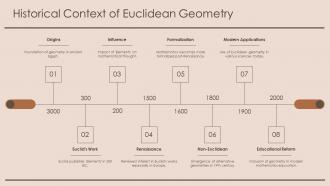
Explore the rich history of Euclidean geometry with our comprehensive PowerPoint presentation. This deck delves into its origins, key figures, and significant developments, providing a clear understanding of its impact on mathematics and science. Perfect for educators, students, and enthusiasts seeking to deepen their knowledge.
People who downloaded this PowerPoint presentation also viewed the following :
Historical Context Of Euclidean Geometry PPT PowerPoint ST AI SS with all 9 slides:
Use our Historical Context Of Euclidean Geometry PPT PowerPoint ST AI SS to effectively help you save your valuable time. They are readymade to fit into any presentation structure.








FAQs for Historical Context Of Euclidean Geometry PPT PowerPoint
Euclidean geometry's philosophical foundations include logical deduction from self-evident axioms, absolute spatial relationships, mathematical certainty through proof, and the concept of idealized geometric forms existing independent of physical reality. These principles revolutionize fields like architecture, engineering, and computer modeling by establishing universal standards for measurement, design precision, and spatial analysis, ultimately delivering consistent frameworks that enable modern construction, manufacturing, and digital applications across industries.
Euclid's "Elements" established rigorous logical proof methodology, systematic axiomatization, and deductive reasoning principles that became foundational frameworks for mathematical inquiry, scientific research, and analytical thinking across disciplines. This comprehensive approach revolutionized how scholars structure arguments, validate theories, and build knowledge systematically, with fields like physics, engineering, and computer science ultimately adopting these logical frameworks to enhance precision and credibility.
Ancient civilizations contributed to Euclidean geometry through practical surveying techniques, architectural principles, astronomical calculations, and mathematical theorems that Euclid later systematized. Egyptian pyramid construction, Babylonian area calculations, and Greek mathematical proofs provided foundational concepts like right angles, proportions, and geometric relationships, with these early innovations ultimately delivering the empirical knowledge base that enabled Euclid's comprehensive geometric framework.
Euclid's "Elements" revolutionized ancient Greek education by establishing systematic logical reasoning, step-by-step proof methodology, and rigorous mathematical thinking as foundational skills across disciplines. These geometric principles enhanced critical thinking capabilities, structured philosophical discourse, and mathematical literacy, with many Greek institutions finding that students trained in Euclidean methods developed superior analytical abilities, ultimately delivering intellectual frameworks that influenced rhetoric, philosophy, and scientific inquiry throughout the classical world.
Euclidean geometry provided Renaissance astronomers with essential mathematical frameworks for celestial calculations, planetary motion modeling, and accurate astronomical measurements through geometric principles and spatial relationships. This geometric foundation enabled scholars like Copernicus and Kepler to develop heliocentric models, calculate orbital mechanics, and create precise star charts, ultimately revolutionizing astronomical understanding and navigation techniques across European institutions.
Medieval scholars preserved Euclidean geometry through Islamic translations and commentaries, Byzantine manuscript copying, and monastic scriptoriums that maintained Greek texts. These preservation efforts enabled universities, libraries, and scholarly institutions across Europe and the Middle East to maintain mathematical knowledge, ultimately delivering the foundational geometric principles that Renaissance mathematicians would later use to advance architectural design, navigation, and engineering disciplines.
Euclidean geometry serves as the foundational framework for architectural design and structural engineering through principles of spatial relationships, precise measurements, and geometric calculations. Modern architects and engineers leverage these classical concepts when designing buildings, bridges, and infrastructure systems, with construction projects, CAD software, and structural analysis relying on Euclidean theorems to ensure stability, efficiency, and optimal resource allocation.
Euclidean geometry's axioms assume parallel lines never meet and angles in triangles sum to 180 degrees, while non-Euclidean geometries challenge these foundations through hyperbolic and spherical models. These alternative geometric frameworks enable advances in physics, computer graphics, and navigation systems, with many industries finding that non-Euclidean principles enhance GPS accuracy, architectural design, and ultimately deliver more sophisticated spatial modeling capabilities.
Euclidean geometry's dissemination was influenced by trade networks, translation movements, and educational institutions that valued mathematical precision for practical applications. Islamic scholars preserved and enhanced Greek texts during Europe's Dark Ages, while Byzantine scholars, Renaissance humanists, and colonial educational systems spread geometric principles across civilizations, ultimately delivering standardized mathematical frameworks that enabled architectural, navigational, and engineering advances worldwide.
Cartesian geometry revolutionized mathematical thinking by introducing algebraic methods to geometric problems, enabling coordinate systems, analytical solutions, and infinite geometric possibilities that extended beyond Euclidean limitations. This algebraic approach transformed geometry from purely visual reasoning to computational analysis, with mathematicians, engineers, and scientists finding that coordinate-based methods streamlined complex calculations and enhanced problem-solving capabilities across multiple disciplines.
Euclidean geometry profoundly transformed Renaissance art through linear perspective, proportional harmony, architectural precision, and mathematical beauty principles that artists like Leonardo da Vinci and Brunelleschi pioneered. These geometric foundations enabled painters, architects, and sculptors to create realistic spatial depth, balanced compositions, and structurally sound buildings, ultimately revolutionizing artistic expression and establishing mathematical principles as cornerstones of aesthetic excellence.
Studying Euclidean geometry enhances understanding of modern mathematics by providing foundational principles for calculus, linear algebra, topology, and computational geometry. Through these geometric foundations, students and professionals develop stronger spatial reasoning, logical proof structures, and analytical thinking skills, with many educational institutions and technical fields finding that this classical approach ultimately strengthens problem-solving capabilities in contemporary applications.
Euclidean geometry continues influencing contemporary research through computer graphics, robotics navigation, architectural modeling, engineering simulations, and GPS coordinate systems. These applications streamline design processes, enhance spatial accuracy, and enable precise technological implementations across industries like aerospace, construction, and digital entertainment, with many organizations finding that classical geometric principles ultimately deliver computational efficiency and reliable measurement standards in increasingly complex technological environments.
Euclidean geometric principles manifest throughout nature in crystal formations, honeycomb hexagonal structures, flower petal arrangements, and mineral growth patterns, demonstrating fundamental relationships between angles, symmetry, and spatial efficiency. These natural applications showcase how geometric laws govern biological and physical systems, with scientists and engineers increasingly leveraging these patterns for biomimetic designs, architectural innovations, and material optimization strategies.
Notable mathematicians have expanded Euclidean geometry through non-Euclidean geometries, analytical coordinate systems, differential geometry, and topological approaches. These mathematical innovations have revolutionized fields like physics, engineering, and computer graphics, with applications in GPS navigation, architectural design, and 3D modeling ultimately delivering enhanced precision and competitive advantages across industries.
-
Great quality slides in rapid time.
-
The best part about SlideTeam is their meticulously prepared presentations (complete-decks and single-slides both), infused with high-quality graphics and easy to edit. All-in-all worthy products.