

Hospital Marketing Plan For Patient Acquisition





Try Before you Buy Download Free Sample Product
 Impress Your
Audience
 100%
Editable
 Save Hours
of Time


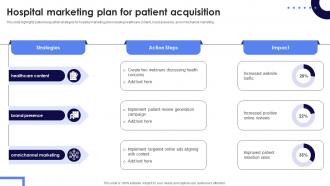
This slide highlights patient acquisition strategies for hospital marketing plan including healthcare content, brand presence, and omnichannel marketing.
People who downloaded this PowerPoint presentation also viewed the following :
Hospital Marketing Plan For Patient Acquisition with all 9 slides:
Use our Hospital Marketing Plan For Patient Acquisition to effectively help you save your valuable time. They are readymade to fit into any presentation structure.








FAQs for Hospital Marketing Plan
Essential components of an effective hospital marketing plan include target audience analysis, competitive positioning, service line promotion, digital presence optimization, and community engagement strategies. These elements work together by identifying patient demographics, differentiating services from competitors, and building trust through consistent messaging across multiple channels, ultimately delivering increased patient acquisition and stronger community relationships.
Hospitals can leverage social media to improve patient engagement through health education content, patient success stories, community health initiatives, live Q&A sessions with medical professionals, and wellness tips. These platforms enable hospitals to build trust, provide valuable health information, respond to patient inquiries in real-time, and showcase their expertise, ultimately enhancing patient relationships and community health awareness.
Patient feedback serves as a cornerstone for hospital marketing strategies by identifying service gaps, highlighting competitive advantages, and revealing patient priorities across care quality, communication, and facility experience. This data enables hospitals to craft targeted messaging, address operational weaknesses, and showcase strengths in marketing campaigns, ultimately building trust and competitive differentiation in increasingly crowded healthcare markets.
Hospitals can measure marketing success through patient acquisition metrics, website analytics, brand awareness surveys, social media engagement rates, and return on investment calculations. These measurement approaches enable healthcare institutions to track campaign effectiveness across digital platforms, patient referrals, and community outreach programs, ultimately delivering data-driven insights that optimize resource allocation and enhance competitive positioning.
**INPUT**: What are the best practices for creating a visually compelling hospital marketing presentation? **OUTPUT**: Best practices include using professional healthcare imagery, maintaining consistent brand colors, incorporating patient success stories, utilizing clear data visualizations, and ensuring accessibility compliance. These elements streamline audience engagement by building trust through authentic visuals, enhancing credibility with outcome metrics, and demonstrating community impact, with many healthcare institutions finding that strategic visual storytelling ultimately delivers stronger stakeholder buy-in and competitive positioning. [Word count: 60]
Hospitals can differentiate through specialized care programs, patient experience enhancements, technology integration, community partnerships, and outcome transparency. By leveraging telemedicine platforms, personalized treatment protocols, and wellness initiatives, healthcare institutions create competitive advantages while building patient loyalty, with many hospitals finding that strategic positioning around quality metrics and specialized services drives sustainable growth.
Effective digital marketing strategies for hospitals include search engine optimization, targeted social media campaigns, patient testimonial videos, content marketing focusing on health education, and local Google advertising. These approaches enhance visibility by building trust through authentic patient stories, providing valuable health information, and ensuring hospitals appear prominently in local searches, ultimately delivering increased patient inquiries and stronger community engagement.
Hospitals can effectively target patient demographics through data analytics segmentation, personalized digital campaigns, community-specific outreach, culturally relevant messaging, and strategic healthcare partnerships. By analyzing patient data and local demographics, hospitals streamline their marketing investments while delivering more personalized healthcare communications, ultimately enhancing patient engagement and building stronger community connections across diverse populations.
Hospital marketing must navigate patient privacy laws like HIPAA, truth-in-advertising regulations, professional licensing requirements, informed consent protocols, and anti-kickback statutes. These compliance frameworks ensure ethical patient communication while enabling hospitals to effectively promote specialized services, with many healthcare institutions finding that transparent, regulation-compliant marketing ultimately builds greater patient trust and competitive advantage.
Partnerships with local businesses enhance hospital marketing reach by expanding audience networks, sharing promotional costs, and building community credibility through cross-referrals and joint campaigns. These strategic collaborations enable hospitals to access diverse customer bases, from corporate wellness programs with employers to health screenings at retail locations, ultimately delivering broader brand visibility and stronger community ties while reducing individual marketing expenses.
Hospitals can streamline marketing processes using customer relationship management (CRM) systems, marketing automation platforms, social media management tools, email marketing software, and analytics dashboards. These technologies enhance patient engagement by automating appointment reminders, personalizing outreach campaigns, and tracking marketing ROI, with many healthcare institutions finding that integrated platforms ultimately deliver improved patient acquisition and operational efficiency.
Content marketing enables hospitals to educate patients through informative blogs, health newsletters, social media posts, video testimonials, and interactive webinars addressing common medical concerns and treatment options. These strategies build trust and credibility while showcasing specialized services, with many healthcare institutions finding that educational content significantly enhances patient engagement and drives service inquiries.
Essential KPIs for hospital marketing include patient acquisition costs, conversion rates from leads to appointments, website traffic and engagement metrics, brand awareness measurements, and patient lifetime value calculations. These metrics enable healthcare organizations to optimize marketing spend, improve patient outreach strategies, and demonstrate ROI, with many hospitals finding that comprehensive KPI tracking ultimately delivers better resource allocation and enhanced competitive positioning.
Hospitals can use storytelling by sharing patient recovery journeys, highlighting compassionate staff interactions, showcasing community health initiatives, and featuring testimonials from families and medical teams. These narratives humanize healthcare experiences by building trust, reducing anxiety around medical procedures, and demonstrating genuine care, with many healthcare institutions finding that authentic stories significantly enhance patient engagement and brand loyalty.
**INPUT**: What trends in healthcare marketing should hospitals be aware of in the coming years? **OUTPUT**: Healthcare marketing trends include personalized patient experiences, telehealth integration, AI-driven analytics, social media engagement, and value-based care messaging. These approaches streamline patient acquisition and retention by enhancing digital touchpoints, automating appointment scheduling, and delivering targeted health content, with many healthcare systems finding that strategic digital transformation ultimately improves patient satisfaction while reducing operational costs.
-
The designs by SlideTeam are honestly the best I have seen so far. Will be definitely coming back for more.
-
If you have visited their site and failed to find the products, try reaching the customer service because it will be the case that you didn't use the search bar well.