

How Blockchain Can Transform Trade Finance Training Ppt





Try Before you Buy Download Free Sample Product
 Impress Your
Audience
 100%
Editable
 Save Hours
of Time


These slides provide information about the working of trade finance and its significance in risk reduction. It also covers concerns of traditional trade finance,such as delayed payments,invoice factoring,document duplication,and tampering with financial records,and the capability of blockchain technology to overcome these.
People who downloaded this PowerPoint presentation also viewed the following :
Content of this Powerpoint Presentation
Slide 1
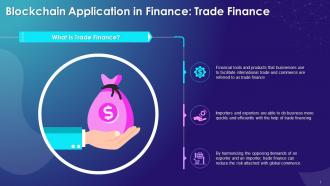
This slide gives an overview of trade finance. Businesses' financial tools and products to facilitate international trade and commerce are referred to as trade finance. It helps importers and exporters streamline their dealings with both efficiency and speed.
Slide 2
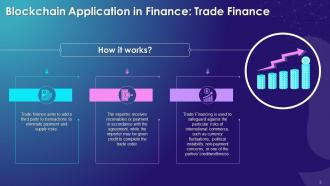
This slide discusses the working of trade finance. Conventional finance and credit issuance are not the same as trade financing. General finance is used to maintain solvency or liquidity, although trade financing does not always mean a buyer is short on cash. Trade finance may be used to safeguard against risks unique to international commerce, such as currency fluctuations, political instability, non-payment concerns, or credit worthiness of one of the parties.
Instructor’s Notes:
There are multiple players in the trade finance ecosystem. These are Importers, Exporters, Banks, Insurers, Trade Finance Companies, and Export Credit Companies.
Slide 3
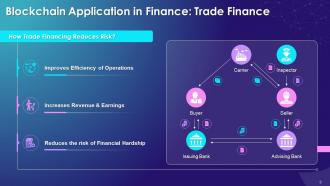
This slide lists benefits of trade finance. These advantages include improved efficiency of operations, increased revenue & earnings, and reduced financial risk.
Instructor’s Notes:
- Improves Efficiency of Operations: Importers and exporters can manage their operations and organize their cash flow with trade financing, as it leads to curbing delays in payments and final delivery of shipments. Trade finance can be considered a way to fund a company's expansion with the collateral on offer being the shipment of products
- Increases Revenue & Earnings: Trade finance enables businesses to grow their revenue and income as the managements can focus on increasing the trade. Continuous cash flow provides businesses with the working capital they require, allowing them to operate more effectively. This comes from the knowledge that their business can meet overheads and other such expenses with ease. Ultimately, this results in more revenue
- Reduces the Risk of Financial Hardship: A firm that does not have trade finance may fall behind on payments and lose a large proportion of clients of suppliers, which might have long-term consequences for the organization. Options such as revolving credit and accounts receivables factoring can assist businesses in transacting abroad, even in times of financial difficulty
Slide 4
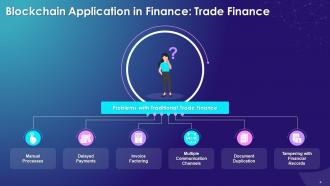
This slide lists the pain-points of Trade Finance. The limitations include manual processes, delayed payments, invoice factoring, multiple communication channels, document duplication, and tampering with financial records.
Instructor’s Notes:
- Manual Processes: The issuing bank's manual processes for examining sales contracts and import paperwork, ensuring that there are no irregularities, and providing financials to the exporter's bank or correspondent bank can take time and are prone to human error
- Delayed Payments: Payments are delayed due to financial intermediaries checking to determine if the documents supplied comply with the documentary credit or guarantee requirements. This procedure might take a long time depending on the number of intermediates in the correspondent banking network
- Invoice Factoring: Invoice factoring, which exporters use to present their invoices to banks to get financial leverage, increases the risk profile in the case of a failure on products delivery
- Multiple Communication Channels: Communication routes, techniques, and formats are routinely utilized for trade finance, with underlying papers supplied either electronically or on paper. Businesses and banks are vulnerable to misinterpretation and fraud due to this
- Document Duplication: Duplicate paperwork can be given to banks, this process results in the same transaction being processed twice or more, as well as difficulty in determining whether another financial institution has previously insured a trade
- Tampering with Financial Records: Financial records might be tampered with when the communication route is not verified or safeguarded against unauthorized access
Slide 5
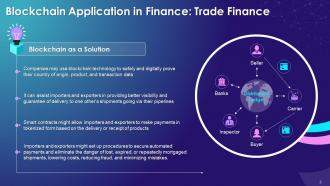
This slide discusses the scope of blockchain technology as a solution for problems that mark trade financing. Companies can use this technology to safely and digitally prove their country of origin, product, and transaction data
How Blockchain Can Transform Trade Finance Training Ppt with all 21 slides:
Use our How Blockchain Can Transform Trade Finance Training Ppt to effectively help you save your valuable time. They are readymade to fit into any presentation structure.













FAQs for How Blockchain Can Transform Trade
Traditional trade finance faces challenges including lengthy processing times, high operational costs, limited transparency, fraud risks, and complex documentation requirements. Blockchain addresses these by automating verification processes, reducing intermediary costs, and creating immutable transaction records, with banks like HSBC and Standard Chartered finding that distributed ledger systems streamline cross-border transactions while enhancing security and operational efficiency.
Blockchain enhances transparency and traceability in trade finance by creating immutable transaction records, enabling real-time visibility across supply chains, and providing cryptographic verification of document authenticity. Through distributed ledgers, banks, exporters, and importers can track shipments, verify compliance, and reduce fraud risks, while streamlining letter-of-credit processes and ultimately delivering faster settlements with enhanced trust.
Smart contracts automate trade finance by executing predefined conditions for payments, document verification, and compliance checks without manual intervention. These blockchain-based protocols streamline letter of credit processing, invoice settlements, and shipment tracking, with banks and exporters finding significantly reduced processing times, lower operational costs, and enhanced transaction transparency across global supply chains.
Blockchain reduces trade finance fraud risk by creating immutable transaction records, enabling real-time verification of documents, and providing transparent audit trails across all parties. Through distributed ledger technology, banks and financial institutions can instantly verify invoice authenticity, prevent double financing, and detect discrepancies in shipping documents, ultimately delivering enhanced security and streamlined compliance processes.
Public blockchains offer transparency and decentralization but present privacy concerns for sensitive trade data, while private blockchains provide controlled access and enhanced security suited for confidential financial transactions. In trade finance, banks and financial institutions increasingly favor private blockchain networks for letters of credit and supply chain financing, as they enable secure document sharing, faster transaction processing, and regulatory compliance while maintaining the competitive confidentiality essential for commercial operations.
Digital identities on blockchain improve trust by providing immutable identity verification, transparent transaction histories, and cryptographic authentication that eliminates fraud risks. Through distributed ledger technology, banks, exporters, and importers can verify credentials instantly, streamline KYC processes, and reduce documentation disputes, with many financial institutions finding that blockchain identities accelerate trade settlements while minimizing counterparty risks.
Blockchain significantly accelerates trade finance transactions by automating document verification, enabling real-time transaction tracking, and eliminating intermediary delays through smart contracts. Through distributed ledger technology, banks and financial institutions streamline letter-of-credit processing, reduce settlement times from weeks to days, and enhance transparency, ultimately delivering faster services and improved cash flow for global traders.
Regulatory hurdles for blockchain in trade finance include data privacy compliance, cross-border regulatory inconsistencies, anti-money laundering requirements, digital signature validation, and existing banking regulations not designed for distributed technologies. While these present implementation challenges, many financial institutions are working with regulators to establish frameworks that enable blockchain adoption while maintaining compliance, ultimately delivering greater transparency and operational efficiency.
Blockchain facilitates cross-border trade by digitizing documentation, automating compliance checks, and enabling real-time transaction tracking across multiple parties. Through smart contracts and distributed ledgers, banks, exporters, and logistics companies streamline letter-of-credit processes, reduce processing times from weeks to days, and minimize operational costs, ultimately delivering faster settlements and enhanced transparency.
Several major banks have successfully implemented blockchain in trade finance, including HSBC's letter of credit transactions, JPMorgan's digital payments network, Standard Chartered's documentary credit processes, and Barclays' trade documentation systems. These implementations streamline cross-border transactions, reduce processing times from weeks to days, and enhance transparency, with many financial institutions finding that blockchain delivers significant operational efficiency and competitive advantage in global trade.
Blockchain integrates with existing trade finance systems through APIs, middleware platforms, and hybrid architectures that connect distributed ledgers to traditional banking infrastructure, SWIFT networks, and regulatory reporting systems. Financial institutions like JPMorgan and HSBC seamlessly bridge blockchain networks with legacy systems, enabling real-time transaction validation, automated compliance checks, and enhanced transparency while maintaining operational continuity.
Blockchain in trade finance presents both environmental challenges and opportunities, with energy consumption from mining operations offset by significant paper reduction, streamlined processes, and eliminated redundant verification steps. While traditional proof-of-work systems consume substantial energy, many financial institutions are adopting energy-efficient consensus mechanisms and finding that digitized documentation and automated workflows ultimately reduce their overall environmental footprint significantly.
Blockchain enables SMEs to access trade finance by providing transparent transaction histories, reducing documentation complexity, and creating tamper-proof records that build lender confidence. Through smart contracts and digital letters of credit, banks can streamline approval processes while minimizing risk assessment costs, with many financial institutions finding that blockchain-verified trade data accelerates lending decisions for smaller businesses.
Professionals working with blockchain in trade finance require a strategic combination of financial expertise, technical literacy, regulatory knowledge, and analytical capabilities. These skill sets enable professionals to navigate complex international transactions, smart contract implementation, and compliance frameworks, with many financial institutions finding that cross-functional expertise ultimately delivers enhanced operational efficiency and competitive advantage.
The future of trade finance will likely feature widespread blockchain adoption, enabling real-time transaction tracking, automated smart contract execution, and seamless cross-border payments. This evolution presents both opportunities for enhanced efficiency and challenges in regulatory standardization, with many financial institutions finding that blockchain integration ultimately delivers faster processing, reduced costs, and improved transparency across global supply chains.
-
Excellent design and quick turnaround.
-
Fantastic and innovative graphics with useful content. The templates are the best and latest in the industry.