

How Does Solar Energy Work Green Energy Resources Ppt Slides Graphics Design





Try Before you Buy Download Free Sample Product
 Impress Your
Audience
 100%
Editable
 Save Hours
of Time


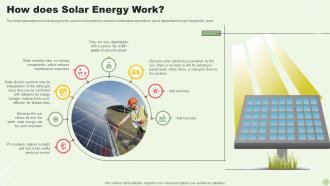
This slide represents how solar energy works, can be used anywhere, reduces maintenance expenditure, and is dependable for up to twenty-five years.
People who downloaded this PowerPoint presentation also viewed the following :
How Does Solar Energy Work Green Energy Resources Ppt Slides Graphics Design with all 6 slides:
Use our How Does Solar Energy Work Green Energy Resources Ppt Slides Graphics Design to effectively help you save your valuable time. They are readymade to fit into any presentation structure.





FAQs for How Does Solar Energy Work Green Energy Resources Ppt
Key benefits include significantly reduced electricity bills, increased property value, environmental sustainability, energy independence, and minimal maintenance requirements. Through solar panel installations, homeowners achieve long-term cost savings, protection against rising utility rates, and reduced carbon footprint, with many residential installations delivering 20-25 years of reliable, clean energy generation.
Solar panel efficiency varies significantly across technologies, with monocrystalline panels delivering 20-22% efficiency, polycrystalline achieving 15-17%, and thin-film technologies ranging from 10-12%. These efficiency differences enable organizations to optimize energy generation based on space constraints, budget considerations, and performance requirements, with many commercial installations finding that higher-efficiency panels ultimately deliver better long-term returns despite higher upfront costs.
Transitioning to solar energy delivers significant cost savings through reduced electricity bills, tax incentives, enhanced property values, and energy independence for businesses. Organizations across manufacturing, retail, and hospitality sectors find that solar investments typically pay for themselves within 7-10 years, while providing decades of reduced operational costs and improved competitive positioning.
Solar energy enhances national energy independence by reducing reliance on fossil fuel imports, diversifying energy portfolios, and creating domestic renewable infrastructure. Through strategic solar installations, countries like Germany and India have significantly decreased energy import costs, strengthened grid resilience, and developed local manufacturing capabilities, ultimately delivering enhanced energy security and economic stability in an increasingly volatile global energy landscape.
Solar energy offers significant environmental benefits including zero greenhouse gas emissions during operation, no air pollutants, minimal water usage, and reduced carbon footprint compared to fossil fuels. These advantages enable organizations to achieve sustainability goals while reducing environmental impact, with many manufacturing facilities, retail chains, and corporate campuses finding that solar installations deliver both cost savings and enhanced environmental stewardship.
Government incentives significantly accelerate solar energy adoption by reducing upfront costs through tax credits, rebates, and financing programs, while creating market stability through feed-in tariffs and renewable energy certificates. These policies enable homeowners, businesses, and utilities to achieve faster payback periods and enhanced return on investment, with many regions finding that strategic incentive structures drive widespread deployment and ultimately deliver energy independence and competitive electricity rates.
Common myths about solar energy include concerns about effectiveness in cloudy weather, excessive costs, maintenance complexity, aesthetic impact, and grid reliability issues. While solar panels do work efficiently in various weather conditions and costs have dramatically decreased, many businesses and homeowners find that modern systems deliver significant energy savings, minimal maintenance requirements, and enhanced property values, ultimately providing competitive advantages in an increasingly sustainability-focused market.
Solar panel installation involves site assessment, permitting, equipment procurement, mounting system installation, and electrical connections. Professional installers evaluate roof conditions, secure local permits, mount panels using racking systems, connect inverters and wiring, and complete grid integration testing, with many homeowners finding that the entire process typically spans 1-3 months from initial consultation to system activation.
Energy storage enables solar systems to capture excess daytime generation for use during peak demand periods, cloudy conditions, and nighttime hours, while providing grid stability and backup power capabilities. These technologies streamline energy management by reducing utility costs, minimizing grid dependency, and enhancing system reliability, with many commercial facilities and residential installations finding that strategic storage integration ultimately delivers greater energy independence and operational efficiency.
Solar energy solutions adapt to urban environments through rooftop installations, community solar gardens, building-integrated photovoltaics, and vertical solar panels, while rural applications leverage ground-mounted systems and agrivoltaics. Urban deployments maximize limited space through innovative mounting solutions and grid integration, while rural installations capitalize on abundant land availability, ultimately delivering cost-effective renewable energy tailored to each setting's unique infrastructure and spatial characteristics.
Developing countries face financing constraints, inadequate grid infrastructure, limited technical expertise, policy uncertainties, and high upfront costs when implementing solar energy solutions. While these challenges present significant hurdles, many nations are increasingly finding that strategic partnerships with international organizations, microfinancing programs, and decentralized solar systems enable sustainable energy access, ultimately delivering economic growth and energy independence.
Solar farms present both challenges and opportunities for local ecosystems, potentially disrupting habitats while creating new microenvironments that benefit certain species. Many installations incorporate pollinator-friendly plantings, wildlife corridors, and grazing compatibility, with agricultural regions finding that agrivoltaics enhance biodiversity by providing shade for crops and nesting sites for birds, ultimately delivering sustainable land use.
Emerging solar technologies include perovskite tandem cells, floating solar farms, agrivoltaics, solar skin design, and AI-powered energy management systems. These innovations streamline energy production by increasing efficiency, reducing installation costs, and enabling dual land use, with many utilities and agricultural operations finding that strategic solar integration delivers competitive advantage while minimizing environmental impact.
Lifecycle assessments demonstrate solar panels' sustainability by showing energy payback periods of 1-4 years while operating 25-30 years, dramatically reducing carbon footprints compared to fossil fuels. Manufacturing emissions are offset within months of installation, with panels ultimately delivering 10-30 times more clean energy than consumed during production, enabling organizations to achieve measurable environmental and cost benefits.
Global trends influencing the solar energy market include declining technology costs, supportive government policies, corporate renewable commitments, energy storage integration, and grid modernization initiatives. These developments streamline solar adoption by enhancing affordability, regulatory support, and system reliability, with many utilities and manufacturers finding that strategic solar investments deliver competitive advantages and operational efficiency in an increasingly sustainability-focused energy landscape.
-
Great quality product.
-
Easy to edit slides with easy to understand instructions.