

How To Have Effective Telephonic Communication Training Ppt




Try Before you Buy Download Free Sample Product
 Impress Your
Audience
 100%
Editable
 Save Hours
of Time


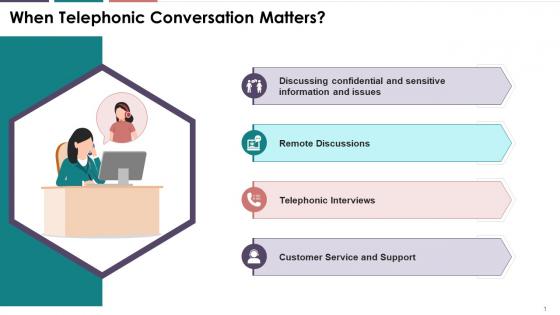
These slides cover the etiquette that must be kept in mind while answering a phone call. These usually apply to both formal and informal communication, which is an integral part of telephone conversations.
People who downloaded this PowerPoint presentation also viewed the following :
How To Have Effective Telephonic Communication Training Ppt with all 18 slides:
Use our How To Have Effective Telephonic Communication Training Ppt to effectively help you save your valuable time. They are readymade to fit into any presentation structure.







FAQs for How To Have Effective Telephonic
Effective telephonic communication includes active listening, clear articulation, professional tone management, empathy demonstration, and strategic questioning techniques. These components work together by building rapport quickly, ensuring message clarity, and resolving issues efficiently, with many customer service organizations finding that structured telephonic training ultimately delivers improved satisfaction scores and stronger client relationships.
Tone of voice significantly impacts phone communication by conveying emotions, building rapport, and influencing customer perceptions, often determining whether interactions feel professional, empathetic, or dismissive. Through proper vocal training, customer service representatives can enhance trust, reduce misunderstandings, and improve resolution rates, with many call centers finding that consistent tone management ultimately delivers better customer satisfaction and stronger business relationships.
Building rapport over the phone involves using active listening, mirroring the caller's speaking pace and tone, and employing verbal acknowledgments like "I understand" or "That makes sense." These techniques enable representatives to establish trust through personalized responses, empathetic language, and strategic questioning, with many customer service organizations finding that consistent rapport-building ultimately delivers higher satisfaction scores and stronger client relationships.
Active listening enhances telephonic communication by demonstrating engagement, building rapport, and ensuring accurate message comprehension through verbal acknowledgments, paraphrasing, and clarifying questions. Without visual cues, customer service representatives and sales professionals increasingly rely on active listening techniques to create meaningful connections, resolve issues efficiently, and ultimately deliver superior customer experiences that drive business loyalty.
Common barriers include background noise, poor signal quality, lack of visual cues, distractions, unclear speech patterns, and technical interruptions. These challenges particularly affect customer service teams, sales professionals, and remote workers, who find that implementing structured communication protocols, active listening techniques, and proper phone etiquette training significantly enhances call effectiveness and customer satisfaction.
Telephonic communication training enhances customer service outcomes by improving active listening skills, teaching clear articulation techniques, and developing empathy-driven conversation strategies. Through structured role-playing and real-scenario practice, call center agents and customer service representatives deliver faster issue resolution, reduced call times, and significantly higher customer satisfaction scores, ultimately strengthening brand loyalty and competitive advantage.
Empathy plays a crucial role in de-escalating tense situations by helping representatives understand customer frustrations, validate concerns, and respond with appropriate emotional intelligence. Through empathetic listening and acknowledgment, call center agents can transform challenging interactions into positive experiences, ultimately reducing call resolution times and improving customer satisfaction scores across service organizations.
Trainers can assess telephonic communication training effectiveness through call recordings analysis, customer satisfaction surveys, performance metrics tracking, role-play evaluations, and pre/post-training assessments. These measurement approaches enable comprehensive evaluation by monitoring conversation quality, response times, and resolution rates, with many organizations finding that combining quantitative data with qualitative feedback delivers clearer insights into skill development and program ROI.
Professional phone communication requires clear articulation, active listening, appropriate greeting and closing protocols, maintaining calm composure under pressure, and using courteous language throughout interactions. These practices streamline customer experiences by building trust, minimizing misunderstandings, and enhancing service quality, with many organizations finding that structured telephonic training ultimately delivers improved customer satisfaction and stronger business relationships.
Cultural background significantly influences telephonic communication through varying directness levels, formality preferences, silence interpretation, and relationship-building approaches. These differences particularly impact global businesses, customer service centers, and international partnerships, with many organizations finding that cultural awareness training enhances client interactions, reduces misunderstandings, and ultimately delivers stronger cross-cultural relationships and competitive advantage in diverse markets.
Tools that enhance telephonic communication training include call recording software, VoIP platforms with analytics, interactive voice response systems, customer relationship management integration, and real-time coaching dashboards. These technologies streamline training by providing detailed call analytics, automated feedback mechanisms, and performance tracking capabilities, with many organizations finding that simulated customer interactions and instant coaching notifications significantly improve agent confidence and customer satisfaction rates.
Role-playing scenarios integrate into telephonic training workshops through simulated customer interactions, peer-to-peer practice sessions, recorded call analysis, and real-time coaching feedback. These interactive approaches enable participants to practice handling difficult situations, refine communication techniques, and build confidence, with many organizations finding that hands-on simulation significantly improves customer service quality and employee performance outcomes.
Effective phone call time management strategies include setting clear agendas beforehand, using active listening techniques, asking direct questions, summarizing key points periodically, and establishing specific time limits upfront. These approaches streamline conversations by minimizing redundancies, maintaining focus on objectives, and ensuring productive outcomes, with many customer service teams and sales organizations finding that structured call protocols reduce average interaction time while improving client satisfaction and operational efficiency.
Effective feedback for telephonic communication should include specific observations about tone, clarity, pace, and listening skills, along with actionable improvement suggestions and role-playing opportunities. Through structured evaluation forms, recorded call reviews, and regular coaching sessions, organizations can help employees enhance their phone presence, active listening abilities, and customer rapport-building techniques, ultimately delivering improved customer satisfaction and more professional business interactions.
Key metrics include call resolution rates, customer satisfaction scores, average handling time, first-call resolution percentages, and communication clarity assessments. These measurements enable organizations to track tangible improvements in service efficiency, customer experiences, and agent performance, with many call centers finding that systematic evaluation ultimately delivers enhanced operational productivity and competitive advantage.
-
Very well designed and informative templates.
-
I am a big fan of their newsletters because that is how I found my perfect requirement at the time of urgency. Thank God, I kept opening those.